
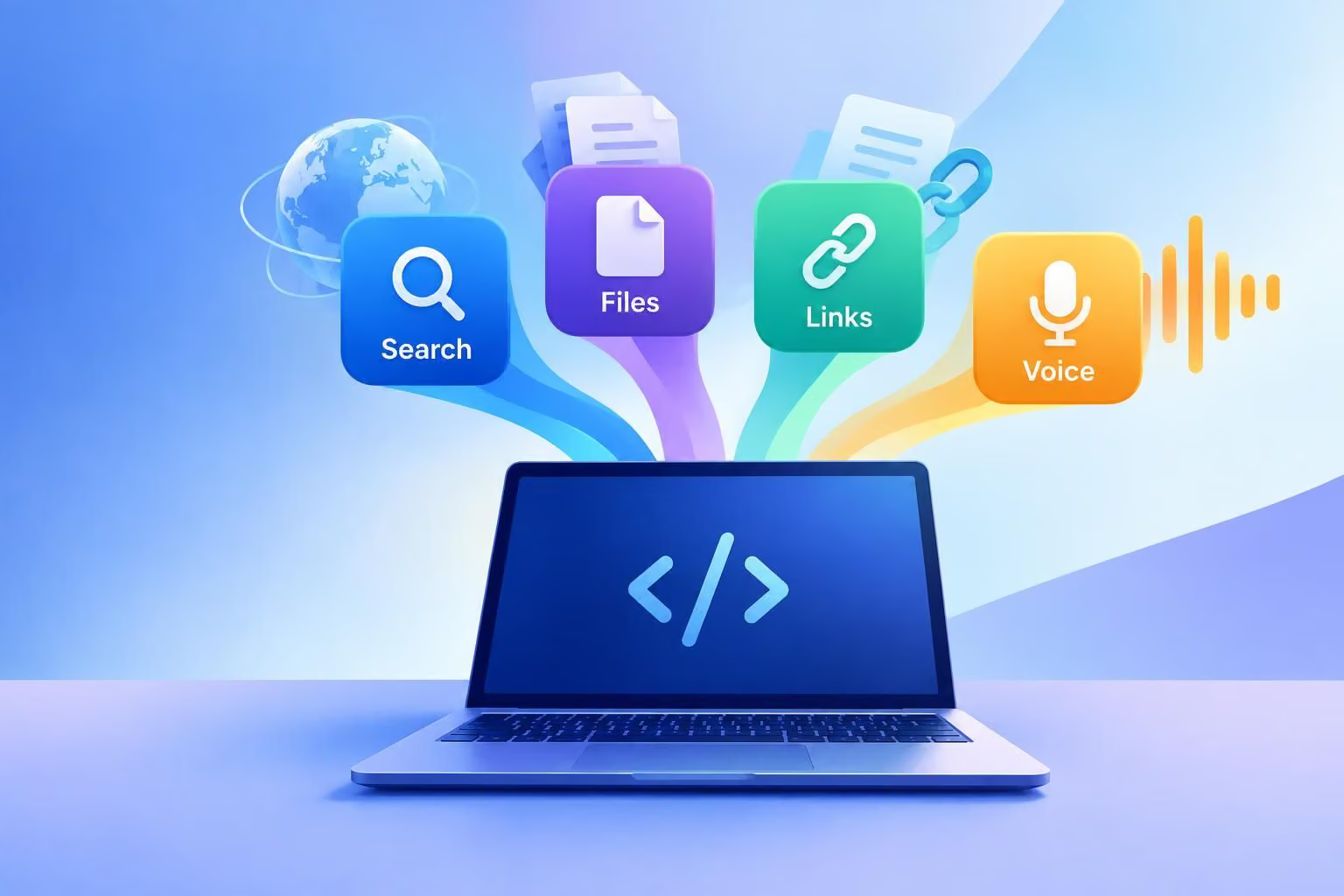
The DeepSeek API app features announced on November 13, 2026 bring the tools behind DeepSeek's consumer chatbot into the developer API. Developers can switch on web search, link reading, file analysis and safety checks with a few request parameters, rather than building those pieces themselves. DeepSeek released them alongside an open-source chat demo.
The announcement describes features rather than a new model, so the practical questions are which tools work with which model, what they cost and how to get started.
What changed from earlier API access
Developers could already reach DeepSeek's search engine through separate Search and Fetch interfaces. Under the new arrangement, the provider takes over tool execution and result assembly, work developers otherwise would need to build themselves. Your client mainly displays the returned blocks and passes them back in the next turn.
The trade-off is control. When DeepSeek runs the search, developers take its results as delivered. DeepSeek's agent harness already lets teams swap in outside search services such as Exa and Perplexity, so teams that need a specific index may still prefer a third-party search.
Which DeepSeek API app features are included, and which model runs them
When a question needs fresh information, the model can run web or image searches and return an answer with citations. Turning on thinking lets it chain several lookups, open pages and use what it reads across steps. Uploaded PDFs, Word and PowerPoint files and images are converted into text or a layout-aware form before the model reads them. Separate OCR, speech recognition and text-to-speech endpoints cover work that doesn't involve chat.
Check the model before you build. The Responses API's built-in search runs only on deepseek-v4-pro; on the flash tier it is skipped. The chatbot guide's demo uses deepseek-flash, so the two routes are not interchangeable. The cost gap matters too: per-token Pro pricing lands roughly three to four times above Flash, so search-heavy apps should price both before committing.
Pricing and access: who pays for what
Nothing is sold as a monthly chat plan: the app is free, and metered billing applies only to API use. Flash is listed at 15 cents per million input tokens and 60 cents per million output tokens off-peak, and roughly doubles at peak hours. Standalone search and page-fetch calls carry a separate charge of 75 cents per 1,000 calls.
Figures are not uniform across guides. One lists Flash from 14 and 28 cents per million tokens, so confirm current rates on DeepSeek's pricing page before budgeting.
Getting started with the open-source chat demo
The demo is a static web app that connects straight to the API, so you don't need a backend of your own. Run it locally with Node.js 22.12 or newer and pnpm, or extract the release archive and open index.html. Add your API key in Settings before the first message. Conversations stay in your browser, but content you send goes to the API service you configure.
Importing a history ZIP replaces all existing local conversations, so export a backup first. The API guide says public services should enable the safety check and meet obligations such as content review, model registration and AI labeling.
Key takeaways
The API now exposes web search, file input, URL reading, safety checks, and separate OCR, speech recognition and speech synthesis endpoints.
Usage is pay-as-you-go, and sources disagree on prices, so check DeepSeek's official rates before you build.
Confirm which model supports which search tool, since the Responses API's built-in search needs deepseek-v4-pro.
Frequently asked questions
Do I need a paid plan to use DeepSeek's app features?
No. The consumer app is free with no subscription, and developers pay per token only when they call the API.
Can I add web search with deepseek-flash?
Yes, through the chatbot guide's search tool, which runs when thinking is disabled. The Responses API's built-in search is separate and requires deepseek-v4-pro.
Is the open-source chat demo ready for public use?
The guide says the demo is for demonstration only. A public product built on the API needs the safety and compliance steps the API guide lists.
Sources
Based on DeepSeek's post on X (@deepseek_ai), November 13, 2026: https://x.com/deepseek_ai/status/2121247896918253875

0 comments
No approved comments yet. You can start the conversation.
Leave a comment