
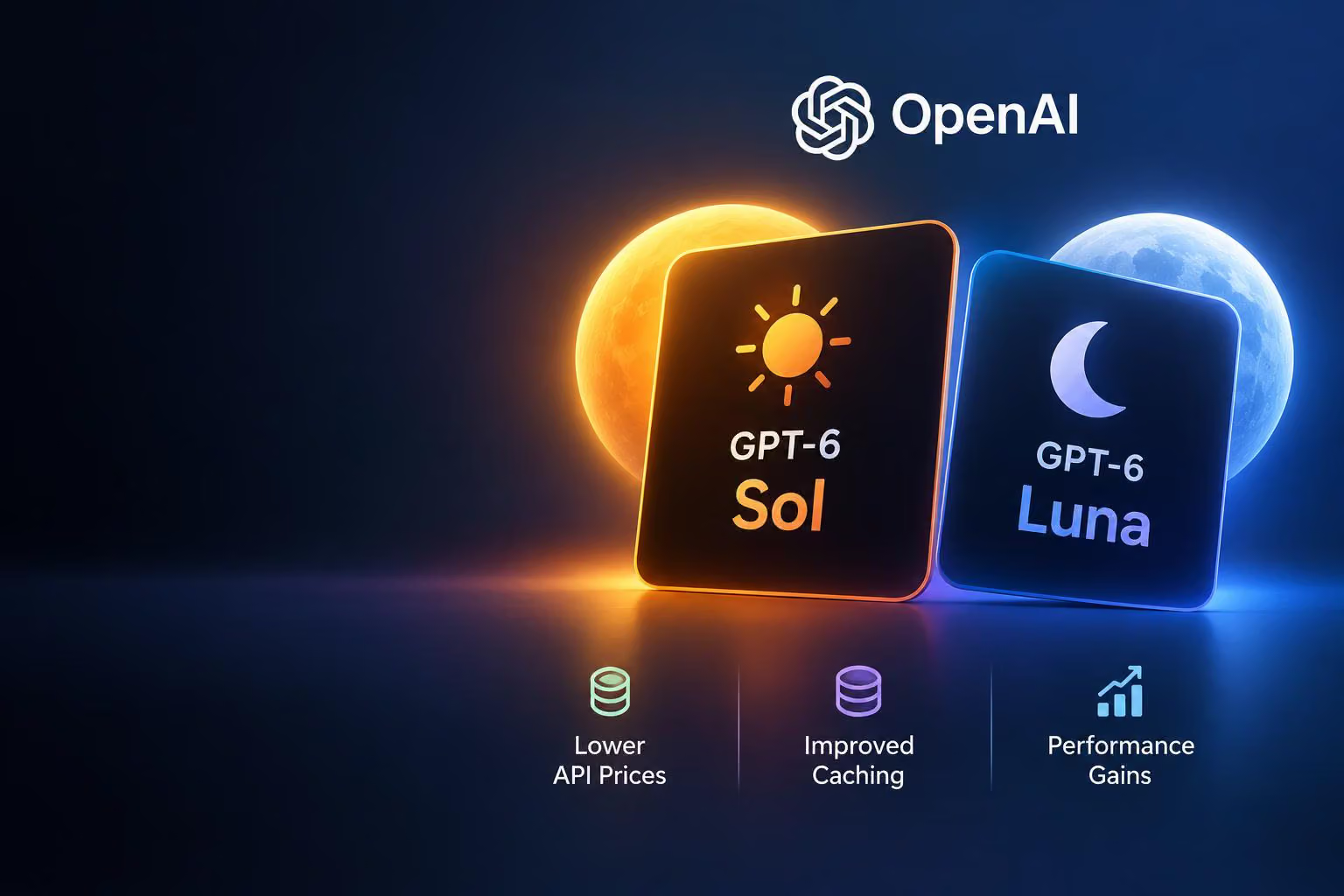
OpenAI has introduced GPT-6 Sol and GPT-6 Luna as faster, less expensive models for work that does not require GPT-6 Astra’s full capability. In a post on X, @OpenAI says the models bring advances from Astra to lower-cost use cases, with both available in the API and in selected ChatGPT Work and Codex plans.
The announcement also describes 50% lower API pricing than GPT-5.6 promotional pricing, improved prompt caching, and reported gains in automation, coding, factuality, computer use, communication, and alignment. These performance comparisons come from OpenAI’s evaluations or public reports about competitor models, not independent testing.
What are GPT-6 Sol and GPT-6 Luna?
GPT-6 Sol and GPT-6 Luna are positioned as the faster, more affordable members of OpenAI’s GPT-6 family. OpenAI says they were trained with methods similar to GPT-6 Astra and carry over advances in professional work, factuality, coding, computer use, and alignment.
Astra remains OpenAI’s highest-capability option in the announcement. Sol and Luna are instead aimed at situations where teams need more room to iterate, lower costs, or sustained use at scale. The announcement does not provide a complete technical specification comparison between Sol and Luna, so it does not establish a detailed division of workloads or capability limits between them.
The API model names are gpt-6-sol and gpt-6-luna.
GPT-6 Sol and Luna API pricing
OpenAI lists the following prices per 1 million tokens, compared with the promotional prices for the corresponding GPT-5.6 models:
Model | Comparison model | Input price: GPT-5.6 promotional → GPT-6 | Output price: GPT-5.6 promotional → GPT-6 | OpenAI’s stated reduction |
|---|---|---|---|---|
GPT-6 Sol | GPT-5.6 Sol | $4 → $2 | $20 → $10 | 50% cheaper |
GPT-6 Luna | GPT-5.6 Luna | $0.20 → $0.10 | $1.20 → $0.50 | 50% cheaper overall; the listed output reduction is approximately 58% |
OpenAI describes both models as 50% cheaper overall than their corresponding GPT-5.6 promotional prices. The listed Luna input price falls by 50%, while its output price falls from $1.20 to $0.50, or approximately 58%.
The lower prices are intended to make repeated experimentation and larger-scale workloads more practical. That matters especially for coding agents and business automation, where a task may involve many model calls rather than one isolated response.
The listed prices are API token prices. They should not be interpreted as a claim that every ChatGPT plan has unlimited access to either model.
Reported performance for automation, coding, and computer use
OpenAI groups Sol and Luna’s reported gains around tasks that require agents to work through multiple steps, use tools, or operate on real codebases.
On AutomationBench, which OpenAI describes as a test of business workflows across apps, GPT-6 Sol at xhigh effort scored 33.2% at a reported cost of $0.27 per task. OpenAI compares that result with 26.9% for Claude Opus 5 at maximum effort, while saying Sol cost 9% as much per task. GPT-6 Astra at low effort scored 30.3% in the same comparison, while Claude Fable 5.1 with an Opus 5 fallback scored 31.4% at more than 8.9 times Sol’s cost per task; the fallback cost was not reported.
At high effort, GPT-6 Luna improved on its predecessor by 5.4 percentage points at a reported 58% lower cost per task. OpenAI also says Sol exceeded Claude Fable 5.1 at a lower cost and surpassed low-effort GPT-6 Astra in the AutomationBench comparison.
On Agents’ Last Exam, which evaluates agents on complex professional workflows, OpenAI reports that GPT-6 Sol at maximum effort scored 56.4%. The company also reports that Sol cost 60% less per task than Claude Opus 5’s highest-scoring configuration.
Coding performance
OpenAI says GPT-6 Sol improves substantially over GPT-5.6 Sol on FrontierCode, an evaluation of whether coding agents produce changes ready to merge into real codebases. It also says Sol matched Claude Fable 5.1 at xhigh effort at a much lower cost. The announcement reports this comparison without providing the underlying FrontierCode scores.
On DeepSWE v1.1, which tests complex software-engineering work in real codebases, GPT-6 Sol at maximum effort scored 68.8%. OpenAI compares that with 69.9% for Claude Fable 5 at xhigh effort and reports that Sol cost approximately 80% less per task.
GPT-6 Luna at maximum effort scored 66.6% on the same evaluation. OpenAI describes that as comparable to Claude Opus 5 and Claude Fable 5 at medium effort, with Luna costing 93% less per task than Opus 5 and 96% less than Fable 5 in those comparisons.
Computer use
GPT-6 Astra remains the model OpenAI identifies as its strongest option for computer use. Even so, the company reports improved cost efficiency from the newer lower-cost models.
On OSWorld 2.0 offline, GPT-6 Sol at xhigh effort scored 60.5%, compared with 60.3% for Claude Opus 5 at medium effort. OpenAI says Sol achieved that similar result at approximately 80% lower cost per task. GPT-6 Luna at maximum effort also exceeded GPT-5.6 Sol at medium effort at one-tenth of the cost, according to the announcement.
These comparisons indicate how OpenAI frames the cost–performance trade-off. They do not establish that Sol or Luna will produce the same results on every production workload. OpenAI says its GPT evaluations were run in a research environment or through its API, which can differ from production ChatGPT because of system prompts, available tools, and other factors. It says competitor scores came from publicly available reports, and that Claude Fable 5 scores were used where Fable 5.1 scores were unavailable.
Factuality, communication, and alignment
OpenAI says GPT-6 Sol makes about half as many mistakes as its predecessor on an internal factuality evaluation based on de-identified real-world conversations in which users had flagged model mistakes. The company says Sol approaches Astra-level reliability at a much lower cost.
OpenAI also reports a substantial improvement for GPT-6 Luna. At higher effort levels, it says Luna matches GPT-5.6 Sol on that evaluation at about one-hundredth of the cost. The source does not include the evaluation’s sample size, full methodology, or independently reproduced results.
The models are also meant to produce clearer technical and coding responses. OpenAI describes the changes as less jargon, fewer unusual turns of phrase, fewer low-value details, and somewhat shorter answers without losing substance.
On alignment evaluations, OpenAI says both models improved over their GPT-5.6 counterparts, including lower rates of misleading statements about their coding work. The source describes these evaluations as deliberately challenging and says they do not measure failure rates in typical use. One supplied OpenAI chart labels this measure “coding deception” and reports lower rates for GPT-6 Sol and GPT-6 Luna than for their GPT-5.6 counterparts, but the announcement’s broader warning still applies: these are evaluation results, not guarantees of production behavior.
Prompt caching and lower costs for repeated context
The API changes are not limited to the headline token prices. OpenAI says GPT-6 models have higher prompt-cache hit rates by default and offer discounts of 90% on cached input-token reads.
Prompt caching lets an application reuse a previously processed portion of a prompt instead of paying the full processing price for the same context again. This can matter for agents that repeatedly send a system prompt, project instructions, tool definitions, or a large codebase context while changing only the latest user request.
OpenAI says developers can:
monitor cached input and changes over time in the Prompt Caching Dashboard;
use a diagnostics tool to identify missed caching opportunities;
change reasoning effort or enable and disable tools without breaking reuse of earlier context; and
set explicit cache breakpoints to control which prompt prefixes are cached.
The company also says GitHub observed that these improvements reduced the share of prompt tokens requiring fresh processing by more than 50% across billions of requests to OpenAI models over several months. That is a reported result about the cited usage, not a guaranteed reduction for every application.
Where GPT-6 Sol and Luna are available
OpenAI says both models are available in ChatGPT Work and Codex for Plus, Pro, Business, Enterprise, and Edu users. Free and Go users can access GPT-6 Luna in the desktop app.
The announcement specifically says the models are not yet available in Chat. OpenAI also says the ChatGPT rollout is gradual, so users who do not immediately see the models in ChatGPT Work or Codex may need to try again later.
Both models are available through the OpenAI API. For API users, Sol and Luna offer lower listed token prices than the corresponding GPT-5.6 promotional prices, while the choice between them depends on the workload, required effort level, and the cost of repeated context. The announcement does not provide enough technical detail to define every capability difference between the two models, so developers should evaluate them against their own tasks rather than treating the model names alone as a workload recommendation.
For the source announcement and its full set of reported evaluations, see OpenAI’s introduction to GPT-6 Sol and Luna.
0 comments
No approved comments yet. You can start the conversation.
Leave a comment