
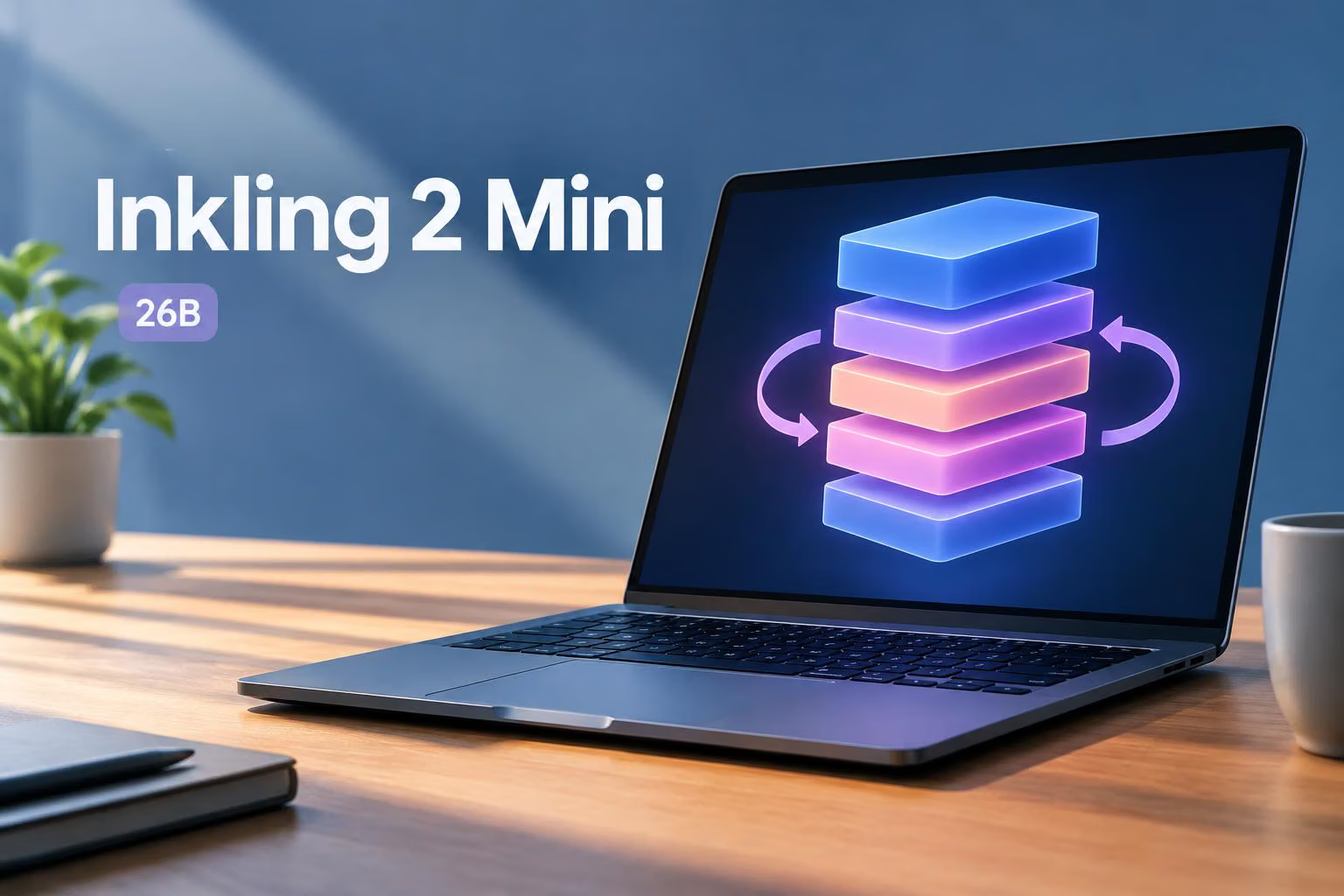
Inkling 2 Mini is a 26B open-weights model from Thinking Machines, announced on November 20, 2026, that the company says can run on a laptop. In its announcement on X, the company says the model scores 20.1 on the Artificial Analysis (AA) Index and is suited to agentic work. It is the smaller sibling of Inkling 2 Small, which the company describes as 594B parameters.
The model's main technique is looping: it reruns its middle layers three times for each token, so it spends more computation without growing its parameter count. The useful questions are what that loop actually buys, who can run the model, and whether the company's claims hold up under independent testing. Some parts look encouraging; others need closer scrutiny.
What Inkling 2 Mini is and how its looping works
The model has 24 layers. According to the company's thread, the middle 12 run three times per token, while the first and last six run once. The release page describes a Mixture-of-Experts design with 26.4B total parameters.
Active-parameter counts differ by source. The company lists 3.4B active parameters, Hugging Face's launch post gives about 3B, and Artificial Analysis counts 5.4B once the repeated passes are included, which leaves roughly 3.1B distinct weights used per text token. The gap likely reflects how repeated passes are counted, so no single figure tells the whole story.
Looping does not change what the weights can store. The company says knowledge mostly tracks total parameter count, so a 26B model should know less than a 594B one. What looping adds is extra computation on the same weights, a different route to better reasoning than simply making the model bigger.
Who can run Inkling 2 Mini, and what does it cost?
Local use is the headline feature. Ollama's library page lists the model for Macs with 32GB or more of memory and for NVIDIA's DGX Spark. The company puts the total memory footprint at about 20GB, with most weights stored in NVFP4 and the last four layers in MXFP8. Unsloth publishes quantized GGUF files and a local-run guide for people who want smaller downloads.
Running locally has no per-token fee, though you pay for the hardware. Hosted access goes through Tinker, the company's API for fine-tuning open-weight models, which the company says offers Mini for inference and customization. A Vals AI listing shows token costs of $0.15 for input and $0.50 for output, but it does not state the billing unit, so confirm current rates on Tinker before budgeting. The weights are on Hugging Face, and Artificial Analysis reports an Apache 2.0 license.
Does looping make Inkling 2 Mini more efficient?
The company argues that looping helps the model reach correct answers with less written output. Artificial Analysis, which tests models independently, found a more complicated picture. Mini used about 38% more output tokens than Qwen3.8 27B to reach the same Intelligence Index score, but needed roughly 2.8 times less compute. Its average was about 152K output tokens per task, compared with roughly 110K for Qwen3.8 27B.
For someone running a model on their own machine, the more useful measure is time and power per task rather than token count. On that measure, Artificial Analysis puts Mini at about six times cheaper and four times faster per task than the 27B comparison. The speed figures on the company's page are a different kind of number: a theoretical ceiling at a stated 614 GB/s memory bandwidth, not a measured run time.
How strong are the benchmark claims?
The 20.1 figure is the company's headline number. The Artificial Analysis index is a weighted average of nine evaluations, scaled from 0 to 100, and the firm's own write-up lists Mini at 20. In the company's comparison table, one other model is also listed at 20.1, so Mini ties for the top spot in that row rather than leading it outright.
Other numbers are less flattering. Vals AI ranks Mini 38th of 43 models on its overall index, at 46.46%. The company's claim to lead open-weights models under 100B on Vals Index v2.2 applies to a much narrower field, and both can be true. Mini's stronger results are in coding and search: the comparison table reports 79.2% on SWE-bench Verified and 85.3% on DeepSearchQA. On factual recall, Mini scores in line with similarly sized models, and the company says it compensates by using search and tools.
Does looping put chain-of-thought monitoring at risk?
This is the question that matters most for safety researchers. The concern is that a model reasoning inside its layers, rather than in written text, gives human overseers less to read. The company reports no meaningful loss in monitorability at this scale. Its variable-loop research model's no-CoT time horizon, meaning how long a task it can handle without written reasoning, rose from 16 seconds at one pass to 37 seconds at three. Its chain of thought got shorter but stayed legible, and it showed no upward trend on agentic sabotage tests as loops were added.
Two caveats follow. The monitorability experiments used the research model, not Mini itself, and the company limits its claim to this scale. Mira Murati's post on X is more guarded, saying the thought process remains monitorable at this scale but that "this may not stay the case."
Key takeaways
Inkling 2 Mini is a 26.4B-parameter open-weights model that the company says needs about 20GB of memory and runs on 32GB Macs or NVIDIA's DGX Spark.
Looping adds computation per token. Independent testing found it writes more output tokens than Qwen3.8 27B, so its edge lies in cost and time per task.
The 20.1 AA score is self-reported and tied with another model in the company's table, while Vals AI ranks Mini 38th of 43.
The monitorability results come from a research variant at one scale, and Mira Murati's post warns the property may not last.
Frequently asked questions
Can I run Inkling 2 Mini on my own computer?
Yes, if you have enough memory. Ollama lists it for Macs with 32GB or more and for NVIDIA's DGX Spark, and the total footprint is about 20GB. Machines with less memory would need a smaller quantized build, such as the GGUF files Unsloth publishes.
Is Inkling 2 Mini open source?
The weights are openly released on Hugging Face, and Artificial Analysis reports an Apache 2.0 license. That is a permissive open-source license that allows commercial use. Check the model card for any additional terms before shipping a product on it.
How much does Inkling 2 Mini cost to use?
Running it locally has no per-token fee, but you pay for the hardware. Hosted use goes through Tinker, and a Vals AI listing shows token costs of $0.15 for input and $0.50 for output without stating the unit. Confirm current rates on Tinker before budgeting.
Is Inkling 2 Mini better than similar models?
It depends on the task. The company reports leading open-weights models of similar size on agentic coding and search, while Artificial Analysis rates it level with Qwen3.8 27B on its index and about six times cheaper per task. Its factual recall is in line with similarly sized models, so it is best treated as a tool-using model rather than a knowledge store.
0 comments
No approved comments yet. You can start the conversation.
Leave a comment