
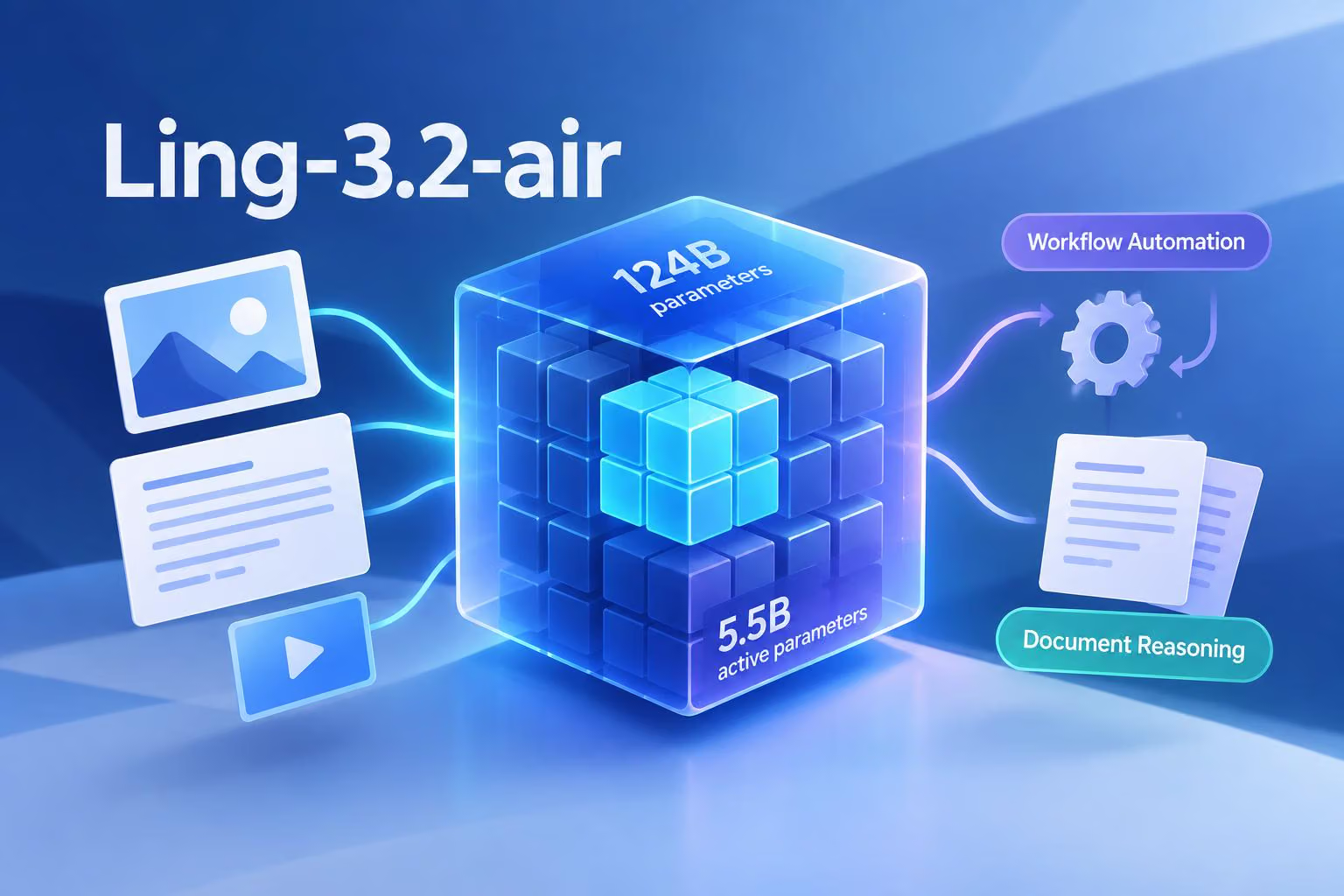
Ling-3.2-air is an open-weight, natively multimodal model that holds 124B parameters, of which only 5.5B are active for each token. The AntLing team announced it on X on 23 November 2026, saying it is stronger at workflow automation and professional document reasoning than its predecessor. The weights are linked on Hugging Face and ModelScope.
The post's headline figure is AutomationBench-AA, which it says climbed from 15.7% to 61%. It also thanks the vLLM and SGLang teams for day-0 support. Every performance figure here comes from the developer, and independent confirmation is still limited.
What Ling-3.2-air is and how it is built
Ling-3.2-air uses a mixture-of-experts (MoE) design, in which a large pool of specialised sub-networks exists but only a few run for each token. The model card lists 512 routed experts, one shared expert and eight activated per token, spread across 35 KDA layers and 7 Gated MLA layers in a 5:1 ratio. The card says the model shares the native multimodal architecture of Ling-3.0-flash-VL, and its example requests include image and video inputs.

Media source: x.com
The card's summary gives 124B total parameters, but the same page lists the model size as 128B. The page does not explain the gap, so treat 124B as the developer's figure and the difference as unresolved.
"Air" is the smaller sibling in the family. The larger Ling-3.2-flash was released in November with 560B total and 25B active parameters and a 1M-token context window. It is offered as a hosted service without public weights, which is the practical difference: Air can be downloaded and run yourself.
How big is the jump over Ling-3.0-flash-VL?
Beyond the AutomationBench-AA result, the model card compares the model with its predecessor on three more tests:

Media source: x.com
GDP.pdf all-pass rate: 8.4% to 16%
AA-Briefcase v1.1 Elo rating: 987 to 1,340
Terminal-Bench 4.0 pass rate: 0% to 27%
Low starting points make these percentages look bigger than they are. A 27% terminal pass rate still means most terminal tasks fail, and a 16% all-pass rate on GDP.pdf means most documents still miss at least one check. The gains are real on the developer's numbers, but they describe a model that is improving rather than one ready for unattended work.
The card also highlights legal and quantitative data work. On Harvey LAB-AA v1.1 the model earns an 87.7% criterion pass rate, yet its all-pass rate is 8.3% before a material hallucination check and 0.8% after it. Passing single criteria is much easier than producing a fully correct answer, so the 87.7% figure should not be read as a measure of legal reliability.
Does 5.5B active really match much larger models?
The post says Ling-3.2-air scores 23 on the Artificial Analysis Intelligence Index v5.0.1, matching GLM-5.3 (Low) and DeepSeek V4 Pro 0813 (Max), which it says activate 40B and 49B parameters per token. The Artificial Analysis model index lists Ling-3.2-air and says the v5.0.1 index combines nine evaluations, including AutomationBench-AA, GDP.pdf and Terminal-Bench 4.0, which are tests the developer also cites. That listing does not display a score for Air, so the figure of 23 currently rests on the developer's claim.

Media source: x.com
Active parameters set how much arithmetic each token needs, so this comparison is about efficiency rather than leadership. The catch is memory: all 124B parameters must be stored, so the hardware bill resembles that of a large model even though each token passes through far fewer weights. It is efficient to run per token, but not cheap to host.
Another open-weight release splits its scale the same way: Reflection AI's Beam model lists 501 billion total parameters with 23 billion active.
How to run Ling-3.2-air: hardware and setup
The card's recommended SGLang setup runs a 256K context on four 141GB-class GPUs (H20-3e or H200), or on four-GPU Blackwell nodes (B300 or GB300). On 80GB cards such as the H100 or H800, it recommends eight-way tensor parallelism instead. The SGLang image also includes MTP speculative decoding. No single consumer GPU can hold these weights.
The vLLM route is less settled. A vLLM recipe pull request opened on 23 November describes block-FP8 weights on TP8 and an optional 1M context using 4× YaRN scaling. A write-up of related pull requests says three pull requests naming the checkpoint were opened earlier that day, and none had been merged. Check the official recipes before relying on them.
To start, download the weights from the links in the post and serve them with SGLang or vLLM using the commands on the card. The card recommends temperature 1.0, top_p 0.95 and top_k 20, with thinking enabled, and shows requests in the chat-completions format.
Cost, access and licence: what it takes to use it
The post links to the weights but does not mention a price. The model card lists no Inference Provider deploying Air, so for now you pay for your own or rented GPUs. Hosted pricing for the wider family is reported inconsistently. Sumus gives $0.30 and $0.90 per million tokens for Ling-3.2-flash, while AI IQ says standard hosted prices have not been published. The model card text does not state a licence, so check the repository before any commercial use.
Three things would settle the open questions: an independent score for Air on the Artificial Analysis listing, a merged vLLM recipe, and a licence file in the Hugging Face repository.
Key takeaways
Ling-3.2-air is an open-weight model with 124B total and 5.5B active parameters, and its card shows image and video inputs.
The developer's gains over Ling-3.0-flash-VL are large in percentage terms, but the starting points were low and most terminal tasks still fail.
A score of 23 matching models with 40B-plus active parameters is an efficiency claim, not a sign of leadership, and the memory footprint stays large.
Running it needs a multi-GPU server, such as four 141GB-class cards or eight 80GB cards, and no hosted provider is listed yet.
Frequently asked questions
Is Ling-3.2-air open source?
It is open-weight, meaning the trained weights are published on Hugging Face and ModelScope. The model card text does not state a licence, so the terms for commercial use are not confirmed. Check the repository before building a product on it.
What does 124B total and 5.5B active mean?
The model holds 124B parameters but routes each token through only 5.5B of them. That lowers compute per token compared with a dense model of the same size. All 124B parameters still have to fit in GPU memory.
Can Ling-3.2-air process images and video?
Yes. The model card's example requests include image and video inputs. The post says the model shares the native multimodal architecture of Ling-3.0-flash-VL.
How is Ling-3.2-air different from Ling-3.2-flash?
Flash is much larger, at 560B total and 25B active parameters, and is offered as a hosted service without public weights. Air is the smaller model whose weights can be downloaded and self-hosted. Its trade-off is that you supply the hardware.


0 comments
No approved comments yet. You can start the conversation.
Leave a comment