
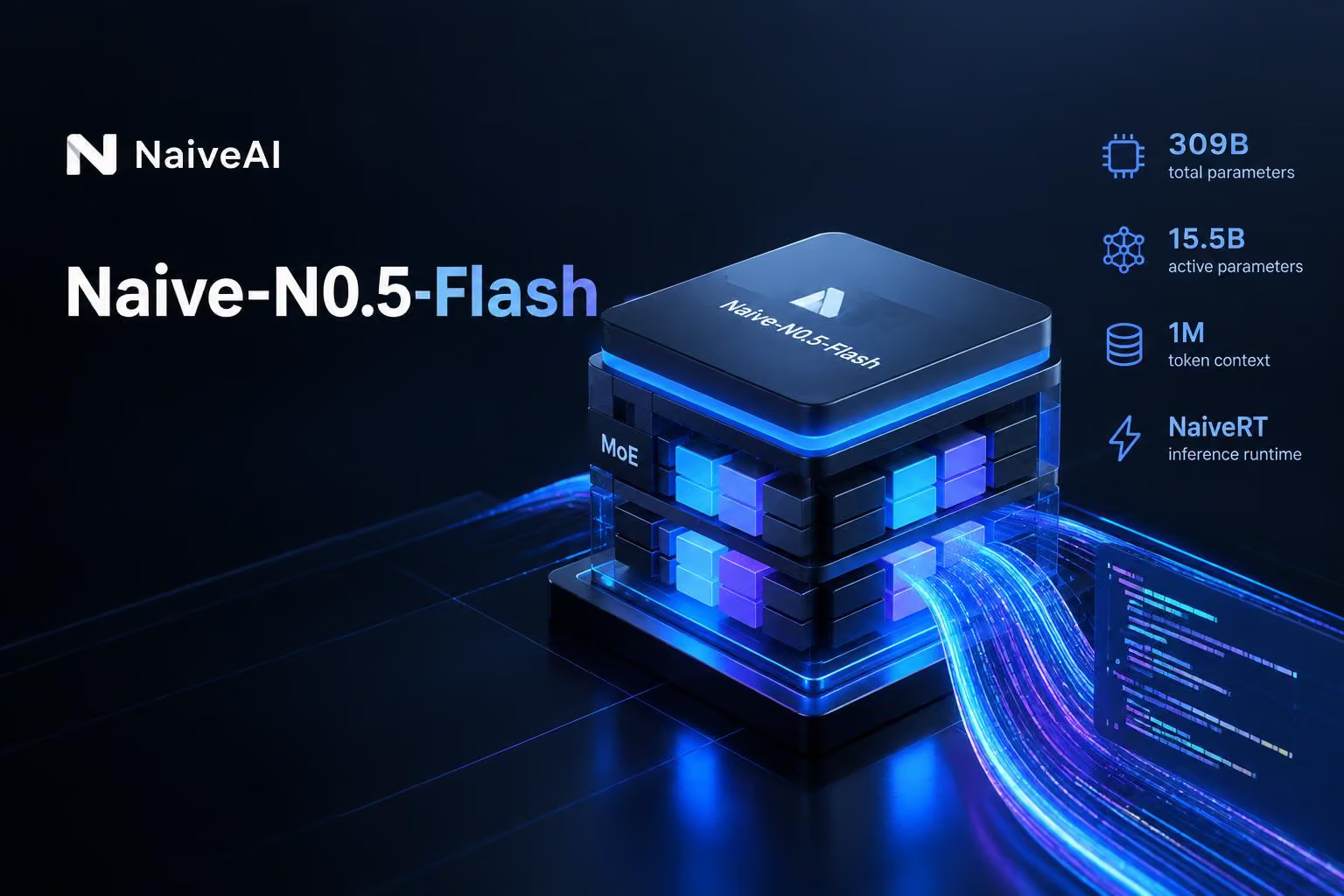
NaiveAI has released Naive-N0.5-Flash, an open-weight Mixture-of-Experts model with 309 billion total parameters and 15.5 billion active parameters. The company positions it for coding and artificial intelligence research and development, with a native 1-million-token context window and an inference system designed for high single-stream decoding speed.
In a post on X, @naiveailab says the model’s weights and inference code are available under the MIT license. NaiveAI says API access will be provided, but the announcement does not state that the API is currently available. Developers can instead begin with the model card and code repositories linked by the company.
Naive-N0.5-Flash at a glance
The model is built around a sparse architecture rather than processing every parameter for every token. Its headline specifications are:
Architecture: Mixture-of-Experts, or MoE
Total parameters: 309 billion
Active parameters: 15.5 billion per token
Context length: Native 1 million tokens
Attention: A hybrid of Sliding-Window Attention and DeepSeek Sparse Attention
License: MIT, according to the model card
Inference software: NaiveRT, NaiveAI’s runtime for the model
The distinction between total and active parameters matters. The total figure describes the model’s complete collection of parameters, including its expert subnetworks. The active figure describes the portion used for a particular token. In an MoE model, a routing system selects only some experts for each token instead of evaluating the entire collection every time. That allows a model to have a much larger total capacity than the amount of computation used for each token suggests.
NaiveAI’s description makes a narrower promise than “the model is best at everything.” It says Naive-N0.5-Flash is aimed at coding and AI R&D, including tasks involving machine-learning engineering, research replication, post-training, and systems optimization.
How the model supports a 1M-token context
Naive-N0.5-Flash uses eight six-layer modules. The model card describes 39 Sliding-Window Attention (SWA) layers and nine DeepSeek Sparse Attention (DSA) layers, with a predominantly five-to-one SWA-to-DSA arrangement. The network has no full-attention layers.
SWA limits each token’s local attention to a 128-token window. This keeps the main attention operation local rather than comparing a new token with the entire history. Local attention is efficient, but by itself it can make it harder to preserve information from much earlier in a long context.
DSA provides a sparse route to older information. A lightweight indexer scores the full history, while the attention backbone works on the top 2,048 selected tokens. The model card says the full key-value cache is still retained and that the indexer still scans the full history. In other words, the 1M-token context does not mean the model ignores most of its past; it uses a sparse selection mechanism to reduce the computation and memory access used by the main attention step.
The DSA layers use grouped-query attention with four key-value groups. NaiveAI says this replaces the original DSA implementation’s multi-head latent attention arrangement in this model. These architectural choices are intended to preserve long-range access without introducing full-attention layers whose decoding cost would grow substantially at million-token context lengths.
The model card also says Naive-N0.5-Flash underwent 3.25 trillion tokens of multi-stage training after the architectural changes. That included 50 billion tokens of indexer warmup, 3 trillion tokens of sparse-attention training, and 200 billion tokens of learning-rate decay.
Why NaiveAI describes the model as AI-built
NaiveAI presents the release as an example of an AI-centered R&D process. The company says its models write code, run experiments, monitor results, analyze outcomes, and iterate, while human researchers set direction, define constraints, and make critical decisions.
According to NaiveAI, this process was used to develop Naive-N0.5-Flash’s architecture and its training, inference, and deployment systems. The company also says the model is trained for AI R&D, so it can participate in parts of the research process itself. That is NaiveAI’s description of its development approach, not independent evidence that the model can autonomously reproduce the entire model-building pipeline.
NaiveAI’s research page gives a more specific example through AutoWM, a world-model project. NaiveAI says a researcher defined the objective, compute budget, and evaluation protocol, after which Naive-N0.5-Flash helped design approaches, run experiments, evaluate results, and choose further directions. The company reports that the resulting system reached 77.43 on WorldArena-1 Track 1, compared with a previously published score of 73.64 at the time described on the page.
That example is best read as a reported case study of the company’s workflow. It does not establish that every developer will see the same research performance or that the model independently handles an unconstrained research project without human oversight.
NaiveRT targets long single-stream rollouts
NaiveAI’s inference system for the model is called NaiveRT. The model card describes a Standard mode delivering 50 tokens per second per user and an Ultrafast mode reaching up to 2,000 tokens per second. NaiveAI’s technical blog gives a more specific result: a peak single-stream decoding rate of 2,122 tokens per second on eight GPUs.
The company says that measurement used a one-second window across 41 HTML and SVG generation requests, with thinking disabled, temperature set to 0.4, top-p set to 0.95, and prefill excluded. NaiveAI reports that a full speculative-decoding round took 3.4 milliseconds with NaiveRT, compared with 12.3 milliseconds using SGLang on the same system. These are company-reported measurements from a particular test setup, not a general speed guarantee.
The emphasis on single-stream speed relates to long AI research and reinforcement-learning rollouts. A rollout can accumulate observations, tool outputs, and earlier turns until its context approaches 1M tokens. NaiveAI argues that ordinary batching can improve overall hardware utilization without making one individual stream finish sooner. Faster per-stream decoding can therefore reduce the time taken by the longest rollouts, which may otherwise delay a synchronous batch or become stale in an asynchronous pipeline.
NaiveRT combines speculative decoding, mega-kernel fusion, and Programmatic Dependent Launch. Speculative decoding uses a smaller draft step to propose tokens and a larger model step to verify them. Mega-kernel fusion combines closely related GPU work to reduce launch overhead, synchronization, and intermediate memory traffic. Programmatic Dependent Launch allows later GPU work to begin as earlier work reaches the required point, reducing the need for CPU coordination.
NaiveAI says the runtime was built in six days through 151 documented optimization trials. The company’s technical blog also says that correctness checks, including comparisons of full-model logits and key-value caches, were required before latency changes could be accepted. Those details describe the company’s engineering process; they do not by themselves demonstrate performance on other hardware or workloads.
What NaiveAI reports about coding and AI R&D performance
NaiveAI reports results across separate coding, AI research, post-training, machine-learning engineering, and systems-optimization evaluations. The model card says that, unless otherwise noted, its evaluations used Claude Code 2.1.207 with a 1M-token context, temperature 1.0, top-p 0.95, and a harness exposing basic file I/O and Bash tools.
The supplied coding graphic reports the following Naive-N0.5-Flash results: 67.8 on DeepSWE v1.1, 32.4 on Agents’ Last Exam, 86.7 on Terminal-Bench 2.1, 73.6 on SWE-bench Pro, 17.5 on ProgramBench, 71.9 on NL2Repo-Bench, and 78.2 on FrontierSWE v1.
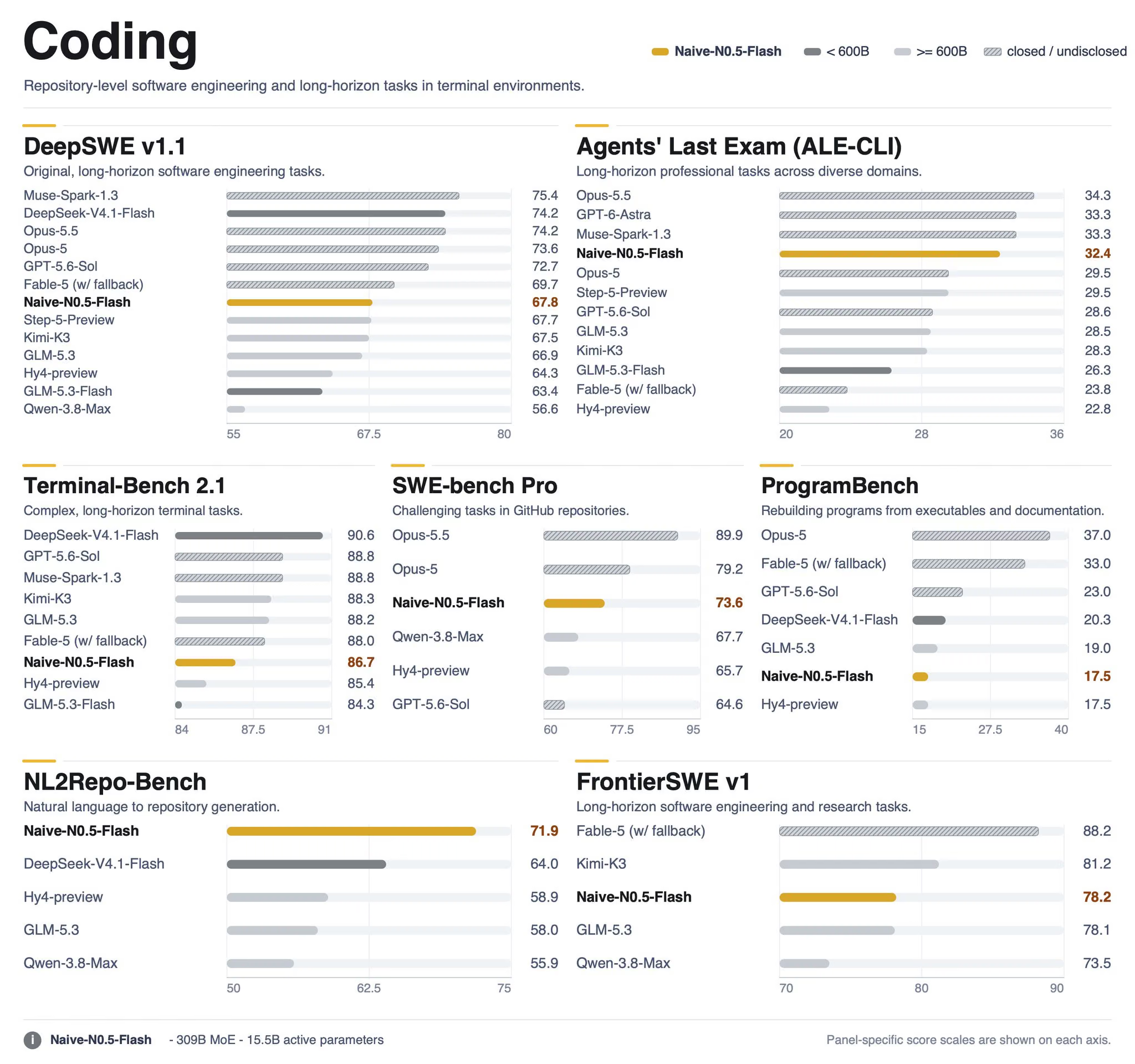
Image credit: @naiveailab on X
The AI R&D graphic reports 37.5 on PostTrainBench, 73.7% on MLE-bench-30, 63.2 on PaperBench, 72.81 on SOL-ExecBench, 0.9051 on NanoChat AutoResearch, and 73.8 on NanoGPT SpeedRun. These evaluations do not all measure the same capability: they cover areas such as post-training, machine-learning engineering, research replication, and GPU or training optimization.
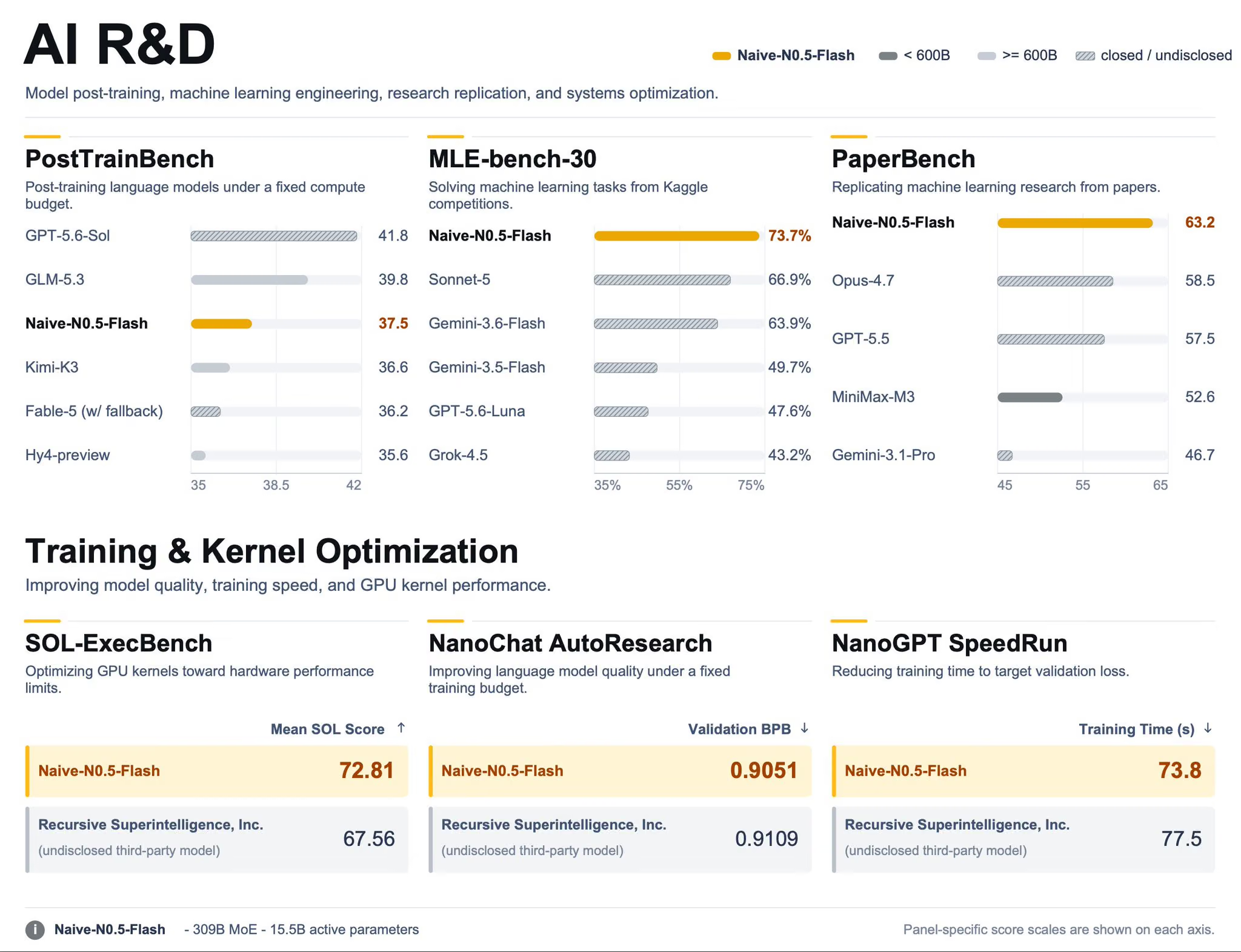
Image credit: @naiveailab on X
The figures should not be treated as one uniform leaderboard. NaiveAI says its comparison scores come from different model pages, blogs, leaderboards, and evaluation setups. Some results use different harnesses, task versions, hardware, metrics, or dates. These are NaiveAI-reported figures, and the supplied release materials do not establish independent reproduction of the results. The most defensible interpretation is that the charts show what NaiveAI reports about the model across several task families, rather than proving a universal ranking.
How developers can access the model
The model weights are available through the Naive-N0.5-Flash Hugging Face model card. NaiveAI also links to the Naive-N0.5-Flash GitHub repository and its technical research page. The model card lists the weights and inference code under the MIT License.
The deployment information sets some substantial hardware expectations:
The model supports FP8 mixed-precision inference.
It requires FP8-capable NVIDIA GPUs.
The weights occupy approximately 315 GB before allowing additional memory for inference.
The model card provides a Transformers example using
transformers[torch,kernels]>=5.17.0,trust_remote_code=True, automatic device mapping, and the FP8 model identifier.NaiveAI recommends
temperature=1.0andtop_p=0.95for general use.
The approximately 315 GB figure covers weight storage; additional GPU memory is needed for inference. The release does not provide a complete, generally applicable serving configuration or independently reproduced benchmarks, and it does not confirm that API access is currently available.
NaiveAI’s homepage describes an API platform, and the model card lists proposed API prices of $0.10 per million input tokens, $0.40 per million output tokens, and $0.01 per million cache-read tokens. However, the model card says API access “will also be provided,” so the pricing should be distinguished from confirmed current API availability.
Who should pay attention to Naive-N0.5-Flash?
Naive-N0.5-Flash is most relevant to developers and researchers who specifically need open weights, long-context coding or research workflows, and are equipped to handle a model with roughly 315 GB of weights plus inference overhead. Its sparse attention design addresses one of the central practical problems of million-token contexts: preserving access to distant information without applying full attention at every layer.
The release is less straightforward for teams looking for a lightweight local model or a turnkey hosted endpoint. The release does not provide a complete, generally applicable serving configuration or independently reproduced benchmarks, and it does not confirm that API access is currently available. Those gaps matter more than the headline parameter count when deciding whether the model is suitable for a real workload.
NaiveAI’s announcement is therefore two things at once: an open-weight model release with a distinctive long-context architecture, and a report about an AI-assisted process for designing and optimizing models. Its reported coding, AI R&D, and runtime results are promising evidence of what the company is trying to build, but developers should validate them against their own hardware, harnesses, tasks, and operating constraints before treating them as production expectations.


0 comments
No approved comments yet. You can start the conversation.
Leave a comment