
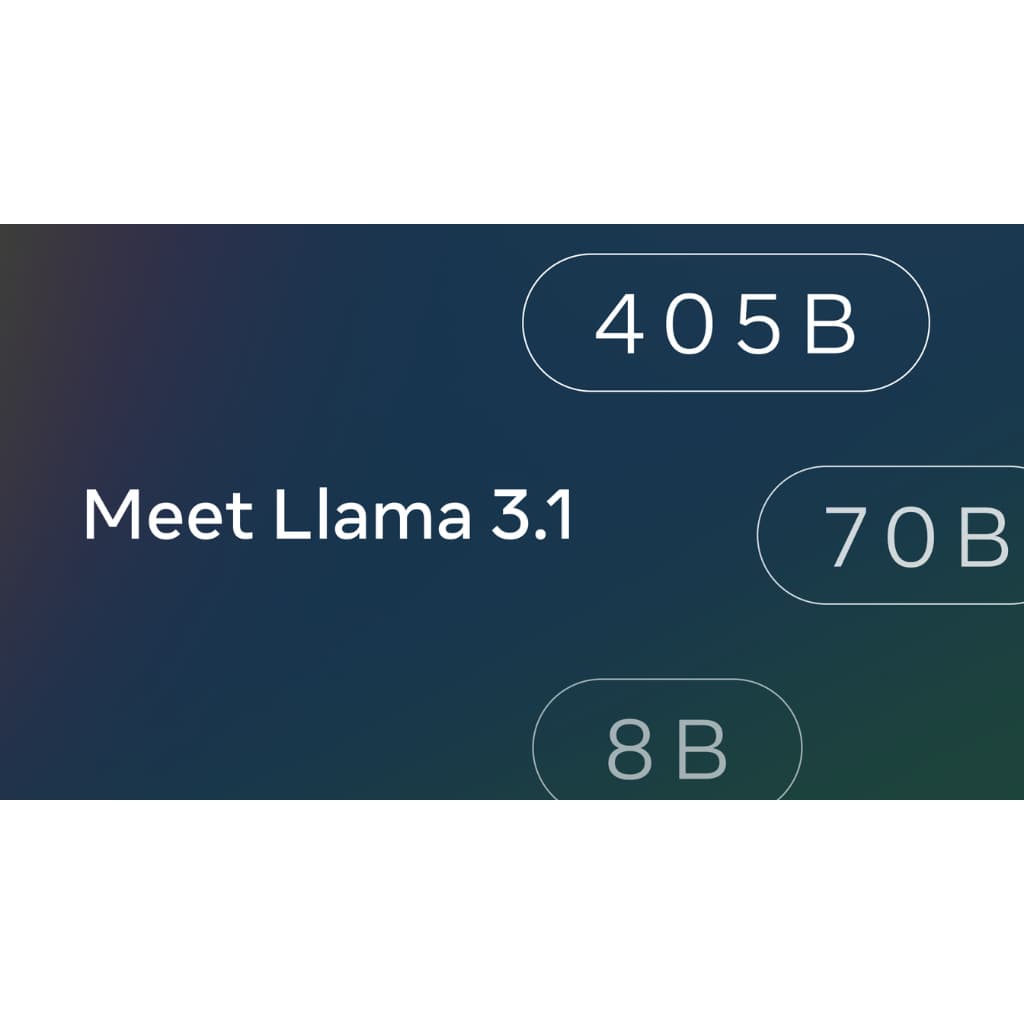
Exploring the Power of Meta Llama 3.1 Custom GPT
State-of-the-Art Performance
Meta Llama 3.1 405B has undergone rigorous evaluation on over 150 benchmark datasets and extensive human evaluations. These assessments demonstrate that Llama 3.1 is competitive with leading foundation models like GPT-4, GPT-4o, and Claude 3.5 Sonnet across a range of tasks. Its superior performance in real-world scenarios ensures reliable and effective solutions for diverse applications.
Advanced Model Architecture
Training Llama 3.1 405B on such a massive scale required significant optimizations. We utilized a standard decoder-only transformer model architecture, enhanced with iterative post-training procedures, including supervised fine-tuning and direct preference optimization. These techniques allowed us to create the highest quality synthetic data and improve the performance of each capability.
Versatile Use Cases
Llama 3.1 supports large-scale production inference with optimized compute requirements through 8-bit numerics. Its instruction and chat fine-tuning processes ensure high-quality, detailed instruction-following capabilities, making it an ideal choice for developing advanced conversational agents, coding assistants, and more.
The Llama Ecosystem
Llama models are designed to work as part of an integrated system that includes calling external tools and components. We are committed to fostering an open source ecosystem by providing sample applications, safety models, and prompt injection filters. Our collaborative approach with industry partners aims to standardize toolchain components and agentic applications, ensuring seamless interoperability and innovation.
Openness Drives Innovation
Unlike closed models, Llama 3.1’s open weights empower developers to fully customize and enhance their applications. This openness ensures that the benefits of generative AI are accessible to a broader community, promoting equitable and safe deployment of AI technologies. Meta’s commitment to open source is driving a future where AI power is distributed more evenly and responsibly.
People Also Ask:
1. What makes Llama 3.1 unique among open source AI models? Llama 3.1 stands out for its unprecedented scale and capabilities, rivaling top closed-source models. It offers state-of-the-art performance in general knowledge, tool use, and multilingual translation, all within an open source framework.
2. How can developers use Llama 3.1 to enhance their projects? Developers can download Llama 3.1 from llama.meta.com and Hugging Face, customize it for their needs, train on new datasets, and perform additional fine-tuning. Its flexible deployment options include on-prem, cloud, and local environments.
3. What are the key innovations introduced with Llama 3.1? Llama 3.1 introduces synthetic data generation, model distillation at an unprecedented scale, and a highly optimized training process using 16,000 H100 GPUs. These innovations enable superior performance and new AI applications.
4. How does Llama 3.1 ensure safety and reliability? Meta conducts extensive red teaming and safety fine-tuning exercises to identify and mitigate potential risks. The model undergoes rigorous evaluation to maintain high-quality performance while incorporating safety mitigations.
5. What potential applications can be built with Llama 3.1? Llama 3.1 supports advanced use cases such as long-form text summarization, multilingual conversational agents, coding assistants, and more. Its enhanced context length and multilingual capabilities open doors to innovative applications across various industries.
Click here to see Llama 3.2

0 comments
No approved comments yet. You can start the conversation.
Leave a comment