
In a post on X, @testingcatalog reported a set of separate developments involving Google, Aleph Alpha, Anthropic, OpenAI, Mistral and Meta. The brief covers model access, an open-weight model, voice-data privacy, leadership news and early-stage agent projects. It does not provide complete date context or primary company documentation, so the items below should be read as reported developments rather than independently verified announcements.
Model access and open-weight development
The brief reports that Google is reshuffling access to models in the Gemini app. From October 9, it says free users will have access only to Flash-Lite, AI Plus subscribers will lose access to Pro, and AI Pro subscribers will gain access to Deep Think.
The source does not identify the year, market or rollout scope for these changes, and it does not explain the detailed meaning of each affected tier.
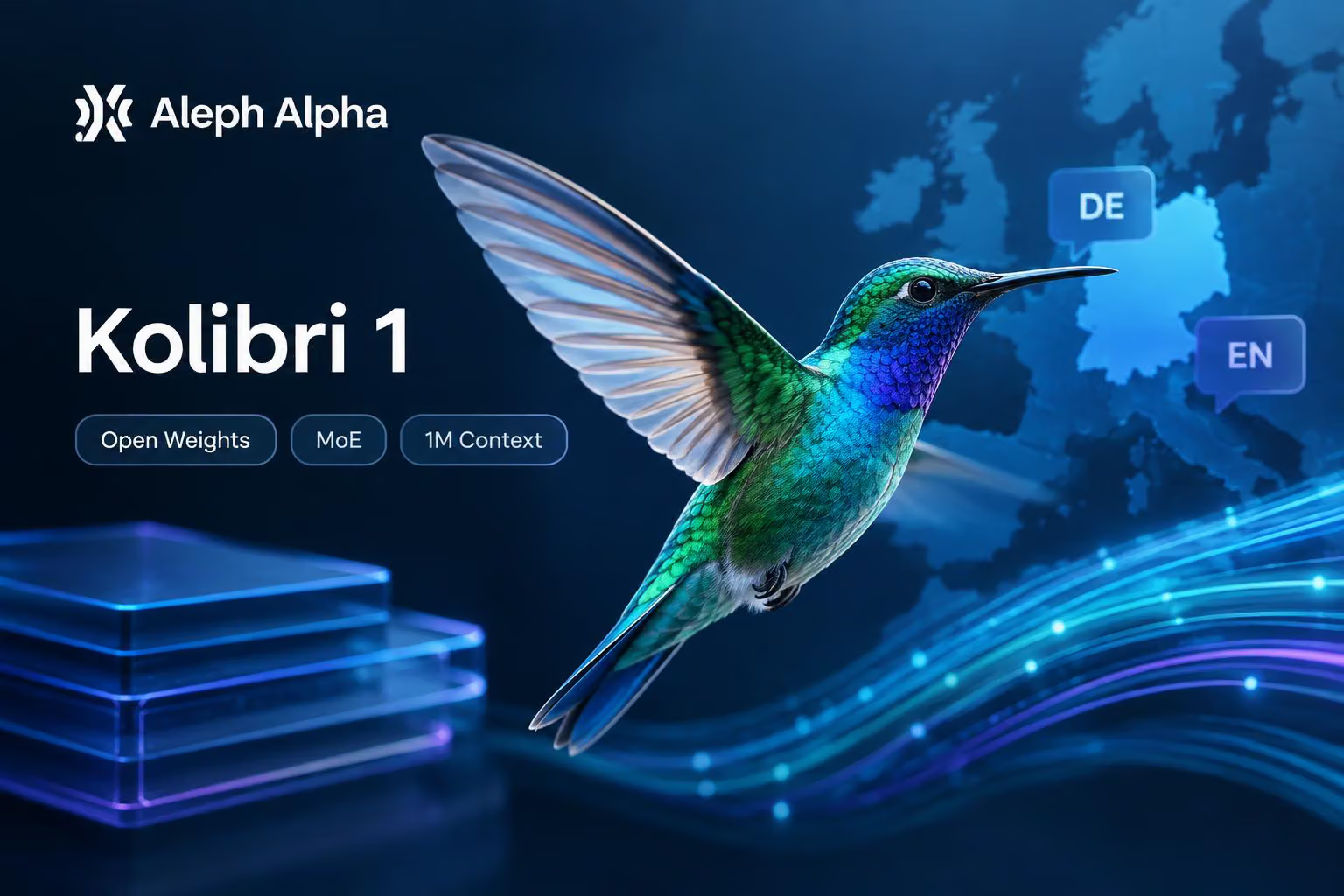
Aleph Alpha’s Kolibri-1 is described as an open-weight model released under the Apache 2.0 licence. The brief gives it 78 billion total parameters and 3.46 billion active parameters in a mixture-of-experts design, a model architecture that activates only a portion of its parameters for each input. It is described as being built for German- and English-language sovereign deployments.
The supplied source does not provide a download link or model card, describe deployment requirements or report measured performance.
Voice features and voice-data privacy
Anthropic is reported to have added a separate privacy toggle for Claude voice users who agree to share voice data for model training. The setting is described as being off by default, meaning users would need to opt in rather than being included automatically.
This is a reported privacy-setting change, not evidence that all Claude voice conversations are used for training. The supplied source does not include the setting’s full policy language, the types of voice data covered or the retention terms.
Mistral is separately reported to be working on its own Voice Mode. The brief says the feature appears to be text-to-speech-based for now, but gives no release date, supported products or technical documentation. It should therefore be treated as a project in development rather than an available product.
OpenAI’s reported model and leadership developments
The brief says GPT-6.1 Sol Ultrafast is coming soon, citing Codex lead Tibo Sottiaux. It provides no release timing, model capabilities, access information or official product documentation. The report describes a planned or expected model, not a confirmed launch.
The same brief reports that OpenAI safety lead David Robinson resigned. It also says Robinson wrote in The Atlantic that OpenAI’s “culture is broken.” The reasons for the departure are not established by the reported material.
These are two separate reports: one concerns a possible upcoming model, while the other concerns a leadership change and an attributed criticism of the company.
Meta’s reported agent platform project
Meta is reported to be building an “Agent Engine” for its Meta API Platform, internally codenamed Forge. In this context, an agent engine would likely refer to infrastructure for building or running software agents, but the brief does not explain what the project will do.
The source provides no launch date, API documentation, feature list or confirmation that developers can access Forge. For now, it is best understood as an in-development project reported by the brief rather than a released platform.
How to read the roundup
The items do not describe one connected announcement. They range from a reported change to Gemini subscription access and a reported open-weight model release to an opt-in privacy feature, a possible future OpenAI model, a resignation and projects that are still being developed.
The reported Gemini timing and tier scope, future product plans and Meta’s project details remain unconfirmed in the supplied brief.

0 comments
No approved comments yet. You can start the conversation.
Leave a comment