
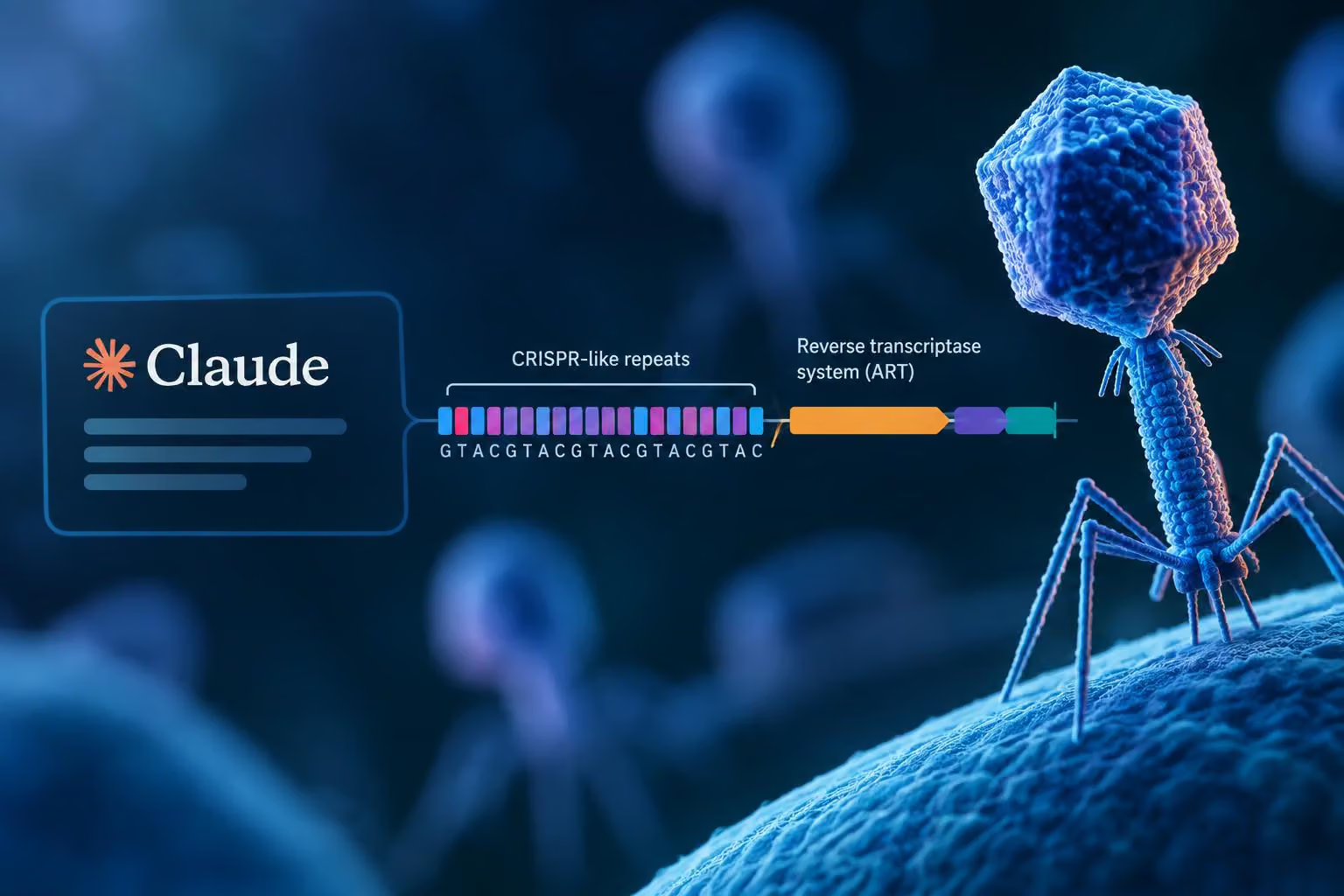
Anthropic says Claude identified a previously uncharacterized enzyme system in bacteriophage DNA, with a long array of repeating DNA sequences that resembles part of a CRISPR system. The company calls the finding an array-associated reverse transcriptase system, or ART, but says its primary biological function is still unknown.
In a post on X, @AnthropicAI says the result came from a new molecular biology research group in which Claude searches biological data, proposes hypotheses and candidate systems, and helps scientists interpret results. Human scientists performed the laboratory work.
Anthropic describes ART as an early research result, not an established gene-editing or medical technology. The company has not determined whether the system can perform any specific programmable DNA operation.
What Claude identified
The finding centers on a reverse transcriptase, or RT. Reverse transcriptases are enzymes that copy information from RNA into DNA. The particular RT associated with ART had already appeared in previous research, according to Anthropic. Anthropic says Claude appears to be the first to notice the larger combination of features surrounding it.
Anthropic describes ART as having three reported components:
The reverse-transcriptase gene.
A partner gene beside it, whose function is not yet known.
A long array of evenly spaced, non-coding DNA repeats.
The system is found mainly in bacteriophages, viruses that infect bacteria. Anthropic says the combination of an unusual RT, a nearby partner gene and the repeat array had not previously been characterized as a single biological system.
The repeat array is the feature that prompted the CRISPR comparison. However, resemblance does not establish that ART works like CRISPR or that it can be used as a genome-editing tool.
How the AI-assisted search worked
Anthropic describes its broader workflow as beginning with surveys of RT families and scientific literature, followed by searches for unusual family members or genomic neighbors and the preparation of human-readable candidate reports. Claude can then critically evaluate the evidence in follow-up analyses, with many candidates eliminated before laboratory testing.
For the ART search, Anthropic says its agents examined more than 200,000 RTs, selected 3,500 candidate systems and narrowed them to 20 for detailed analysis. Roughly 950 Claude agents worked for 21 hours and processed 210 million tokens of data.
One agent then examined the raw DNA near an unusual RT and noticed a tandem repeat pattern. It counted the repeats, measured their spacing, compared the arrangement with known RT systems and searched the literature for earlier reports. The resulting report went to Anthropic’s scientists for review.
This division of work matters. Claude searched large amounts of genomic information and generated a candidate hypothesis, while human researchers reviewed the candidate and performed the experiments.
Why the repeat array resembles CRISPR
CRISPR arrays contain repeating DNA sequences interspersed with spacer sequences. The array is transcribed into RNA, and spacer-derived parts of that RNA can help associated proteins recognize particular genetic targets.
Anthropic says its first experiments found that the ART repeat array is also expressed as a set of distinct short RNAs. That observation is the basis for the company’s suggestion that something analogous may be involved in ART. It does not show that the RNAs guide DNA cutting or any other particular molecular operation.
The comparison is therefore structural and preliminary. ART has a repeat layout associated with an RT, while CRISPR systems can use repeat-and-spacer arrays as part of DNA-targeting machinery. The available evidence does not establish that ART cuts, copies or pastes DNA, nor does it show that the system is programmable.
Anthropic points to other biological systems that eventually became useful tools after scientists first noticed unusual molecular features. But those historical examples do not predict what ART will do. Its function, mechanism and possible uses remain open questions.
What human experiments have shown so far
Anthropic says its scientists reviewed Claude’s analysis and tested the most promising candidate, but the announcement does not provide the ART-specific measurements or experimental methods.
The clearest reported finding is that the ART array is expressed as distinct short RNAs. Anthropic says further experiments are underway to determine how the system works and what role its three components play.
That leaves several important questions unanswered. The company has not identified ART’s primary function, explained what the partner protein does or shown whether the repeat-derived RNAs interact with the reverse transcriptase. It also has not established whether ART can cut, copy or paste DNA, or whether researchers could adapt it for biotechnology.
The result is best understood as a candidate biological system identified through AI-assisted genome mining. Claude helped search a large dataset, recognize an unusual pattern and organize a hypothesis for human review. Scientists then reviewed the candidate and began testing it. Whether ART becomes a useful molecular tool, or simply reveals an interesting feature of bacteriophage biology, will depend on experiments that Anthropic says are still in progress.



0 comments
No approved comments yet. You can start the conversation.
Leave a comment