
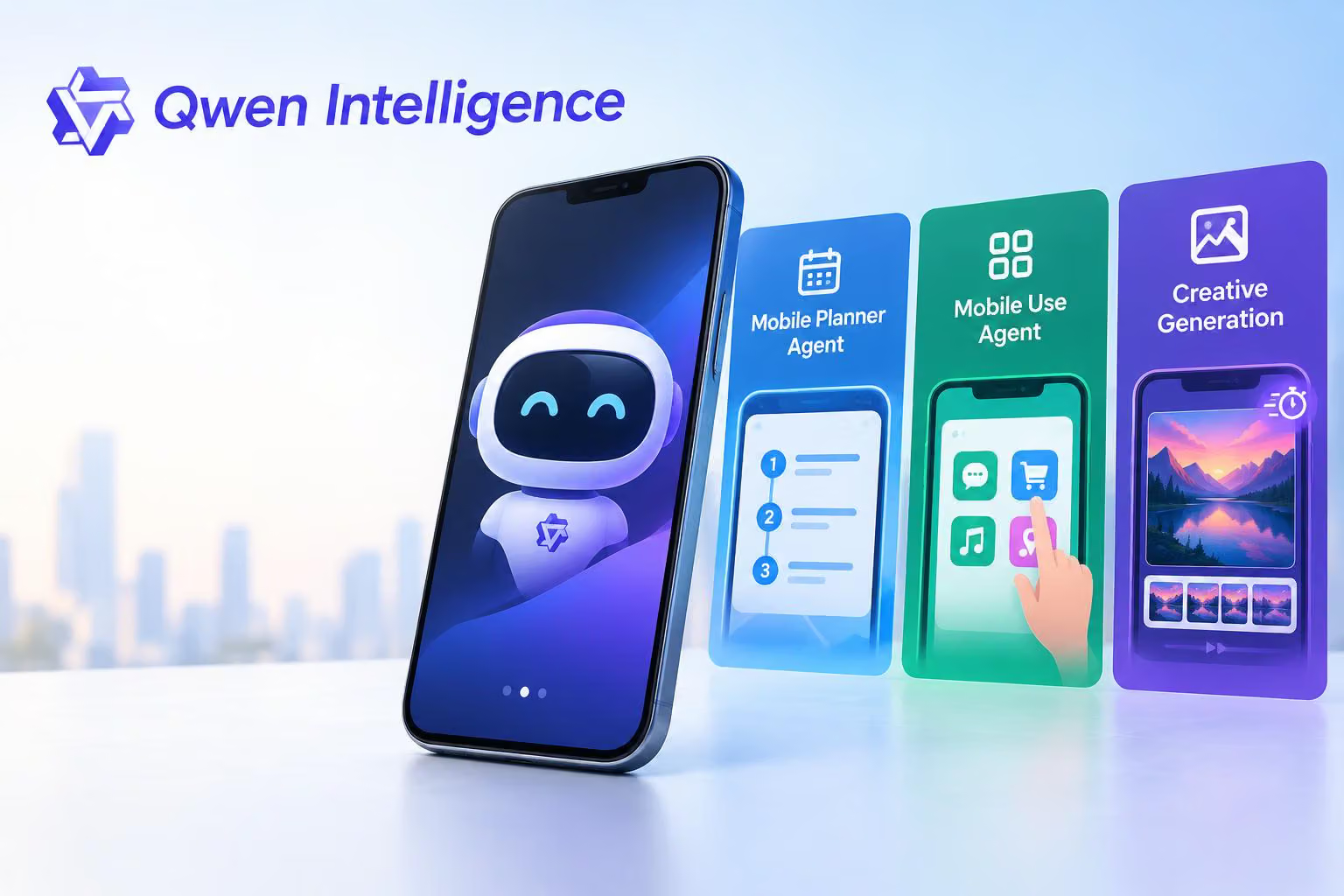
Alibaba says Qwen Intelligence is launching with three agents for different kinds of mobile work: planning complex tasks, carrying them out through mobile interfaces, and generating creative content. In an X post, @Alibaba_Qwen reports benchmark scores for the planner and mobile-use agents, along with an image-generation speed comparison.
Three agents, three roles
Mobile Planner Agent: planning and coordination
The Mobile Planner Agent is designed to break a request into steps and coordinate their execution. Its project page describes a trained planner working with a stateful Harness—a supporting system that manages tools, memory, reusable procedures called Skills, and specialist sub-agents. The system uses execution feedback to track progress and recover from errors, rather than simply producing a static sequence of instructions.
One recorded example describes recovering a development procedure from partial memory, then opening an editor, connecting shared input, and enabling USB debugging in order. It illustrates why planning involves more than task decomposition: actions can have prerequisites, and the agent needs evidence from the environment to confirm what happened.
Alibaba reports that its 27-billion-parameter Qwen-Planner-Agent scored 77.05% overall on MobilePA-Bench, 9.83 percentage points above its stated baseline, and ranked first overall among the systems listed on the project page. The repository contains a technical report and recorded examples, not model weights, training code, or the agent implementation.
Mobile-Use Agent: acting through apps and tools
Alibaba describes the Mobile-Use Agent as API-first, with a graphical user interface (GUI) fallback. An API, or application programming interface, lets software request actions through a structured interface; a GUI is the on-screen interface a person typically taps and swipes. The announcement does not explain exactly how the agent chooses between them.
The post reports scores of 82.1 on MobileWorld, 92.2 on MobileWorld-Real, and 97.2 on AndroidDaily, plus a 90% end-to-end success rate. The post does not specify the setup behind that 90% rate, so it should not be treated as directly comparable to the named benchmark scores.
The announcement links this agent to a Qwen-UI-Agent technical report, which describes a real-world GUI agent for mobile, desktop, and web tasks. The MobileWorld project separately attributes the 82.1 MobileWorld result to Qwen-UI-Agent. The shared score connects the reports, but does not establish that Qwen-UI-Agent and the announced Mobile-Use Agent are identical.
Mobile Creative Agent: generating content
Alibaba says the Mobile Creative Agent can turn a one-sentence request into a ready-to-use creation. The post reports that an image takes three seconds to generate, about twice as fast as “leading peers.”
The linked paper is an empirical study of training pixel-space text-to-image diffusion models. It discusses training methods and reports speedups for the paper’s approach relative to latent-space counterparts; it does not identify the announced Mobile Creative Agent or document its reported generation time.
What the mobile benchmarks measure
The scores are easier to interpret when the evaluations are separated by what they ask an agent to do. MobilePA-Bench focuses on planning and structured tool use, while MobileWorld tests mobile tasks that can involve cross-app workflows, user interaction, and external tools.
MobilePA-Bench describes an interactive, stateful evaluation with 1,705 tasks, 212 tools, and 13 functional domains. It scores Tool Use, Memory Usage, Skill Usage, and Sub-agent Collaboration. Its overall score is weighted: Tool Use contributes 50%, Memory and Skills each contribute 20%, and Sub-agent Collaboration contributes 10%. So half of the overall result reflects tool-use performance. The benchmark runs tasks against a persistent environment, where tools may depend on prior actions, user context can matter, and the agent may need to respond to runtime feedback.
MobileWorld contains 201 tasks across 20 apps. Its task categories include GUI-only work, agent-user interaction—where an agent may need to ask for clarification—and tasks combining GUI actions with tools accessed through the Model Context Protocol (MCP), a way for software to connect to external tools. Tasks average 27.8 completion steps, and 62.2% involve more than one app. This makes MobileWorld broader than a test of navigating a single interface.
MobileWorld-Real is a separate real-device evaluation described in the Qwen-UI-Agent report. Its page describes 409 human-written tasks across 104 live Android apps and seven everyday-use domains, including changing content, accounts, permissions, and network conditions. It says an automated judge reviews action-and-screenshot trajectories. This differs from MobileWorld’s benchmark setting, so the scores are not measurements under identical conditions.
What the announcement leaves open
Alibaba says it is opening a benchmark suite that includes MobilePA-Bench, MobileWorld, MobileWorld-Real, and MobileWorld-Safety. MobileWorld has a public project repository and documentation. MobilePA-Bench’s page describes a confidential hosted evaluation: applicants submit an endpoint for a reviewed report, while hidden tasks and ground truth remain private. The announcement names MobileWorld-Safety but does not describe its evaluation or report results for it.
The announcement calls Qwen Intelligence a launch, but does not specify consumer access, pricing, or supported devices. The supplied project page for the planner also says its repository is not a release of the model weights, training code, or agent implementation.

0 comments
No approved comments yet. You can start the conversation.
Leave a comment