

Google says its Gemini 4 Argon agents are being used for specialized engineering work inside the company, including data-center memory optimization, large-scale C and C++ to Rust migrations, and performance tuning. The reported examples concern Google’s internal infrastructure and workflows—not a public product launch or evidence that the agents operate without human oversight.
In a post on X, @kimmonismus reported that Google’s agents had analyzed infrastructure profiling data, identified memory optimizations and helped apply changes that were later rolled out. The post also described a one-million-token output limit, but did not specify whether that limit applies to every Argon agent or identify the relevant model configuration.
The supplied image presents these activities as part of broader internal work involving specialized coding, research and engineering productivity.
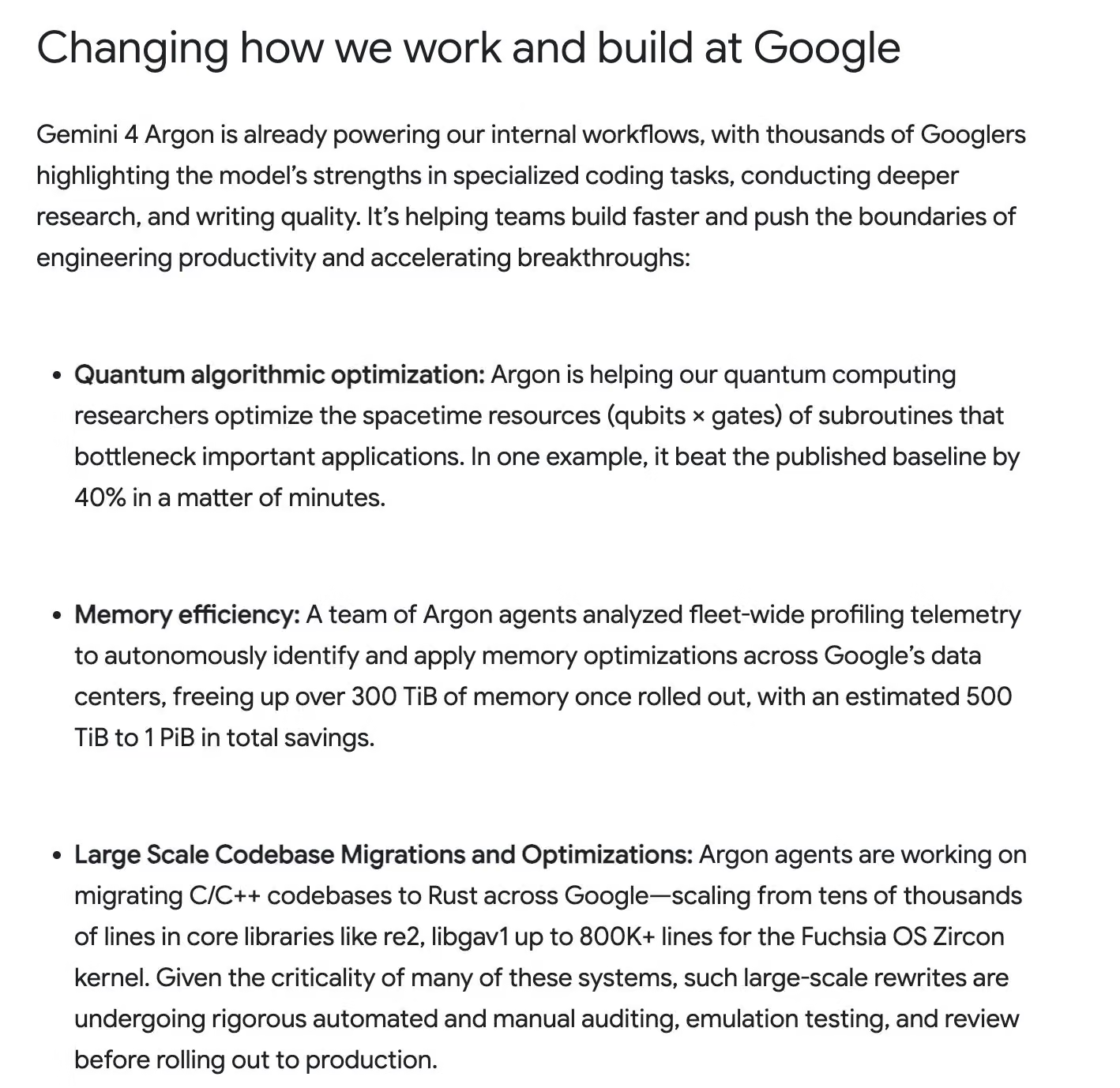
Image credit: @kimmonismus on X
Optimizing memory across Google’s data centers
Profiling telemetry is operational data that records how systems use resources. In this case, the reported workflow involved analyzing fleet-wide profiling data to find opportunities to reduce memory use, then applying changes across Google’s data centers.
The X report says those changes freed more than 300 tebibytes (TiB) of memory after rollout. A tebibyte is a unit of digital storage equal to 1,024 gibibytes. The supplied image gives a larger estimate of 500 TiB to 1 pebibyte (PiB) in total savings, but does not provide a measurement method, timeframe or baseline for that estimate.
Those figures should therefore be read as Google’s reported results rather than independently verified measurements. The material also does not explain which systems were changed, how agents proposed the optimizations, or what human review took place before deployment.
Rewriting C and C++ code in Rust
The reported work also includes migrations from C and C++ to Rust. A migration of this kind rewrites existing software in another programming language while attempting to preserve its behavior. Rust is often used for systems programming because its compiler can enforce important memory-safety rules, but moving a large, mature codebase remains a substantial engineering task.
The supplied X post describes more than 800,000 lines of kernel code, while the accompanying image says the migrations range from tens of thousands of lines in core libraries such as re2 and libgav1 to that larger kernel project. The image identifies the kernel project as the Fuchsia OS Zircon kernel and says the work includes automated and manual auditing, emulation testing and review before changes reach production.
That description indicates a staged engineering process rather than a simple instruction to rewrite an entire codebase and deploy the result. It also does not establish that the full 800,000-plus-line migration is complete. The source gives no further details about which portions have been migrated, how compatibility was measured or how much of the work was generated by agents versus completed by engineers.
Tuning performance-critical code
One example in the report concerns a video decoder. Google reportedly used agents to replace 32,000 lines of SIMD code with safe Rust. SIMD, or single instruction, multiple data, is a technique for applying one operation to many data elements at once and is commonly used in performance-sensitive software.
According to the supplied post, the existing Rust port became 2.7 times faster while producing identical video output. The post does not specify the test hardware, workload, baseline measurements or evaluation procedure, so the result cannot be treated as a general benchmark for Argon or for Rust-based video decoders. It is a reported result from one internal example.
Other reported engineering uses
The supplied image also describes Argon helping Google’s quantum-computing researchers optimize the “spacetime” resources used by quantum subroutines. In this context, the phrase refers to the combined resource cost represented by the number of qubits and the number of operations, or gates, used by an algorithm.
The image says one example beat a published baseline by 40% in minutes. It does not identify the baseline, workload, evaluation setup or publication, so the reported comparison lacks the detail needed to judge how broadly the result applies.
What the report establishes—and what it does not
Taken together, the examples portray Argon as being used for bounded, high-value engineering tasks: analyzing operational data, proposing or implementing code changes, optimizing performance and supporting large migrations. The reported safeguards include automated and manual auditing, emulation testing and review before production rollout.
The material does not establish that Gemini 4 Argon is generally available, that it can independently manage Google’s infrastructure, or that every reported change was completed without engineers. It also does not provide primary technical documentation, dates, baselines or detailed outcome measurements.
The most supportable conclusion is narrower: Google is reported to be applying its agents to difficult internal engineering workflows, where the systems can work over large codebases and infrastructure data but where testing, auditing and deployment review remain important parts of the process.

0 comments
No approved comments yet. You can start the conversation.
Leave a comment