
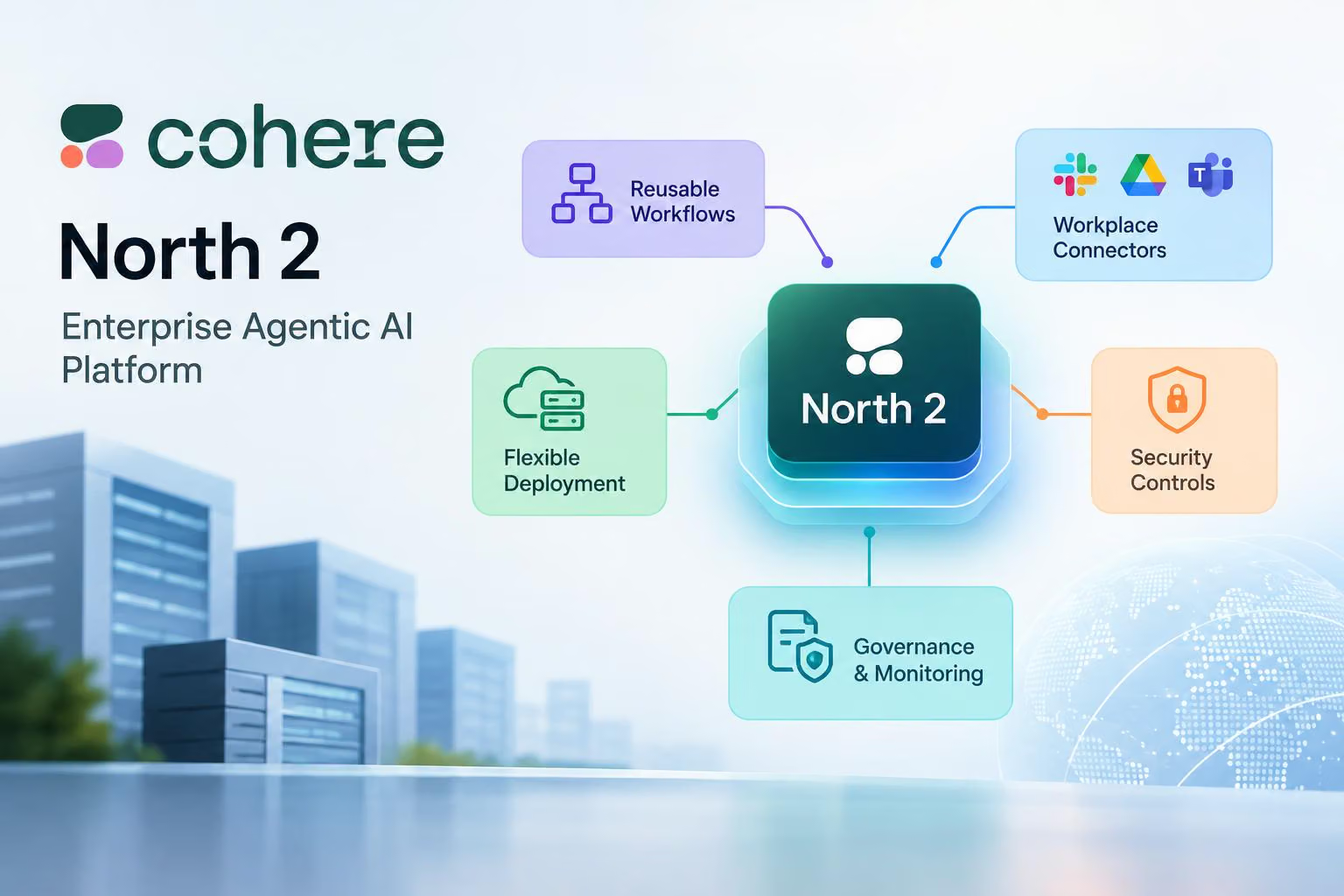
Cohere is presenting North 2 as a major upgrade to its enterprise agentic AI platform, with more than 15 stated features for building workflows, connecting business systems, controlling deployment, and governing AI use. In a post on X, @cohere describes North 2 as a way to create reusable agents and automations, connect workplace applications, and run models in environments ranging from cloud infrastructure to air-gapped deployments.
The announcement focuses on four practical enterprise concerns: coordinating multi-step work, connecting AI to existing systems, controlling where models and data run, and managing security and usage. Pricing, packaging, and broad availability are not specified in the announcement.
What Cohere North 2 is designed to do
North 2 is described as a full-stack platform for agentic AI: software in which AI agents can perform multiple steps, use connected information and tools, and complete tasks with varying levels of human oversight. Cohere says the upgrade includes a redesigned orchestration system for more sophisticated multi-step agents and automations.
The platform is aimed at organizations that want to create and share AI workflows rather than build each one from scratch. Cohere’s announcement describes North 2 as supporting reusable agents, shared organizational knowledge, applications, and automations. These features are presented as ways to make repeated business processes easier to create and maintain.
Reusable workflows and multi-step orchestration
North 2’s orchestration system is intended to coordinate complex workflows across multiple steps. Users can create agents and automations with prompts, while the system manages the process and keeps people involved where an organization requires human review.
Cohere lists several building blocks for this approach:
Skills are reusable capabilities that agents can call instead of rebuilding the same logic for each workflow.
Libraries provide shared knowledge and assets that people across an organization can use.
Memory allows agents to retain context across sessions instead of starting without prior context each time.
Applications let users prototype decks, dashboards, documents, and lightweight applications from natural-language instructions.
Automations include templates for common processes, a visual drag-and-drop workflow builder, performance monitoring, and integrations with existing tools.
In practical terms, the feature set is aimed at repeatable work: an organization could define a process once, share it, and refine it over time instead of relying on separate ad hoc conversations. The announcement describes these capabilities but does not provide measured reliability or productivity results.
Connecting North 2 to workplace systems and data
Cohere says North 2 can connect to commonly used workplace applications and organizational data. The listed connectors include Slack, SharePoint, OneDrive, Microsoft Outlook, Microsoft Exchange, Jira, Linear, Notion, and GitHub.
These connections are intended to let agents work with information and processes that already exist inside an organization. For example, a connected agent might use approved workplace knowledge while helping with research, coordination, or task automation. Teams evaluating the platform would need to confirm the availability, permissions model, and setup requirements for each connector.
Cohere also lists planned connections to financial-data providers including PitchBook, Crunchbase, Daloopa, FiscalAI, S&P Global, and FactSet. The announcement describes these as planned rather than confirmed available connectors.
A separate Cohere and PwC partnership announcement describes a collaboration focused on enterprise search, knowledge access, research, decision support, and task automation. It says the work will combine North with Cohere’s models and retrieval capabilities and PwC’s industry, risk, regulatory, and transformation expertise. That announcement also describes private-cloud, on-premises, and air-gapped deployment options.
Deployment flexibility, sovereignty, and security
Cohere presents deployment choice as a central part of North 2. The announcement lists self-hosted, virtual private cloud, hybrid, on-premises, and fully air-gapped environments. An air-gapped deployment is separated from external networks, a setup that can help organizations keep sensitive systems isolated when their policies require it.
The company also describes North 2 as model agnostic. Organizations can use Cohere’s models or bring other models. Teams would need to confirm the supported models and conditions for using external models as part of their technical evaluation. The combination of deployment and model choices is intended to give enterprise teams more control over where AI runs, which models process their data, and how the platform fits existing infrastructure.
Cohere reports that North has SOC 2 Type 2, ISO 27001, and ISO 42001 certifications. The announcement does not specify the scope, dates, or audit details for those certifications. It also lists guardrails for filtering content, improving safety, and validating model responses.
Other security features described by Cohere include autonomy policies, which are intended to limit agents to authorized actions and require human oversight for critical decisions; system observability tools for monitoring service performance; and detailed logs of changes. Cohere also says it uses continual security testing, red-team exercises, and third-party vulnerability scanning. These features and practices would still need to be assessed against an organization’s own security and compliance requirements.
North Admin and enterprise governance
North Admin is the platform’s main governance layer in the announcement. Cohere says administrators can configure visibility down to the user and agent level, assign roles and permissions, determine which models can be used, and integrate with existing identity and access-management systems.
The controls also cover usage and cost management. Administrators can monitor activity in real time, review analytics, set alerts, define consumption tiers, and apply limits based on requests and token rates for users and groups. Organization-wide caps and user-level controls are intended to make AI consumption more predictable as adoption grows.
This gives enterprise teams several separate decisions to manage:
Who can use AI features: roles, permissions, authentication, and access to specific models.
What an agent can do: guardrails, autonomy policies, and human approval for sensitive actions.
How activity is monitored: service-performance visibility, logs, analytics, and alerts.
How usage is constrained: rate limits, quotas, consumption tiers, token limits, and organizational caps.
Cohere says these tools can help organizations measure AI investment and return on investment. The announcement provides no cost figures or measurement framework for evaluating a particular organization’s financial outcome.
Models, hardware, and the limits of the announcement
Cohere says North 2 can use Cohere models or models supplied by an organization. The company also describes a collaboration with NVIDIA involving Cohere models running on NVIDIA Blackwell and Hopper hardware. Cohere says this combination can produce more tokens per second per node and use fewer tokens for some workloads.
NVIDIA Vice President of Generative AI Kari Briski is quoted describing the hardware as helping North 2 deliver more tokens for less. The announcement presents these as Cohere and NVIDIA’s reported findings and does not include benchmark figures, test conditions, or comparative cost analysis.
The announcement also names LG CNS and Bell Cyber as partners. LG CNS describes using North to support AI deployments across South Korea, while Bell Cyber describes using the platform in security operations and emphasizes control, privacy, and data sovereignty. Their statements describe intended or reported use of the platform rather than independently measured customer outcomes.
What enterprise buyers still need to confirm
North 2’s announcement addresses several practical enterprise requirements: reusable workflows for repeatable work, connectors for existing systems, deployment choices for data and infrastructure control, and administrative features for security and governance. Its reported capabilities and partner statements provide a basis for evaluation, but not independent proof of performance or business value.
Before evaluating North 2 for production use, organizations would still need to confirm:
pricing, packaging, licensing, and availability;
which features and connectors are generally available;
the requirements and limitations of cloud, private-cloud, self-hosted, hybrid, on-premises, and air-gapped deployments;
supported external models and hardware configurations;
the scope and dates of the reported certifications;
data handling, retention, identity, permissions, and logging behavior for each integration;
benchmark, reliability, security-testing, and total-cost evidence for the organization’s own workloads.
Those details will determine whether North 2’s emphasis on orchestration, sovereignty, security, and governance matches a particular enterprise’s technical and regulatory requirements.

0 comments
No approved comments yet. You can start the conversation.
Leave a comment