

Cognition has introduced SWE-2, a coding model designed to offer different capability–cost tradeoffs through medium, high, and max effort levels. The company says SWE-2 improves on SWE-1.7 in several coding evaluations while using fewer turns and costing less on some comparable tasks.
Cognition (@cognition) announced SWE-2 as its closest model yet to the coding frontier. The model is available in Devin Desktop and CLI, with a rollout to Devin Web and Fusion also announced. Cognition says Pro, Max, and Teams subscribers can use it free for one month; the announcement does not specify the complete rollout schedule or regional availability.
The results below come from Cognition’s announcement and technical write-up, not independent testing. The company used publicly available results where available and otherwise evaluated models through different model-specific harnesses, so the figures should be treated as reported comparisons rather than a single controlled external test.
How SWE-2 compares on reported coding benchmarks
Cognition reports SWE-2 scores of 50.0% on FrontierCode 1.1 Main, 73.0% on DeepSWE 1.1, 92.8% on Terminal-Bench 2.1, and 27.3% on Terminal-Bench 4. Cognition says the table reports the best available score across reasoning-effort settings for each model–benchmark pair.
Benchmark | SWE-2 | Kimi K3 | Grok 4.6 | Fable 5.1 | GPT-5.6 Sol | GPT-6 Astra | SWE-1.7 |
|---|---|---|---|---|---|---|---|
FrontierCode 1.1 Main | 50.0% | 44.2% | 48.0% | 50.9% | 47.5% | 53.3% | 42.0% |
DeepSWE 1.1 | 73.0% | 68.5% | 67.5% | 67.4% | 72.7% | 74.1% | 37.7% |
Terminal-Bench 2.1 | 92.8% | 88.3% | 88.4% | 91.4% | 88.8% | 89.9% | 81.5% |
Terminal-Bench 4 | 27.3% | 21.5% | 20.3% | 55.8% | 37.3% | 57.9% | 7.6% |
*Source: Cognition’s SWE-2 announcement. Cognition says Appendix A uses public results where available and otherwise uses the harness associated with each model family. The figures are not independently verified.*
The table shows why a single ranking would be misleading. SWE-2 is ahead of the listed models other than GPT-6 Astra and Fable 5.1 on FrontierCode 1.1 Main, while Fable 5.1 has the highest listed Terminal-Bench 4 score. GPT-6 Astra leads Cognition's results on FrontierCode 1.1 Main and DeepSWE 1.1. The choice therefore depends on the benchmark and on whether a team values peak score, cost, or a particular coding-agent workflow.
Cognition also says SWE-2 is within one point of Fable 5.1 on FrontierCode 1.1 Main while costing 64% less under the company’s listed-price comparison. Those cost figures are part of Cognition’s evaluation and should not be read as a guarantee of an individual user’s bill.
What SWE-2’s effort levels change
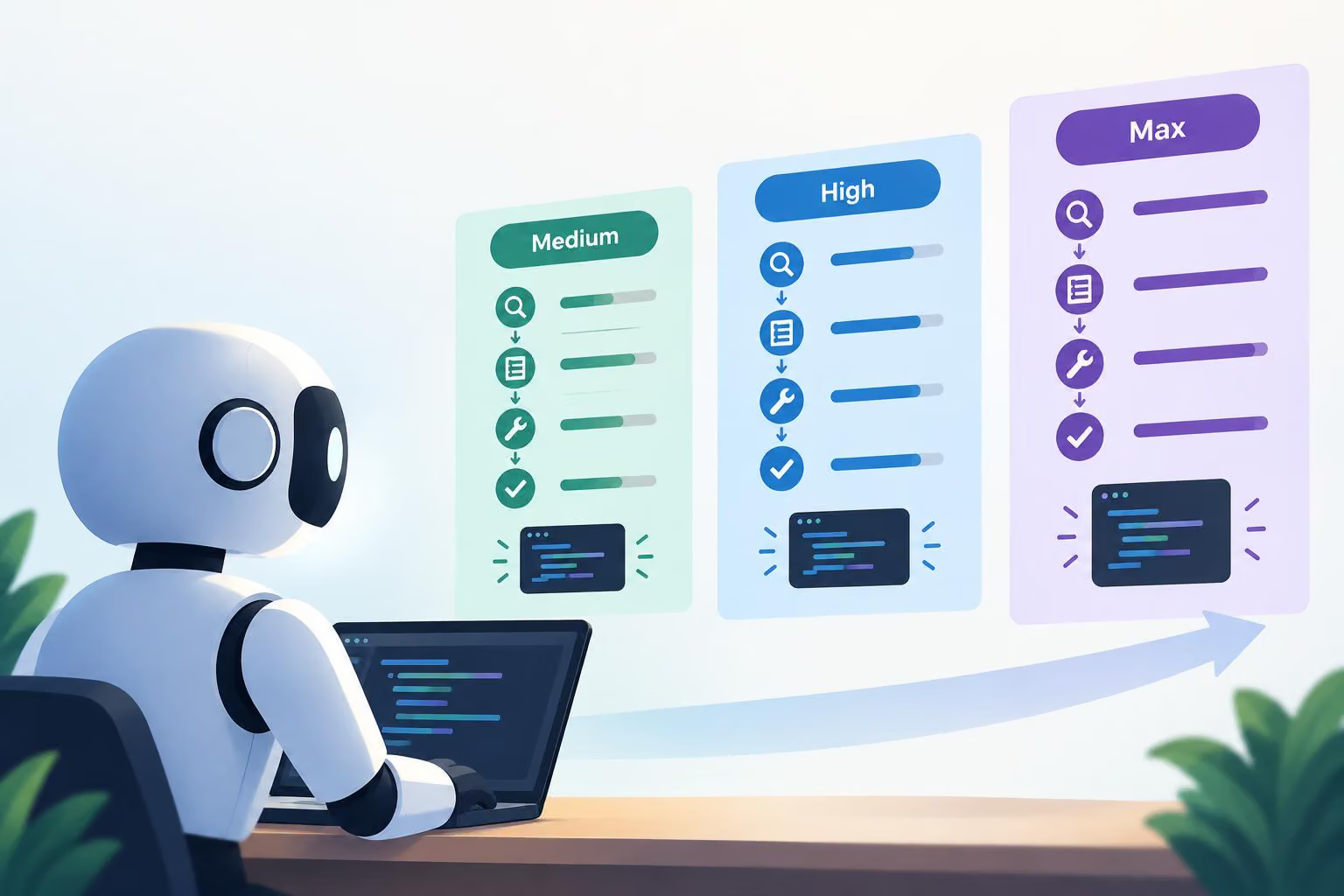
SWE-2 is Cognition’s first model with built-in effort levels. In practical terms, the setting controls how much exploration, planning, tool use, and verification the model is willing to spend before finishing a task.
Medium is intended to provide the more cost-efficient path for simple and intermediate work. Cognition says it starts implementation sooner and avoids some unnecessary exploration.
High spends more effort on complex tasks, including more planning and codebase exploration.
Max is designed to use more tokens and turns when the task benefits from deeper investigation and verification.
Cognition describes these settings as a single cost–performance frontier rather than three unrelated models. The company says medium became both cheaper and more capable during training, while max learned to use additional tokens and turns to reach higher scores.
On the company’s FrontierCode 1.1 Main evaluation, SWE-2 medium scored higher than SWE-1.7 while using 58% fewer turns and costing 81% less on average. Cognition attributes the difference partly to more focused exploration before editing. Its reported mean step counts were 53 for SWE-2 medium, 80 for high, 98 for max, and 127 for SWE-1.7 across 100 tasks, with three runs per task and steps grouped by the tools called.
Cognition also reports that SWE-2 medium made its first real edit after a median of 18 steps, compared with 48 steps for SWE-1.7. That observation does not mean less exploration is always better: for a complex change, high or max may spend more time tracing dependencies or checking uncertain assumptions before editing.
A reported efficiency change from SWE-1.7
The practical distinction is not simply that SWE-2 is faster. Cognition says SWE-1.7 often explored the codebase very thoroughly, which could help performance but also lead to over-exploration on simpler tasks. The company reports that SWE-2 more often judges which files and tools matter before making changes.
Cognition also says its internal testing found improvements in end-to-end test writing, alternative approaches when an obvious path is blocked, and verification when a user’s assumption needs checking. These are company observations from internal testing, not independent measurements or a promise that SWE-2 will behave that way on every project.
How Cognition says it trained SWE-2
SWE-2 is post-trained from Kimi K3, which Cognition describes as a 2.8-trillion-parameter model already trained for agentic coding. Cognition says its reinforcement learning (RL)—a training method that rewards desirable outcomes from sampled attempts—added 5–6 points on many benchmarks and shifted K3’s cost–performance frontier.
The main training changes were:
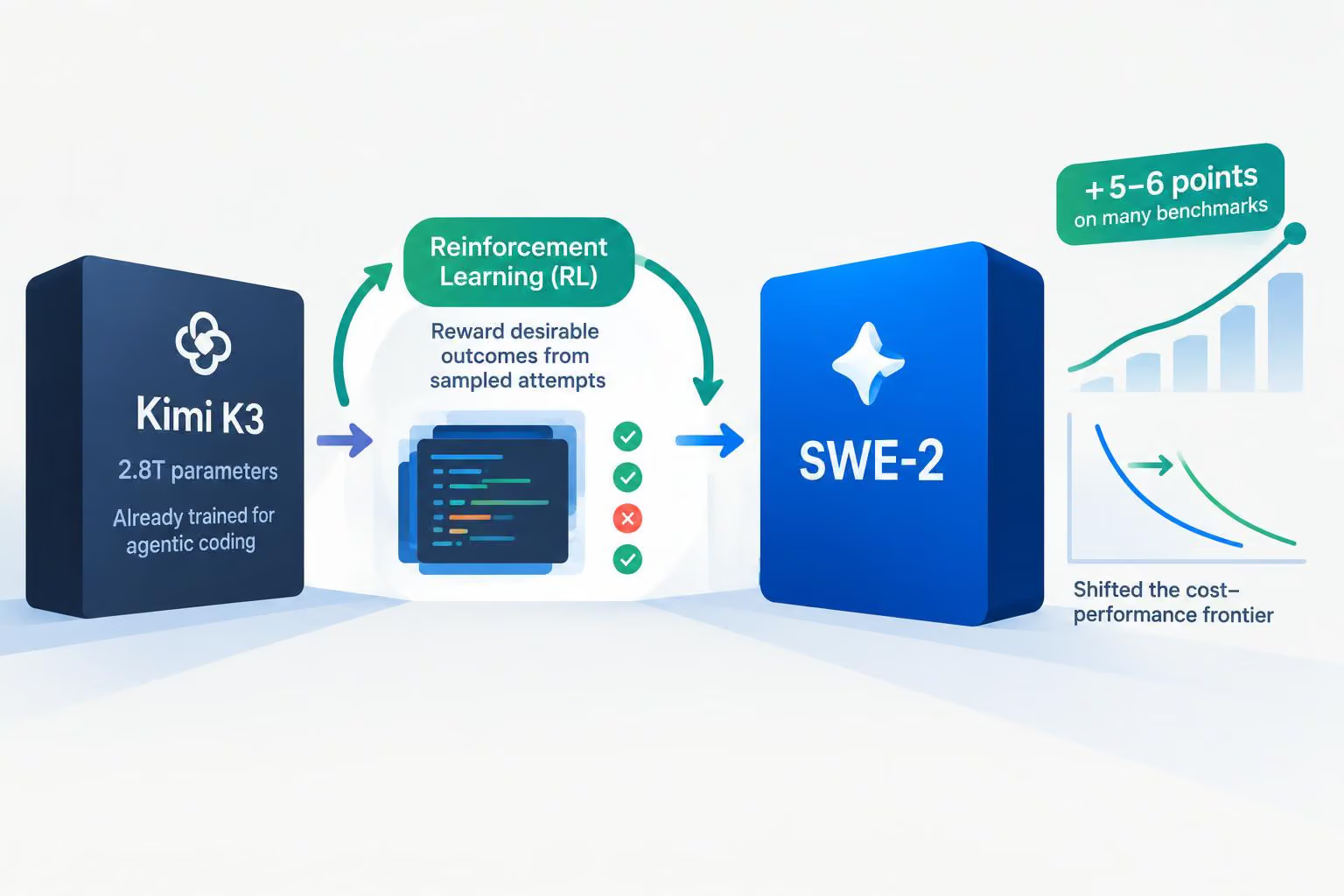
Cost penalties tuned to the frontier
Cognition trained the effort levels in one RL run using a reward of:
R = S − λₑ CHere, S represents whether one sampled attempt by the coding agent—a rollout—solved the task, C represents a mix of inference cost and rollout time, and λₑ is a penalty selected for effort level e.
The company says it tuned each penalty to the local slope of the base model’s cost–performance curve. The intent is to improve the available tradeoffs across the entire curve rather than optimize only one setting. In less mathematical terms, the training process tries to avoid making a cheaper model by simply sacrificing too much solve rate, or making a stronger model by spending inefficiently.
A length-weighted reward baseline
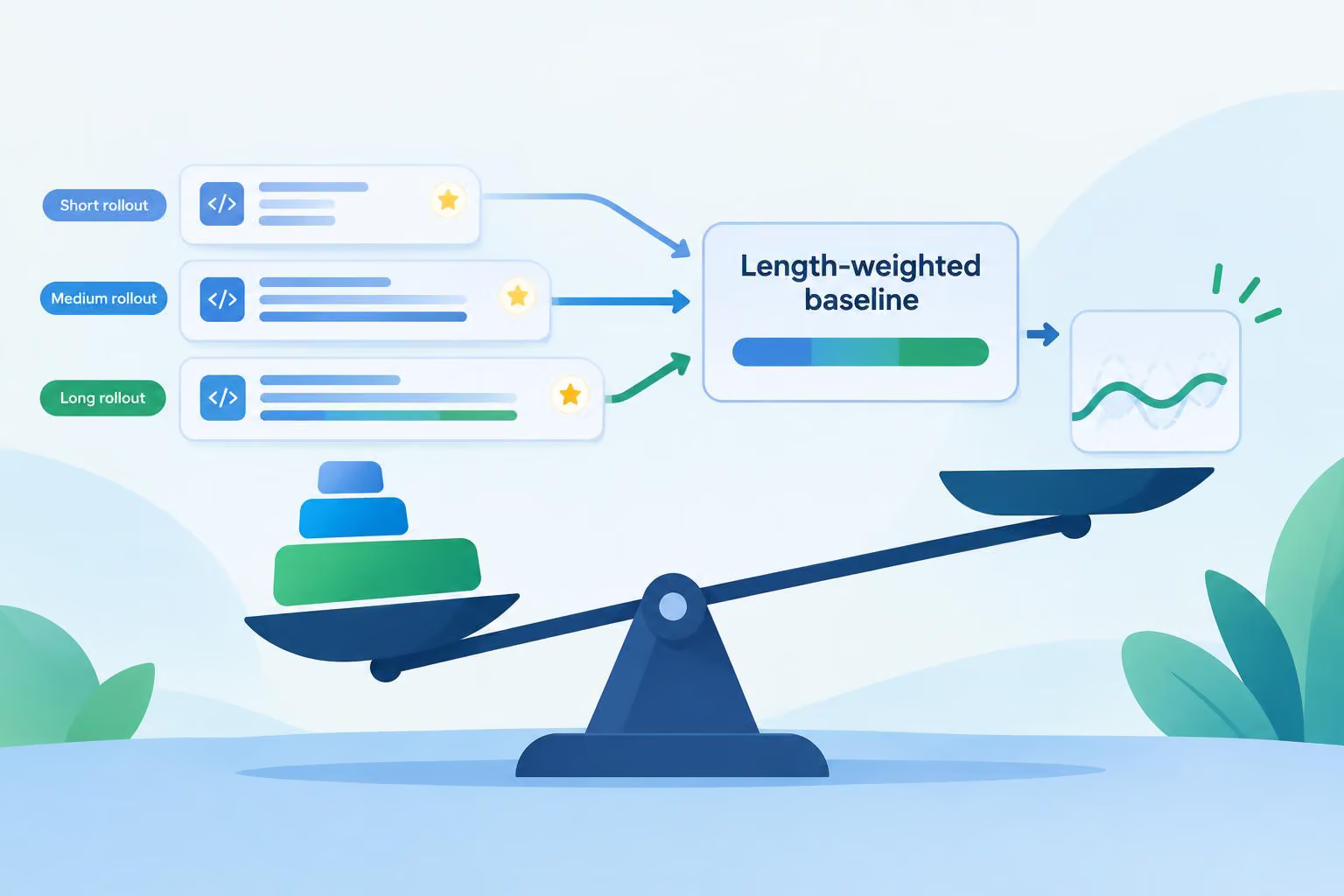
Cognition also describes a reward baseline used since SWE-1.6 to stabilize RL. A baseline reduces the noise in the learning signal. Instead of averaging each sampled reward equally, Cognition estimates the baseline as a length-weighted average, giving longer rollouts proportionally more weight in that baseline.
The technical post says this approach improved stability in the company’s ablations. It does not establish that the same improvement will appear in another training setup.
Faster and more consistent rollout serving
Training a coding agent requires generating many attempted solutions, or rollouts. Cognition says it improved the system that serves those rollouts by batching nearby requests, using speculative decoding with a draft model, and training that draft model online as the main policy changed.
It also used NVFP4 and FP8 low-precision kernels with quantization-aware training. These techniques reduce memory use, while the company says they maintained similar throughput to SWE-1.7 and reduced the mismatch between the policy used for inference and the one used during training, despite SWE-2’s larger base model.
More difficult environments and stronger verifiers
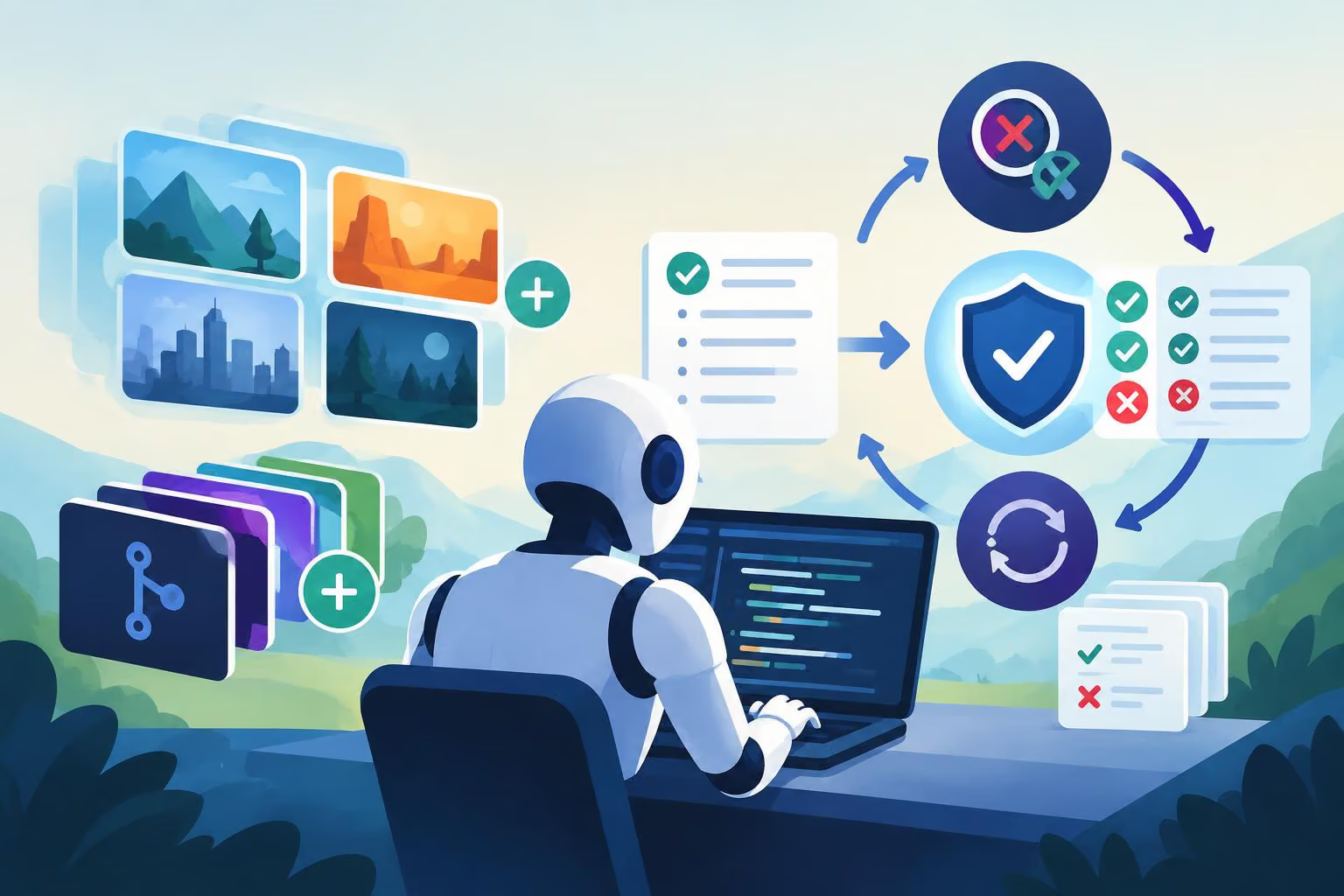
Cognition says it tripled the number of RL environments and expanded the distribution of repositories used for training. It added instruction-following requirements and repeatedly hardened its verifiers—automated checks that determine whether a coding attempt succeeded.
That last step matters because a coding agent can sometimes exploit a weak checker instead of solving the intended task. Cognition says it used previous SWE-2 checkpoints to find false positives and false negatives, then refined the environments and verifiers in a recurring data flywheel.
What the results do—and do not—show
The announcement supports a clear claim about Cognition’s design goal: SWE-2 is intended to let users choose between lower-cost execution and more extensive reasoning within one model family. The reported FrontierCode comparison suggests that medium can reduce tool-use overhead relative to SWE-1.7, while high and max are intended for tasks where additional planning and verification may be worthwhile.
The evidence does not establish an independent ranking of coding models. Cognition’s appendix combines public results with internal evaluations and uses different harnesses for different model families. It also reports the best result across effort settings, which is useful for comparing reported peaks but does not show the typical score or cost for every setting.
Cognition’s published comparison does not provide a complete per-effort cost-and-score table for SWE-2 across all four benchmarks. Teams evaluating the model would therefore need to measure their own workloads, including task success, turns, latency, token use, and the cost of retries. The one-month subscriber offer is a product promotion, not evidence that SWE-2 is generally free.
Cognition additionally reports trustworthiness evaluations covering politically sensitive questions and context-dependent vulnerability in coding tasks. It says SWE-2 passed 98.0% of the former evaluation overall, with separate rates for English, Simplified Chinese, and Traditional Chinese, and that no tested customer or language framing produced a statistically significant change in vulnerability for any model. These findings are also company-run evaluations: the propaganda and censorship test used a single GPT-5.6 Luna judge, while the coding vulnerability test used a GPT-5.6 Sol-high judge.
For engineering teams, the most useful takeaway is therefore not that SWE-2 guarantees better code. It is that Cognition is exposing effort as an explicit operating choice: use medium when focused exploration is sufficient, and consider high or max when a task’s complexity justifies more planning and verification. Whether that tradeoff is worthwhile depends on the team’s own repositories, tool setup, evaluation harness, and cost limits.



0 comments
No approved comments yet. You can start the conversation.
Leave a comment