
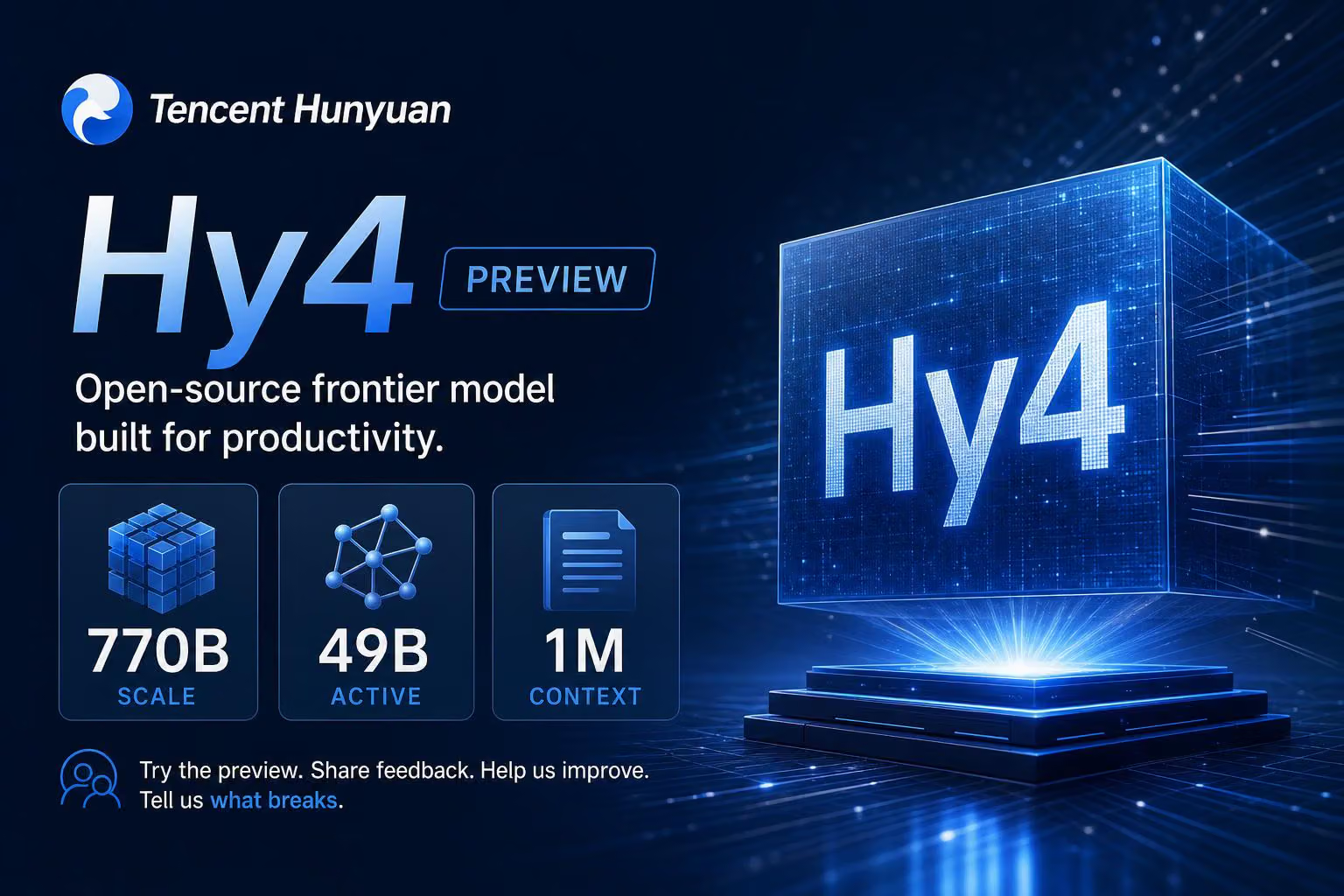
Hy4 preview is Tencent Hunyuan's large language model, which the company released and open-sourced on August 28, 2026. That outlet puts the model at 770 billion total parameters, 49 billion activated, and a context window above one million tokens.
Tencent Hunyuan's post on X presents Hy4 as built for productivity and as an open-source frontier effort, and asks users to try the preview and report what breaks. The preview label matters, though: one model directory describes Hy4 preview as an early version of the wider Hy4 generation.
What are the Hy4 preview specs?
Tencent's GitHub repository lays out a 78-layer design. Only the first layer is dense; the other 77 are mixture-of-experts blocks, each holding 256 routed experts and one shared expert. The router selects eight routed experts per token, alongside the shared one.
That split explains the gap between size and cost. Compute per token tracks the 49 billion active parameters, but all 770 billion weights still have to fit in memory. BigGo Finance reports that the jump over Hy3, which had 295 billion parameters, is more than twofold.
Self-hosting is a heavy lift. A vLLM serving recipe lists configurations on 16 B200, 8 B300 or 8 MI355X accelerators, which puts the full model out of reach for most small teams.
Is Hy4 preview really open source, and what does it cost?
The repository places Hy4 preview under the Apache License 2.0 and lists an FP8 build alongside the standard weights on Hugging Face, ModelScope, GitCode and CNB. Apache 2.0 generally permits commercial use, so the weights can underpin paid products.
Hosted access is billed by the token. BigGo Finance cites charges of 6 yuan per million input tokens and 18 yuan per million output tokens on Tencent Cloud TokenHub and OpenRouter. Output costs three times input, so workloads that generate long answers will cost more than the input rate suggests.
Tencent's own apps also offer the model. TechNode lists the Chinese and international versions of WorkBuddy and CodeBuddy, plus Yuanbao and ima.
How strong are the benchmark claims?
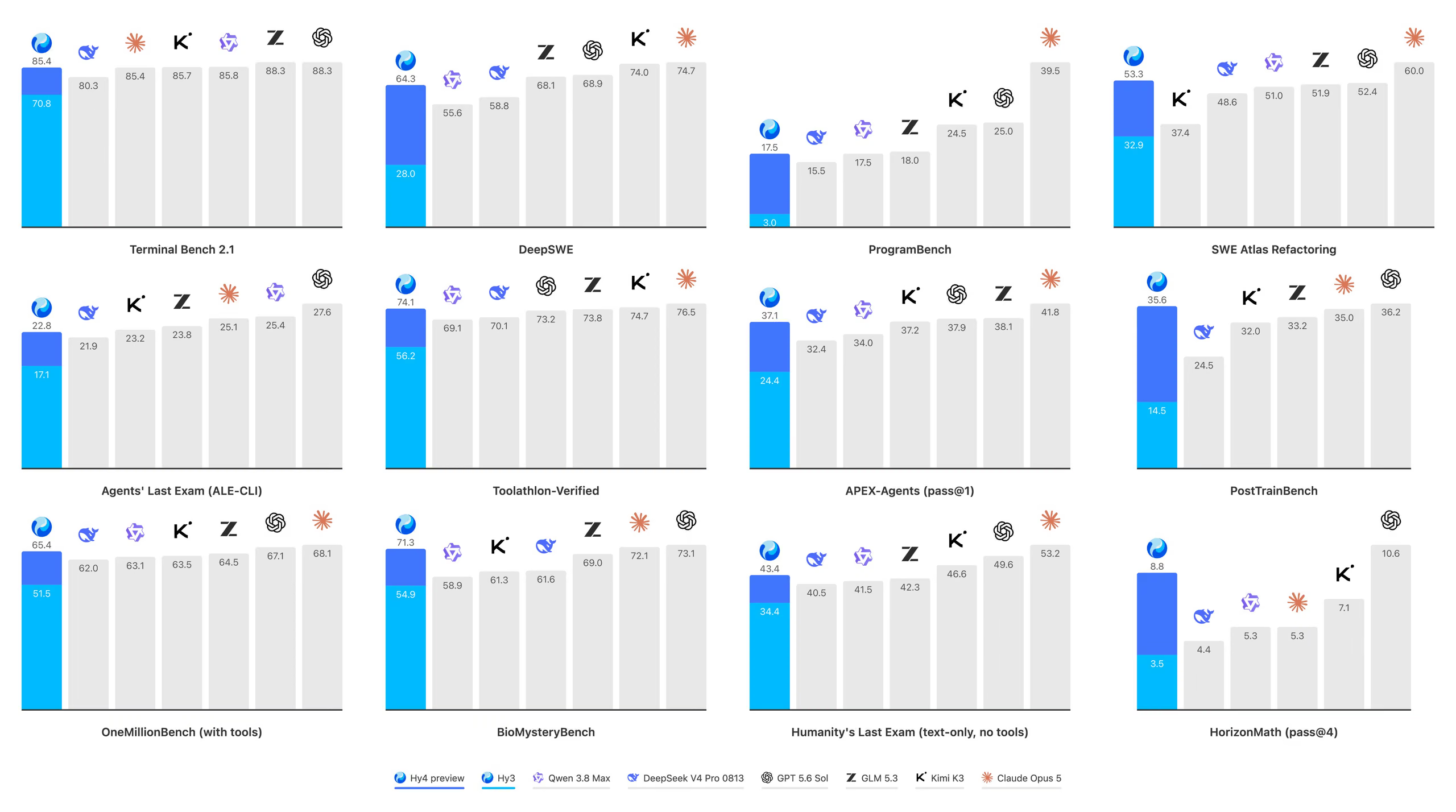
In a blind test Tencent ran internally, involving 163 experts and 203 engineering tasks, Hy4 preview scored 2.99 out of 4. TechNode reports 2.94 for Kimi K3 and 2.92 for GLM 5.3 under the same evaluation.
The margins are thin: 0.05 points ahead of Kimi K3 and 0.07 ahead of GLM 5.3 on a four-point scale. Because Tencent ran the test itself, treat it as a signal rather than proof of leadership. Independent benchmarks and tests on your own workloads will matter more.
The repository makes a bigger claim: that the model puts Hy4 preview at the open-source frontier, and that its generation-over-generation gain is the largest the team has measured. Those are self-assessments, so test them as you would any vendor claim.
What has changed since the August release?
The August release is a preview, and a later announcement has been reported. One secondary source, a shattered.io timeline, says Tencent made a broader Hy4 announcement on November 4, including Hy4 Flash. Tencent's own channels should confirm that before anyone builds on the preview.
The post points readers to the Hy blog, Hugging Face and GitHub for access and further detail. Check those pages for the current model lineup.
Key takeaways
- Hy4 preview is a 770B-parameter mixture-of-experts model with 49B active parameters, a 1M-token context and Apache 2.0 weights.
- Tencent's lead over Kimi K3 and GLM 5.3 is small and comes from its own internal test.
- Hosted pricing is per token and output costs three times input, so test with your own traffic mix before committing.
Frequently asked questions
Is Hy4 preview free to use commercially?
The weights are released under Apache 2.0, which generally permits commercial use. Hosted API access is billed per token, so budget for it.
Where can I download or try Hy4 preview?
The weights are on Hugging Face, ModelScope, GitCode and CNB. The model is also available through Tencent Cloud TokenHub, OpenRouter, and Tencent apps such as Yuanbao and CodeBuddy.
What does "49B active" mean?
Only 49 billion of the 770 billion parameters are used for each token. That lowers compute per token, but the full model still has to fit in memory.


0 comments
No approved comments yet. You can start the conversation.
Leave a comment