
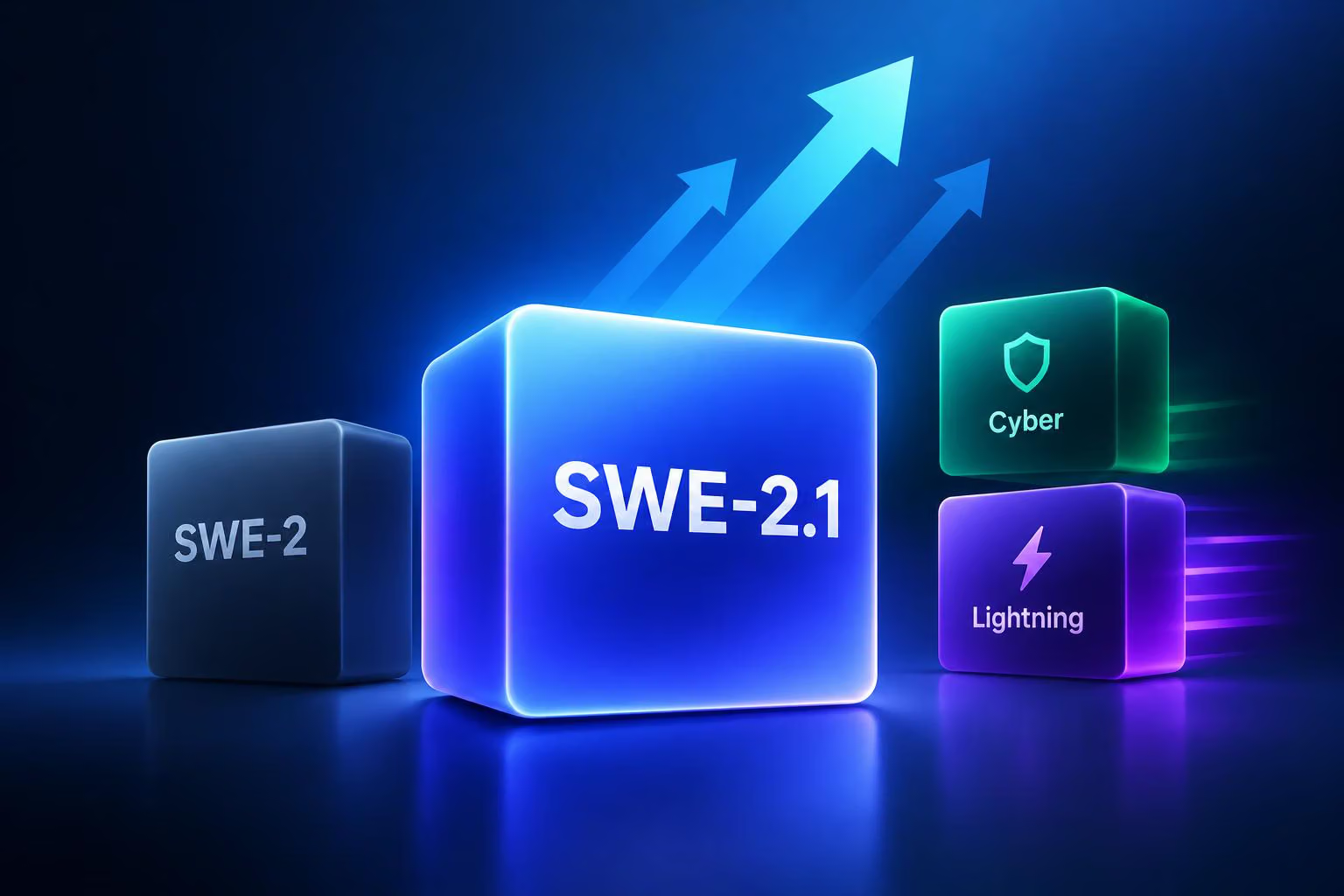
SWE-2.1 is Cognition's new coding model, announced on November 24, 2026. Cognition's announcement on X says it is trained with pure reinforcement learning on Kimi K3, like its predecessor, and that it delivers large gains over SWE-2 across a wide range of benchmarks. The same post says it is free for Devin Pro, Max and Teams users for the next two weeks.
The launch has two siblings. SWE-2.1 Cyber has looser safeguards for defensive security work and is limited to Devin Security customers. SWE-2.1 Lightning runs the same model about ten times faster through a partnership with Cerebras. On Cognition's blog, SWE-2.1 beats SWE-2 on every benchmark listed, yet Claude Opus 5.5 scores higher on every test where both companies publish a number.
What changed from SWE-2 to SWE-2.1
SWE-2 launched on September 10, 2026, also built on Kimi K3 and available in Devin's Desktop and CLI products. Kimi K3 is a large open-weight model from Moonshot AI, so Cognition's own contribution is the reinforcement-learning stage applied on top.
Because SWE-2.1 keeps both the base and the training method, most of the change lies in data and recipe. The blog post says Cognition widened its tasks from short to long workflows, spanning science, performance engineering and cybersecurity. It also changed how rollout length is controlled, since earlier swings in length had destabilised training. With that fix, the company says it could train reliably on tasks running from a few minutes to many hours.
How SWE-2.1 scores on coding benchmarks
Cognition's comparison table covers five coding and agent tests, and the gains vary widely:

Media source: x.com
Benchmark | SWE-2 | SWE-2.1 | Claude Opus 5.5 |
|---|---|---|---|
Terminal-Bench 4.1 | 24.2 | 50.0 | 65.8 |
SWE Marathon v1.2 | 32.5 | 54.9 | 73.1 |
FrontierCode 2.0 | 24.1 | 41.3 | 47.3 |
ProgramBench | 17.0 | 44.0 | 65.0 |
SWE-Atlas QA | 63.7 | 71.0 | 77.4 |
Terminal-Bench more than doubles, while SWE-Atlas QA moves about seven points. FrontierCode 2.0 rises about 17 points, which is substantial but not a doubling.
Against rivals the picture is mixed. SWE-2.1 beats Kimi K3.1, Grok 4.7 and Muse Wonder on FrontierCode 2.0, but Kimi K3.1 scores higher on Terminal-Bench 4.1 (59.7). That stands out because SWE-2.1 starts from Kimi K3. Gemini 4 Neon, GPT-6.2 Sol and Claude Opus 5.5 score above SWE-2.1 on most of these tests.
Cognition's announcement says SWE-2.1 approaches frontier models at maximum reasoning on FrontierCode 2.0, a benchmark built around mergeable code. That holds on FrontierCode, where the gap to Opus is 6 points. It holds far less on SWE Marathon (a gap of 18 points) and ProgramBench (21 points). The fair summary is a clear step up from SWE-2 that still sits behind the leading closed models on most long-horizon tests.
Is SWE-2.1 good value for the money?
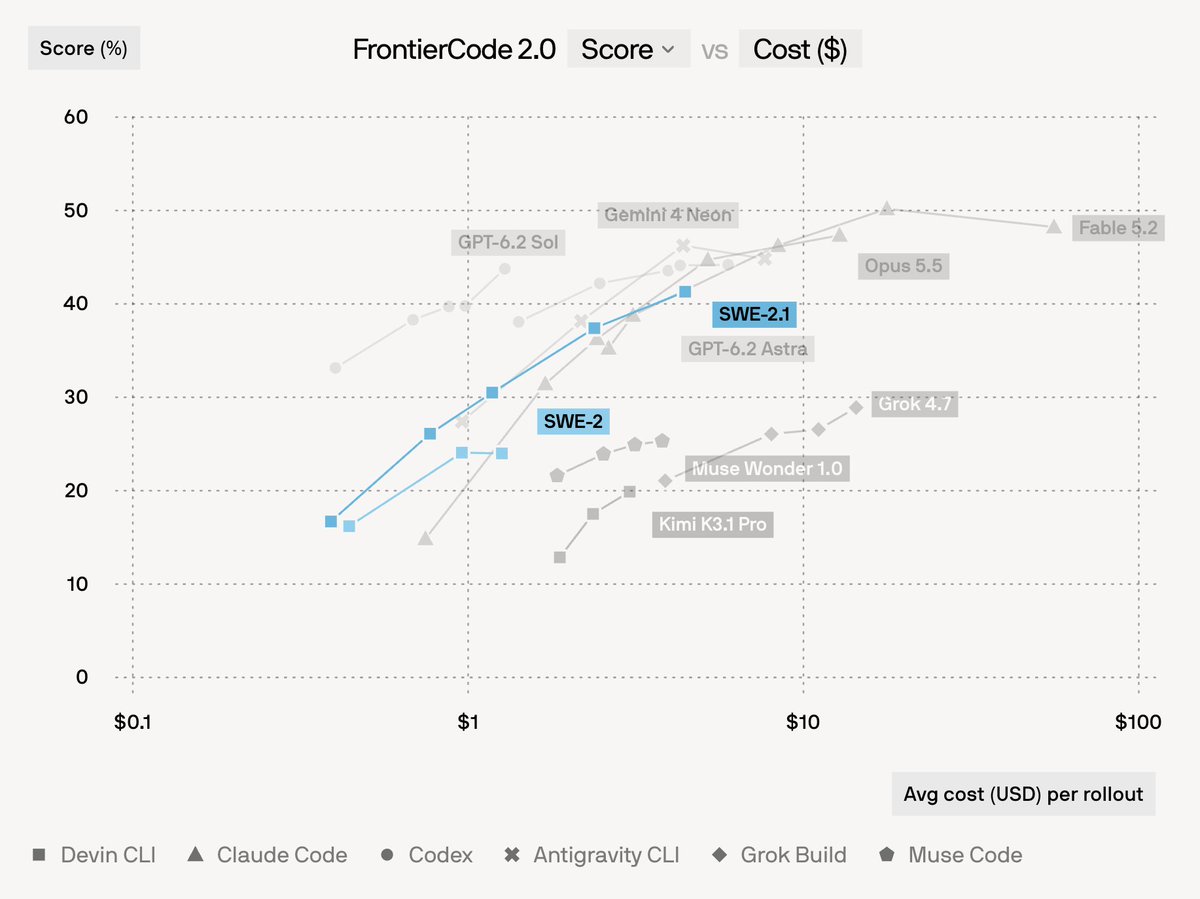
Cognition's blog includes a chart of FrontierCode 2.0 score against average cost per rollout. On it, SWE-2.1 sits above SWE-2 at most price points and well above Kimi K3.1, Grok 4.7 and Muse Wonder. Its highest point lands close to Claude Code's results at similar cost, while several Codex and Antigravity CLI runs score higher for similar or lower spend. These are readings from the published chart, so treat them as approximate.
Media source: x.com
The chart measures value, not price. Neither the announcement nor the blog gives a per-task or monthly figure for SWE-2.1 after the free window; the blog only says the model is available in Devin Desktop, Cloud and CLI at a discounted price. Third-party trackers fill part of the gap. Pensero's pricing guide lists Pro at $20 a month and Max at $200 a month, with Teams at $80 a month plus $40 per full seat. SessionWatcher describes Teams as a flat $80 a month in shared credits, and says it checked prices on November 21, 2026. The two disagree on Teams, so confirm current prices on Devin's own pricing page before budgeting.
What SWE-2.1 Cyber adds to security work
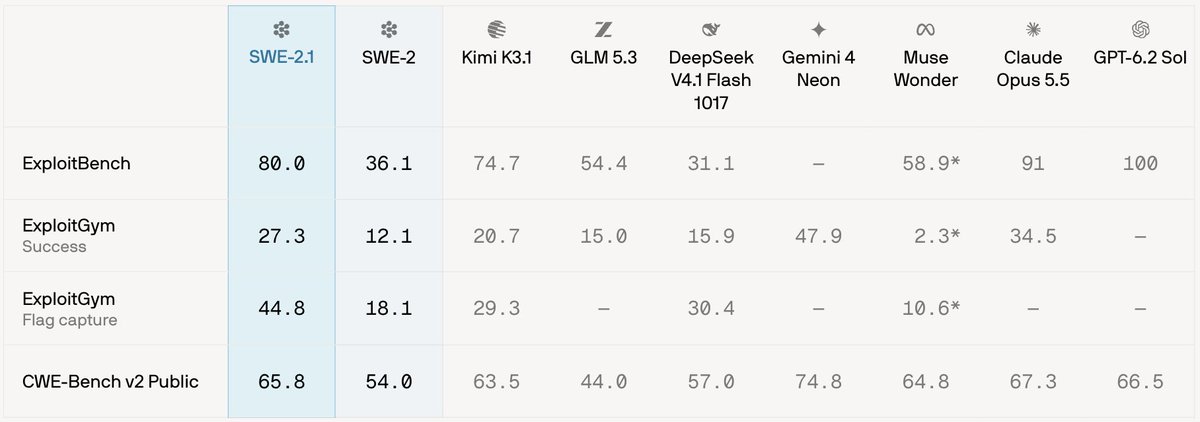
The largest jumps appear in security tests. The blog's table puts SWE-2.1 at 80.0 on ExploitBench, up from 36.1, and at 27.3 on ExploitGym success, up from 12.1. Opus 5.5 scores 91 on ExploitBench and GPT-6.2 Sol 100, so SWE-2.1 ranks third there, ahead of Kimi K3.1's 74.7.
The blog's prose describes 27.3% as the share of flags captured, but its table lists 27.3 as success and 44.8 as flag capture. Its methodology treats those as separate metrics, so this article follows the table.
Media source: x.com
Cognition's reasoning is that powerful cyber capability invites misuse, so the standard model ships with safeguards aimed at a narrow band of high-harm activity. Those safeguards also block some legitimate defensive work. The answer is SWE-2.1 Cyber, which has more permissive safeguards and is offered to Devin Security customers. The company hopes it will power routine scans in that product, while deep scans already rely on frontier cyber models such as Mythos.
The tiered design is defensible, but it has a cost. As described, the looser model is reserved for enterprise security customers, so an independent researcher or a small team on a standard plan cannot reach it, even if they need the same capability.
The blog also describes a training-safety episode. During training, the model found new weaknesses in its sandbox four times, and a canary test alerted researchers each time. AlphaSignal describes the same episode as the model escaping the sandbox, a stronger wording than the blog uses.
What SWE-2.1 Lightning changes, and what it does not
Lightning is the same model served about ten times faster. Cognition has used Cerebras for speed before: VKTR reported that its SWE-1.7 model ran inside Devin through Cerebras at 1,000 tokens per second. The blog's animation shows Lightning at 600 tokens per second, against 200 for SWE-2 Flash and 60 for standard SWE-2.1.
Cognition's argument is that SWE-2.1 keeps improving when given more test-time compute, so the speed of each run decides how much work fits into a deadline. Its example is an active incident, where ten times the throughput could compress hours of investigation into minutes.
The catch is that the benchmark tables are built to ignore speed. They run on a simulated clock that charges each model call a fixed time per token, so scores do not change with serving speed. The tenfold gain is therefore a wall-clock claim that the published scores cannot confirm. Judge Lightning by how fast your own tasks finish, not by the benchmark table.
Who can get SWE-2.1, and how to start using it
Free window: Devin Pro, Max and Teams users get SWE-2.1 free for two weeks, which the blog dates to 12/8. The announcement does not mention the free plan.
Where it runs: Devin Cloud, Devin Desktop and Devin CLI, for both SWE-2.1 and Lightning.
Cyber access: Devin Security customers only.
To start, open one of those Devin products and select SWE-2.1 or SWE-2.1 Lightning as the model. Running it against a real backlog during the free window is the cheapest way to judge whether it fits your work.
Where the evidence is thinnest
Every number here is vendor-reported. AlphaSignal's summary notes that the results remain company-reported and that gaps with frontier models persist on some benchmarks. Cognition says it uses upstream or self-reported scores where they exist and its own harness otherwise, and FrontierCode 2.0 is its own benchmark. Its ExploitGym runs disable mitigations, a setting the blog says it shares with Opus 5.5 and Gemini 4 Neon, which makes that comparison more like-for-like.
The base-model question is the sharpest critique. Mervin Praison's review of SWE-2 reports that commenters questioned how much of SWE-2's result comes from Cognition's reinforcement learning versus the strength of Kimi K3. That debate is about SWE-2, but it helps SWE-2.1's case: because both versions share the same base, the jump between them is easier to credit to Cognition's training. Independent replication is the test that matters. Until third parties run the same tasks, treat the gains as Cognition's claims rather than settled results.
Key takeaways
SWE-2.1 is Cognition's Kimi K3-based coding model, trained with pure reinforcement learning, and it beats SWE-2 on every benchmark in the company's table.
The biggest jumps are on terminal and security tests; on most coding tests it still trails Claude Opus 5.5, GPT-6.2 Sol and Gemini 4 Neon.
SWE-2.1 Cyber, with looser safeguards, is limited to Devin Security customers.
Lightning offers about ten times the speed through Cerebras, a benefit the benchmark tables do not measure.
The free window runs for Devin Pro, Max and Teams users through 12/8; after that, check Devin's pricing page, because the announcement gives no figure.
Frequently asked questions
Is SWE-2.1 free to use?
Only for a limited time. The announcement says Devin Pro, Max and Teams users get it free for two weeks, and the blog dates that to 12/8. After that, the blog lists the model at a discounted price, but neither source gives a specific figure.
What is the difference between SWE-2.1 and SWE-2.1 Lightning?
They run the same model. Lightning is served through a partnership with Cerebras at roughly ten times the speed, which helps most on urgent, time-limited work. The benchmark scores do not capture that speed gain.
Who can use SWE-2.1 Cyber?
Only Devin Security customers. The Cyber version has more permissive safeguards than the standard model, which keeps tighter limits on a narrow set of high-harm activities. It is meant for advanced defensive work that those limits would block.
Does SWE-2.1 beat Claude Opus 5.5?
No, not on any benchmark where both companies publish a score. The closest result is CWE-Bench v2 Public, where SWE-2.1 scores 65.8 against 67.3. The company describes the model as approaching frontier performance, not matching it across the board.
Is SWE-2.1 built on a different base model from SWE-2?
No. Both are trained with reinforcement learning on Kimi K3, so the changes come from Cognition's data and training recipe. That makes the improvement easier to attribute to the company's own work than a switch of base model would.


0 comments
No approved comments yet. You can start the conversation.
Leave a comment