
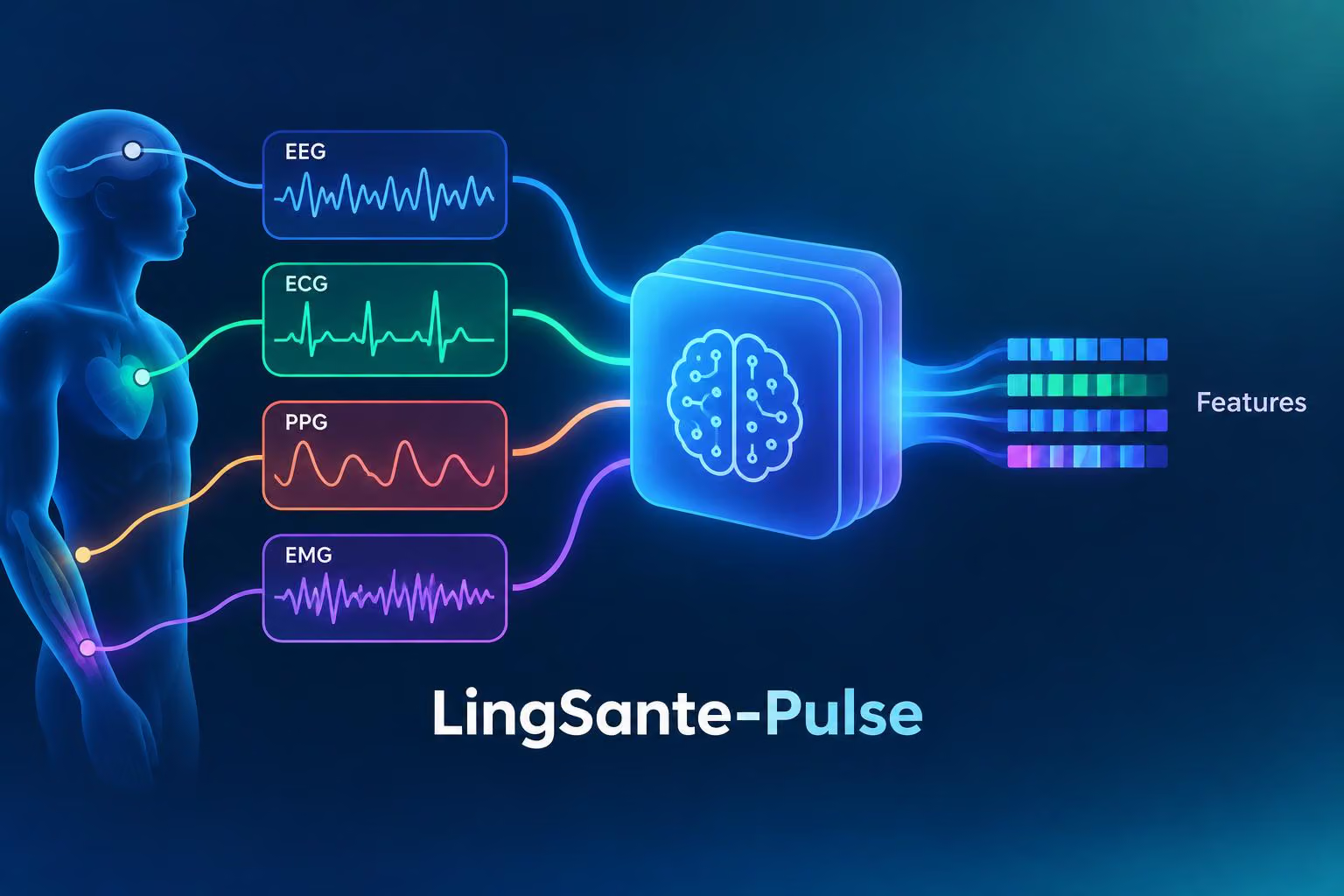
LingSante-Pulse is an open-weight physiological foundation model: a single pretrained encoder that turns ECG, EEG, PPG and EMG recordings into numerical features that other software can use. In its launch thread, the Ant Ling account says the model places first on average across four signal types in 38 task setups, using one frozen network for both multi-sensor and single-sensor inputs.
The release costs nothing to obtain, as far as the sources show. The post says the encoder weights and inference code are available under MIT, and Startup Fortune's report on Ant's Afu app describes the family as being handed out under that licence. Neither the post nor the model page lists a price or paid tier.
The headline numbers are self-reported: they come from the authors' arXiv paper and the chart attached to the post. The arXiv record lists a single version, submitted on 20 November 2026.
What a physiological foundation model outputs
Out of the box, LingSante-Pulse predicts nothing. The Hugging Face page describes it as a signal encoder, and the download contains no layer trained for a particular label. You feed in a waveform, receive feature vectors, and train a small classifier on top. Each input channel contributes 256 values to a CLS output and 256 to a patch-mean output, with optional patch features at 0.25-second intervals. A third-party review of the release puts the model at 16.7 million parameters.
Press coverage tells a different story. A Yahoo Finance report on Ant's Afu app calls LingSante-Pulse a health-prediction model that can assess risk for more than 150 conditions. The model page and the arXiv abstract describe an encoder, so that risk-scoring claim cannot yet be checked against a published model. Another report says Pulse had not been released, which conflicts with a Hugging Face listing that the third-party review dates to 20 November.
How the encoder was trained
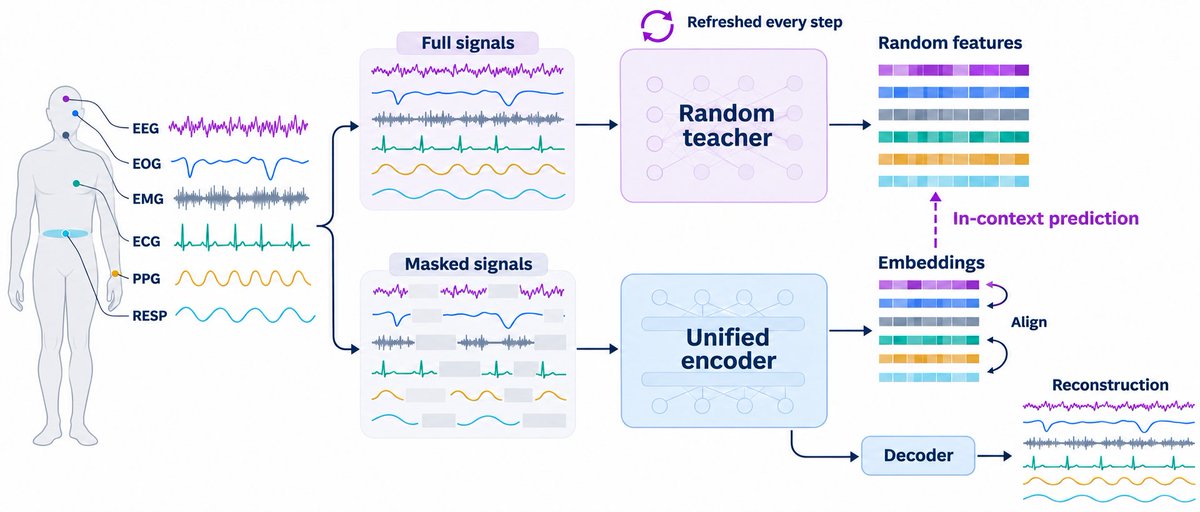
Training uses three objectives at once. One pulls together pairs of channels from the same recording source, another asks the model to predict structured random features, and a third rebuilds hidden stretches of waveform, as the arXiv paper describes. The motivation is practical: clinical monitors and wearables capture partly overlapping sets of signals, so a model that copes with missing channels is more useful than one fixed to a single setup.
Media source: x.com
The authors say the random-feature and reconstruction objectives pull in compatible directions, helping the model hold on to timing and rhythm details. They also report that pairing a respiration signal with a correctly matched companion channel improves features built from respiration alone. Both findings come from the authors' own experiments.
How strong are the benchmark results?
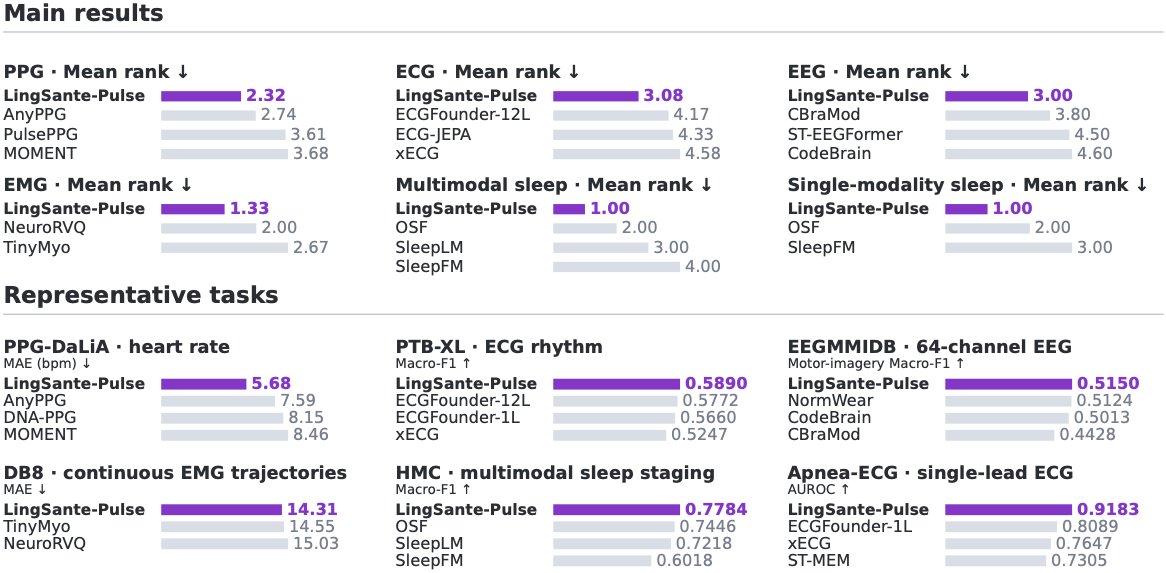
The post's chart puts LingSante-Pulse first on average in each group it shows. Its PPG mean rank is 2.32 against 2.74 for AnyPPG, and both sleep groups score 1.00. Averages can hide small gaps, though. On PTB-XL rhythm classification the model scores 0.5890 Macro-F1 against 0.5772 for ECGFounder-12L, a gap of about 0.012. On EEGMMIDB motor imagery, the margin over NormWear is 0.0026.
Media source: x.com
The most concrete result is heart-rate estimation. The post claims 25.1% lower error than AnyPPG on PPG-DaLiA, and the chart shows 5.68 bpm against 7.59 bpm. Sleep staging is harder to read. The post reports 0.7784 Macro-F1 on HMC, while the SleepFM paper reports mean F1 scores of 0.70–0.78 for sleep staging. The two papers use different data and protocols, so their numbers are not directly comparable. A 0.012 gap is useful for ranking but says little about clinical readiness, especially with absolute scores near 0.6.

Media source: x.com
How it compares with rival models
Most rivals in the post's chart are single-signal models: AnyPPG and PulsePPG for PPG, ECGFounder and xECG for ECG, CBraMod and CodeBrain for EEG, and NeuroRVQ and TinyMyo for EMG. The sleep comparisons include OSF, SleepLM and a model named SleepFM, which appears to be the multimodal sleep model trained on over 585,000 hours of polysomnography. Pulse's distinction is breadth: one frozen encoder across four signal types, rather than one specialist per signal.
Mean rank also depends on the rival set. Leading a short list of named models says less than leading a whole field, so the comparison is worth re-running against your own baseline.
How to start using it
Install the separate inference package before loading the weights, since the Hugging Face page ships the code apart from the model. Its example loads the model, then encodes an array, and asks you to state the true sampling rate and the physical identity of each channel, such as ECG lead II. Inputs can be a single signal, a multi-channel array or a batch, and the package applies fixed 128 Hz preprocessing.
Weights are on ModelScope as well as Hugging Face, and code and examples are on GitHub. Check the install first. The third-party review reported that the Hugging Face repository had no inference code and that no matching package was on PyPI at the time.
Limits and what would confirm the claims
The arXiv paper is a preprint, not a peer-reviewed article, and its results are self-reported. Ant's model cards bar the downloadable models from independent diagnosis or treatment decisions, and the company describes the family as a research tool rather than a medical device, according to Startup Fortune. Any clinical use would need its own validation and regulatory sign-off.
Outside groups reproducing the rankings on public datasets would strengthen the claims, as would a published prediction head with its own benchmarks and a working install from the listed repositories.
Key takeaways
LingSante-Pulse is an MIT-licensed encoder for ECG, EEG, PPG and EMG. It outputs features, not diagnoses.
The headline claim of first place on average across four signal types comes from the developers, and so far there is no outside check.
Some margins are small, such as about 0.012 Macro-F1 over ECGFounder-12L on rhythm classification.
Press reports describe a tool that assesses risk for more than 150 conditions, but the model page describes only an encoder, so treat the risk claim as unverified.
Frequently asked questions
Is LingSante-Pulse free to use?
The post says the weights and inference code are available under MIT, and press coverage describes the family as being handed out under that licence. Neither the post nor the model page lists a price or paid tier.
Can LingSante-Pulse diagnose disease on its own?
No. It produces features only, so you must train and validate your own model on top. Ant's model cards bar using the downloadable models for independent diagnosis or treatment decisions.
Which signals does it support?
It covers ECG, EEG, PPG and EMG, and it accepts one sensor or several. Each input needs its true sampling rate and channel identity.
Where do I get the weights and code?
The weights are on Hugging Face and ModelScope, and the code and examples are on GitHub. Install the separate inference package first and confirm it installs, because the third-party review found no matching package on PyPI at the time.



0 comments
No approved comments yet. You can start the conversation.
Leave a comment