
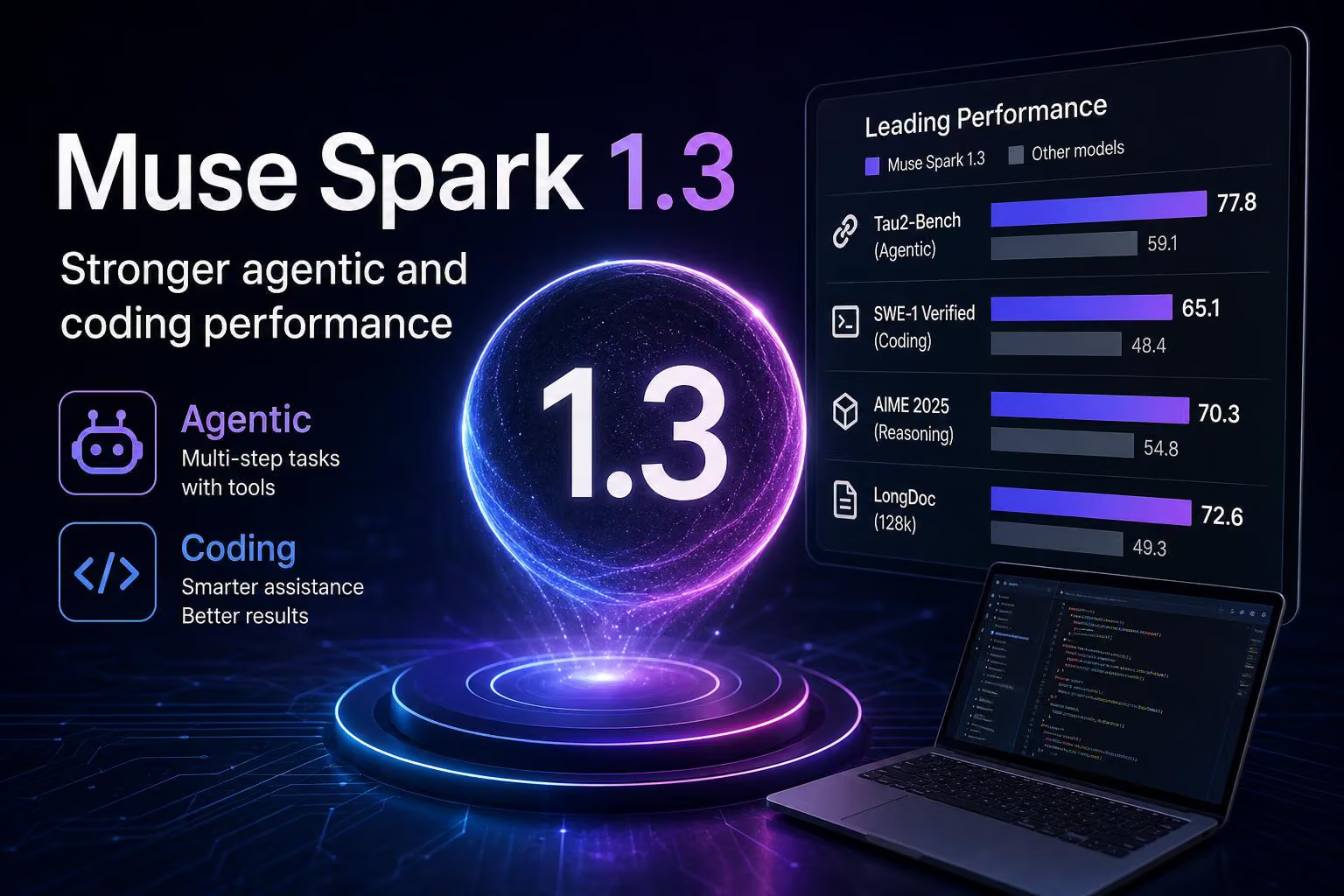
On September 2, 2026, @alexandr_wang announced the release of Muse Spark 1.3, making it available through Muse Code and the Meta Model API. The announcement describes the model as the company’s most capable yet, with stronger agentic and coding performance, improved usability, and a much lower cost target.
What Muse Spark 1.3 is positioned to do
The release focuses on two practical model capabilities: working through multi-step tasks with tools or software, and helping with coding. The post says the model is stronger in both areas and that the usability improvements should be noticeable to users.
That positioning puts Muse Spark 1.3 beyond a general chatbot announcement. Its named distribution channels—Muse Code and the Meta Model API—point to use by developers working directly in coding tools as well as teams integrating model capabilities into their own applications.
The post also characterizes the model as “almost too cheap to meter.” That is a description of the release’s cost positioning, not a published price. Meta hasn't published pricing or usage terms.
Benchmark graphic shows broad performance claims
An accompanying benchmark graphic compares the maximum version of Muse Spark 1.3 with Muse Spark 1.2, GPT 5.6 Sol, and Opus 5 across agentic, long-context, and coding tests.
The graphic reports Muse Spark 1.3 scores of:
1,754 on GDPval-AA v2 for knowledge work
64.9 on JobBench for professional tool use
66.9 on OSWorld 2.0 for agentic computer use
89.4 on DeepSearchQA for agentic browsing
57.8 on the Agentic IF Index for instruction following
49.4 on AutomationBench for end-to-end business workflows
98.5 on MRCR 256K–512K and 98.1 on MRCR 512K–1M for long context
75.4 on DeepSWE v1.1 for long-horizon agentic coding
59.4 on SWEAtlas CodeBase QnA for codebase understanding
88.8 on Terminal-Bench 2.1 for agentic terminal coding
In the graphic, Muse Spark 1.3 has the highest displayed score on most of these comparisons. It is below Opus 5 on GDPval-AA v2, JobBench, and OSWorld 2.0, and below GPT 5.6 Sol on DeepSearchQA and the Agentic IF Index. On Terminal-Bench 2.1, it shares the displayed top score with GPT 5.6 Sol.
These figures suggest a broad performance profile rather than a model optimized for only one task category. The graphic also shows particularly strong results on the two long-context MRCR tests, although the comparison columns for Opus 5 are marked with dashes on those rows.
Availability is the immediate practical change
For developers, the most concrete part of the announcement is access: Muse Spark 1.3 is available in Muse Code and through the Meta Model API. That gives users two routes to try the model—within a coding-focused product or through an API integration.
The release’s usefulness will therefore depend on how the model performs in real workflows, not only on the displayed benchmark scores. For teams evaluating it, the clearest starting points are the tasks highlighted by the announcement itself: coding assistance, tool-using agents, and applications where usability and operating cost affect whether an agent can be used regularly.
Muse Spark 1.3 arrives as a capability-and-cost update aimed at making stronger agentic and coding performance more accessible through both an end-user coding environment and an API.

0 comments
No approved comments yet. You can start the conversation.
Leave a comment