
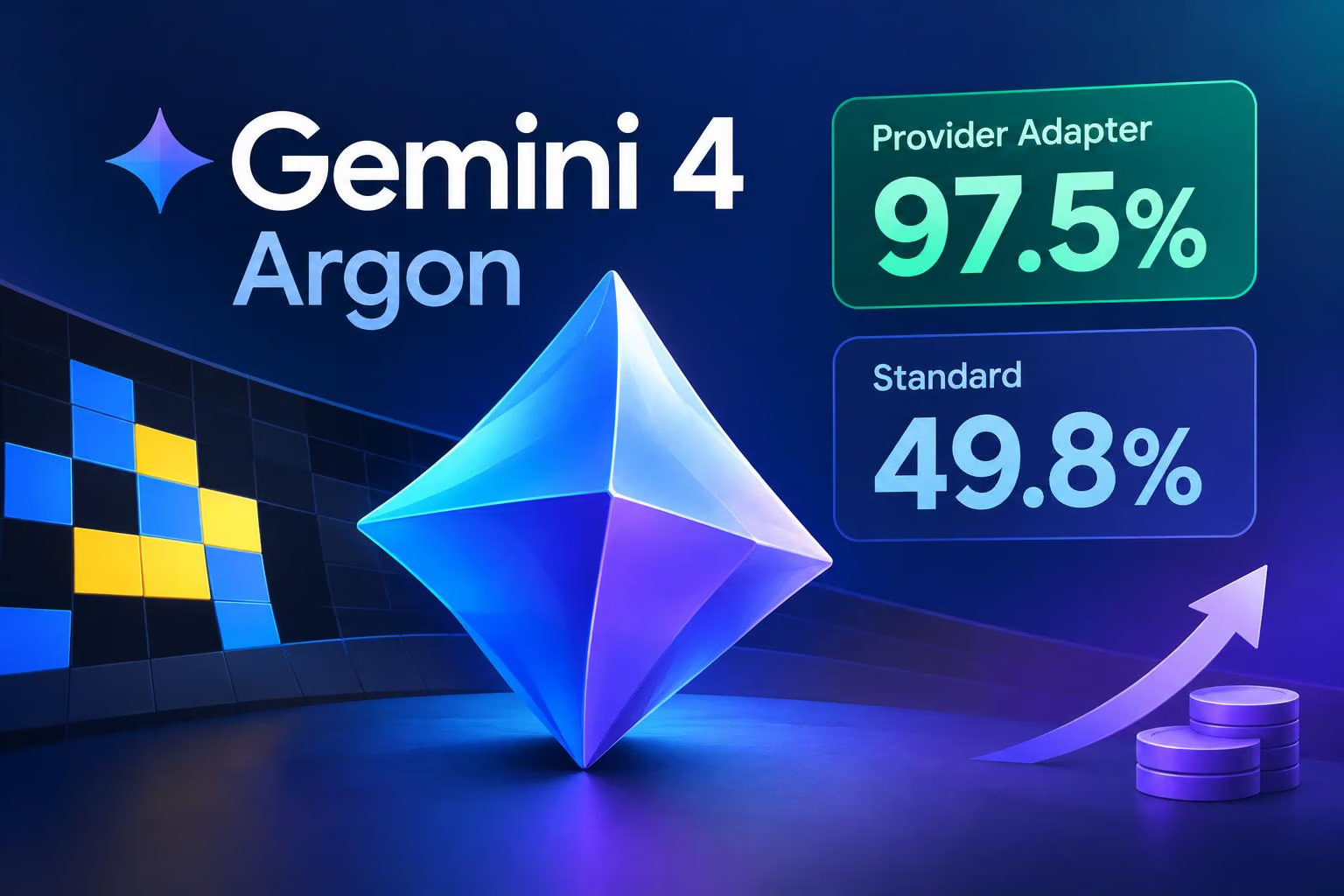
Gemini 4 Argon scores 97.5% on ARC-AGI-3 in ARC Prize's verified testing with the Provider Adapter harness (97.3–97.5% across reasoning levels), but 49.8% on the standard harness, from runs that did not all finish, ARC Prize (@arcprize) reports. ARC priced its runs at Google's introductory $2 per million input tokens and $10 per million output tokens, and Google's Gemini API pricing page doubles both rates on December 1, 2026.
Our take: the number to judge is what Argon delivers for its price. On the harder interactive test it is far ahead of Gemini 3.8 Flash under both harnesses, with the biggest gap under the Provider Adapter harness, and the price ARC tested at is a limited-time one.
Google's pricing page lists the model ID gemini-4-argon with paid-tier API rates and "Not available" for the free tier, which suggests it is callable through the paid API. OfficeChai's coverage says the model "remains limited mostly to trusted testers", and our earlier announcement coverage described a trusted-tester rollout.
What ARC-AGI-3 measures and how Argon was tested
ARC-AGI-3 is an interactive reasoning benchmark in which AI agents explore novel game environments, work out goals on the fly and are scored on how efficiently they learn; 100% means beating every game as efficiently as humans. ARC Prize Foundation ran Argon, and its results page is dated October 13, 2026.
ARC reports ARC-AGI-3 under two conditions and, per its testing policy, labels and publishes them separately because they answer different questions:
Standard harness: a minimal, provider-neutral interface where the model carries forward only the notes it chooses to keep.
Provider Adapter harness: uses provider-designed context management, preserving the model's opaque reasoning state between requests and compacting longer conversations so it can reuse prior work.
Which setting produced each number
The three headline figures in the post come from different reasoning levels. According to ARC's results page, the best ARC-AGI-1 and ARC-AGI-2 scores (98.5% and 91.3%) are at high reasoning, while both headline ARC-AGI-3 figures (49.8% standard, 97.5% adapter) are at low reasoning.
Reasoning level | ARC-AGI-1 | ARC-AGI-2 | ARC-AGI-3, standard harness | ARC-AGI-3, Provider Adapter harness |
|---|---|---|---|---|
High | 98.5% | 91.3% | not published | 97.3% |
Medium | 98.5% | 87.1% | 46.3% | 97.3% |
Low | 76.5% | 42.1% | 49.8% | 97.5% |
The adapter results barely move with reasoning level (97.3% to 97.5%), while ARC-AGI-1 and ARC-AGI-2 drop sharply at low reasoning. The standard-harness column is incomplete: ARC says API issues stopped the evaluation from finishing, with runs completed on 42 of 55 tasks at low reasoning, 46 of 55 at medium and 19 of 55 at high. Reported scores count all 55 tasks and keep partial credit from unfinished runs, and ARC left the high-reasoning standard point off its chart. In these runs low reasoning (49.8%) scores above medium (46.3%). With coverage incomplete, the standard-harness scores are not clean measurements.
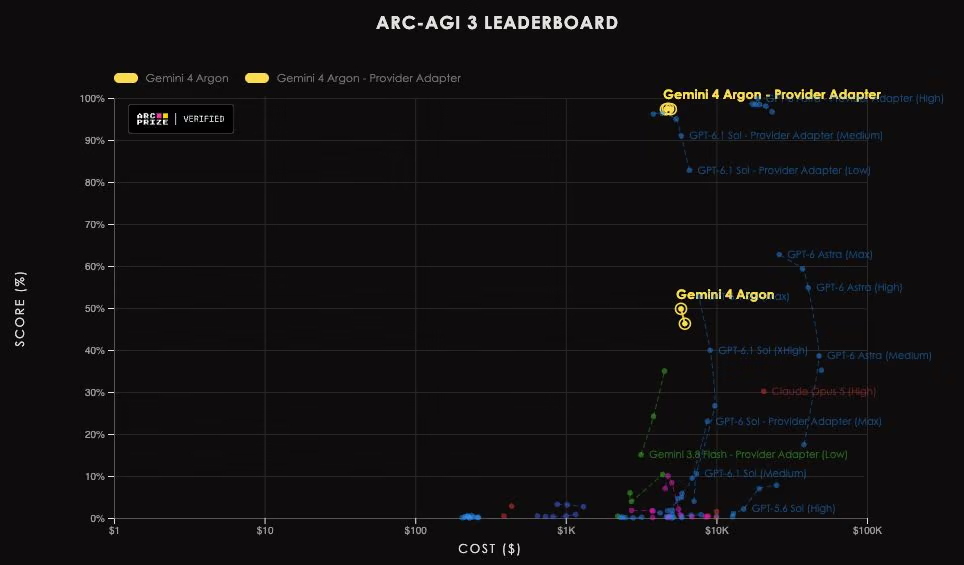
Image credit: @arcprize on X
How Gemini 4 Argon compares
ARC's results table puts Argon alongside its closest family member and two OpenAI entries:
Model | ARC-AGI-1 | ARC-AGI-2 | ARC-AGI-3 |
|---|---|---|---|
Gemini 4 Argon | 98.5% | 91.3% | 97.46% |
Gemini 3.8 Flash | 98.5% | 89.2% | 35.00% |
GPT-6.1 Sol | 98.5% | 94.2% | 96.37% |
GPT-6 (Astra · Sol · Luna) | 98.5% | 95.0% | 99.95% |
The table does not label the harness per row. For Argon and Gemini 3.8 Flash, the ARC-AGI-3 figures match the Provider Adapter results on their own pages. ARC says Google DeepMind is the second frontier lab above 95% on ARC-AGI-3.
Against Gemini 3.8 Flash, the gap depends on the test. Argon ties it on ARC-AGI-1 and is 2.1 points ahead on ARC-AGI-2. On ARC-AGI-3 it is 62.5 points ahead with the adapter (97.5% vs 35.0%) and 39.4 points ahead on the standard harness (49.8% vs 10.4%). Flash's results page gives its best standard and adapter scores at high reasoning, not low. On ARC-AGI-2, GPT-6.1 Sol is 2.9 points above Argon and the GPT-6 entry is 3.7 points above.
Gemini 4 Argon API price and the December 1 step-up
All Argon rates on Google's pricing page are paid-tier, per 1M tokens, and each rate doubles on December 1, 2026:
Tier | Input to Nov 30 | Input from Dec 1 | Output to Nov 30 | Output from Dec 1 |
|---|---|---|---|---|
Standard | $2.00 | $4.00 | $10.00 | $20.00 |
Batch and Flex | $1.00 | $2.00 | $5.00 | $10.00 |
Priority | $3.60 | $7.20 | $18.00 | $36.00 |
Cached input on Standard goes from $0.10 to $0.20, and Google lists implicit caching only (explicit caching is not supported). ARC's $2/$10 cost basis is the Standard rate; Batch and Flex are half that, so the run costs below are Standard-tier figures, not Batch or Flex ones.
Because both Standard rates double, any mix of input and output tokens costs exactly twice as much from December 1. Assuming the same token use, Standard tier and no caching, ARC's roughly $4.8K Provider Adapter run would cost about $9.6K and its roughly $5.8K standard-harness run about $11.6K. That later standard-harness figure is above the $10,000 per-run cap in ARC's testing policy. ARC's post also lists $0.16 per task on ARC-AGI-1 and $0.32 per task on ARC-AGI-2, which would become $0.32 and $0.64. The ARC-AGI-2 chart plots Argon at three reasoning levels; its lowest-cost point sits under about $0.10 per task near 42%, and its top point near 91%.
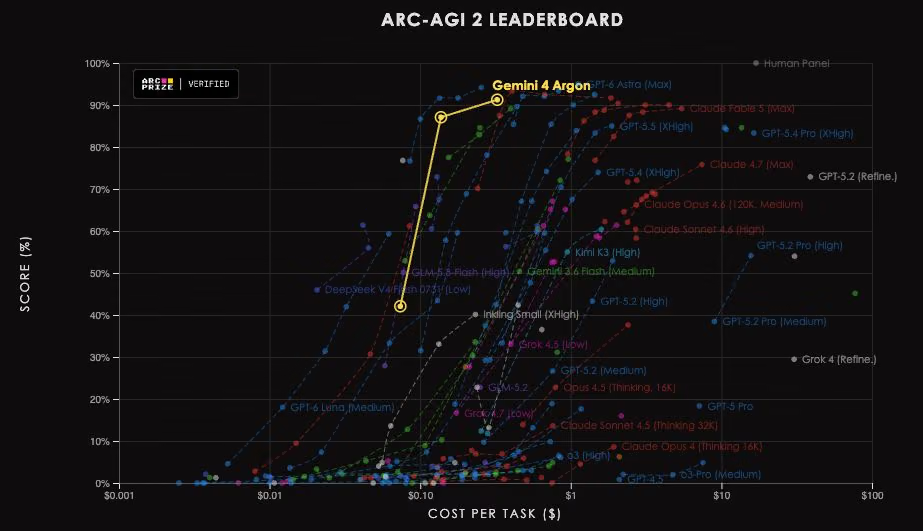
Image credit: @arcprize on X
The Flash comparison shifts less. Gemini 3.8 Flash costs $0.75 input and $3.75 output through December 31, 2026, then $1.50 and $7.50. Argon is 2.67× Flash's list price at both the introductory and later rates. In December, before Flash's step-up, the gap widens to 5.33× on both input ($4.00 vs $0.75) and output ($20.00 vs $3.75).
Our read: the higher list price buys little on ARC-AGI-1, a modest gain on ARC-AGI-2 and a large gain on the interactive ARC-AGI-3 test. Two caveats apply. Argon's ARC-AGI-3 scores here are low-reasoning ones set against Flash's high-reasoning ones, and these are list prices only, so actual cost per task also depends on how many tokens each model uses and at which reasoning level.
What the score does and doesn't tell you
ARC-AGI-3 scores the model together with its scaffolding, and it measures game environments rather than coding, tool use or long-context work. Test Argon in your own agent loop, and budget with the December rates rather than the introductory ones.
0 comments
No approved comments yet. You can start the conversation.
Leave a comment