
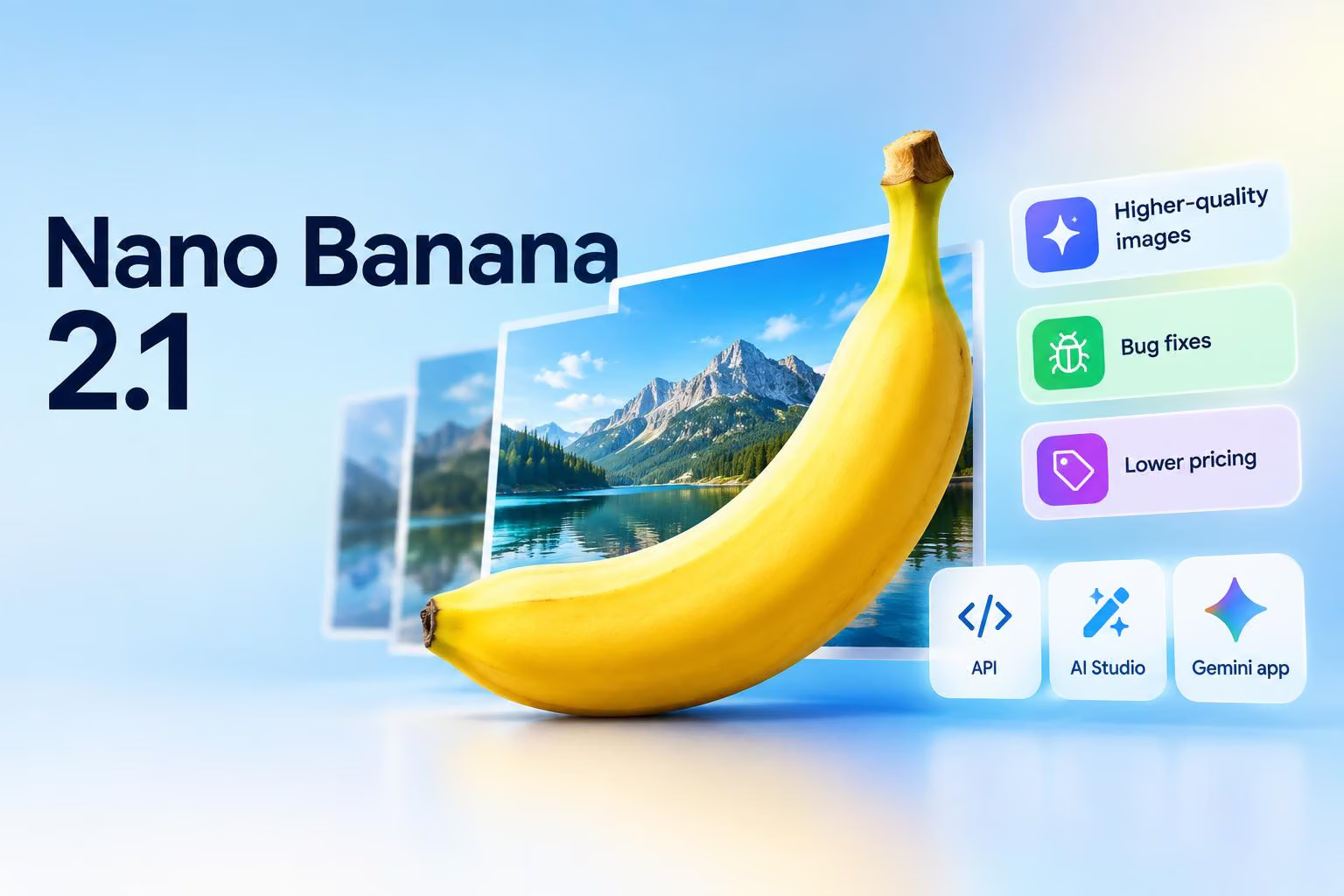
Nano Banana 2.1 is Google's updated image generation and editing model, announced on October 6, 2026. Logan Kilpatrick's post on X says it brings higher-quality images, many bug fixes from earlier models and a lower price, with access through the API, AI Studio and the Gemini app.
The post gave no figures, but Google's price list now fills the gap: the 1K rate is $0.0336, roughly half the $0.067 that Nano Banana 2 costs. The quality and bug-fix claims remain unmeasured.
What does Nano Banana 2.1 cost through the API?
Standard rates are $0.0336 for a 1K image and $0.0504 for 2K, and batch requests are billed at half, according to BenchLM's pricing table. The 4K figure is where sources disagree. A news report on the launch puts it at $0.113, while BenchLM lists $0.0756. Check the live price list before budgeting for the largest size.
Image output is now billed at $30 per million tokens, against $60 for Nano Banana 2. Prompts, however, cost $1.50 per million tokens, triple the earlier rate, and the API has no free tier. A worked example from AIFreeAPI prices a 1K image with 1,000 prompt tokens at $0.0426, against $0.0705 on Nano Banana 2. The image itself is cheaper, but a team sending long, detailed prompts will save less than the headline cut implies.
What changed from Nano Banana 2?
The post names quality gains and bug fixes without specifics. One guide to the launch summarises Google's own statements as claiming gains in visual design, mask-based editing and keeping a subject consistent. Those remain company claims, and no independent benchmarks are cited in the sources behind this article.
A developer overview from OrcaRouter lists up to 14 reference images, 1K to 4K output and SynthID watermarking on every image. Nano Banana 2 offered a 512-pixel option at $0.045, but 2.1 does not offer that size. Price is the one change with concrete numbers; the quality gains are the part readers should test on their own images.
Where can you use Nano Banana 2.1, and is it free?
Developers call the model through the Gemini API under the ID gemini-nano-banana-2.1, listed as stable. The post also names AI Studio, though the sources behind this article do not describe its limits. In the Gemini app, one guide reading Google's app page says free accounts stay on Nano Banana 2 while 2.1 needs a paid Google AI plan. Another report adds that each plan's daily image limits apply.
Teams on the older model face a deprecated Nano Banana 2 with no shutdown date set. According to ToolColumn's pricing guide, Google recommends 2.1 for new projects.
How does 2.1 compare with Nano Banana Pro and 2 Lite?
At 1K, Nano Banana Pro costs $0.134 per image against $0.0336 for 2.1, about four times as much. Google frames Pro as its pick for intricate professional tasks, so price alone does not settle the choice. Nano Banana 2 Lite matches 2.1 at 1K but offers no 2K or 4K output. For larger images at the lowest entry price, 2.1 is the more flexible option.
Key takeaways
- The 1K and 2K API rates roughly halved, while the 4K cut is smaller and reports disagree on its exact figure.
- Prompt tokens cost more, so savings shrink for long, detailed prompts.
- The quality and bug-fix gains are Google's claims, so test them on your own images before switching.
Frequently asked questions
Is Nano Banana 2.1 free to use?
Not through the Gemini API, which has no free tier. In the Gemini app, a guide reading Google's app page says free accounts stay on Nano Banana 2, while 2.1 needs a paid Google AI plan.
Is Nano Banana 2.1 better than Nano Banana Pro?
It costs far less per image, though Pro remains the choice for intricate professional work. One ToolColumn guide says Google's model card ranks 2.1 above Pro on every row, a claim not independently confirmed.
What is the Nano Banana 2.1 API model ID?
It is gemini-nano-banana-2.1, listed as stable on the Gemini API.
Sources
- Logan Kilpatrick (@OfficialLoganK) on X
- Google moves free Gemini to Flash-Lite and launches Nano Banana 2.1, The Next Web
- Nano Banana Pricing, BenchLM
- Nano Banana 2.1 price and features, Roo
- Nano Banana 2.1 overview, Fello AI
- Nano Banana 2.1 family and pricing, OrcaRouter
- Nano Banana 2.1 access and API pricing, AIFreeAPI
- Nano Banana 2 vs Pro (and 2.1), Swap Biswas
- Nano Banana 2.1 API pricing, LaoZhang
- Nano Banana Pricing, Plans and Limits, ToolColumn
0 comments
No approved comments yet. You can start the conversation.
Leave a comment