
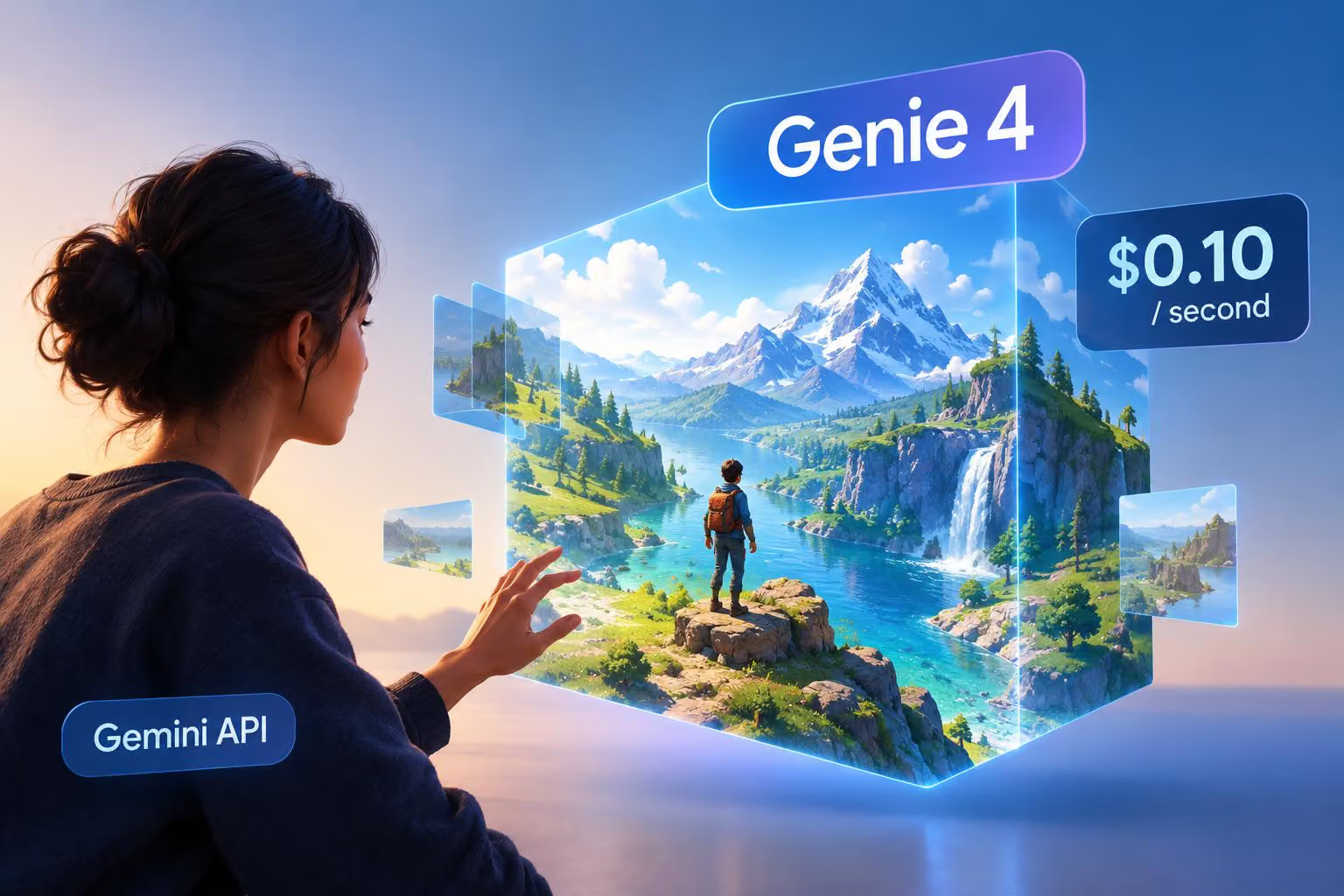
The Gemini API and Google AI Studio now give developers access to Genie 4, Google's real-time world model. A post from @OfficialLoganK on X calls it the first world model Google has built for developers. Access is paid only, and the reported rate is about $0.10 per second of generated world, or roughly $6.05 a minute.
Genie 4 was first announced on October 27 as a research preview for trusted testers. Project Genie opened to eligible Google AI Ultra subscribers before the developer release followed on November 19, 2026.
What Genie 4 produces in the Gemini API
A world model generates an environment you can move through, not a fixed clip. Developers supply words, a picture or both, and the model returns continuous 720p worlds at 24 frames per second. Sound is produced in sync with the visuals and can include background ambience, effects and characters speaking. The model's Gemini layer keeps the scene's state consistent over time. You steer it live with the keyboard, and typed prompts can alter the weather, the lighting, objects or events while the scene runs. Google applies an imperceptible SynthID watermark to every result.
The practical upshot is that Genie 4 works as a building block for interactive products rather than a finished app, and every second of output carries a cost.
How does Genie 4 differ from Genie 3?
Google released Genie 3 as a research preview a little over a year before Genie 4 arrived, and later offered it to subscribers through a web interface called Project Genie). The real-time approach carries over. According to Google's announcements, Genie 4 adds three things:
Sound. The model produces its own audio, which DeepMind presents as a first for its real-time world models.
Physics. DeepMind says the model handles physical behaviour such as aerodynamics and collisions.
Gemini underneath. The October announcement says Gemini Omni keeps scenes looking and behaving realistically, while other Gemini models supply the reasoning that holds a long event together.
The bigger change for builders is access rather than raw capability. Genie 3 reached people through a consumer interface, while Genie 4 is the first in the line that developers can call from code. DeepMind also stresses that the model is early-stage and experimental.
Who can use Genie 4, and on which plan?
Developers reach Genie 4 through the Interactions API on the paid tier of the Gemini API, and it also appears in Google AI Studio. Per a third-party breakdown of Google's pricing page, this model is excluded from the free tier and from the Batch, Flex and Priority options.
Consumers have a separate route. Eligible Google AI Ultra subscribers can use Genie 4 in Project Genie, and Google AI Pro members can join a waitlist. The Ultra plan starts at $99.99 a month, but Google has not said how much Genie 4 usage it includes or whether API rates will change after launch.
How much does Genie 4 cost to use?
Pricing is reported at roughly $0.10 per second, which equals about $6.05 a minute. That works out to about $363 for an hour of generated world. The $363 figure is the report's own arithmetic rather than a published Google price, so confirm the rate on Google's Gemini API pricing page before budgeting.
Per-second billing changes the maths. At the reported rate, a ten-minute test session costs about $60, and a demo left running for an hour can cost hundreds of dollars, so session time limits and caps on concurrent users are worth setting early. Google's text models are priced per million tokens instead, which makes Genie 4's meter a different kind of bill.
How to start using Genie 4 in Google AI Studio
Google's launch post points to three kinds of work: testing interactive ideas, mocking up spatial designs, and training robots and agents. Robotics already has a precedent. According to Wikipedia), the Waymo World Model, a variant built on Genie 3, simulates edge cases for robotaxis.
1. Open Google AI Studio and begin with the canvas and starter apps, where you can experiment with prompts. 2. Turn on billing and set a budget alert, since this model has no free tier. 3. Before writing production code, check the rate and the API reference that Google links from its launch post. 4. Begin with a reference image and a short prompt, then change the prompt mid-session to see how well the world holds together.
What to watch as Genie 4 reaches developers
Watch the per-second rate first. Before you commit, check the current rate, the size of any Ultra allowance and whether Google changes API billing after launch. The 720p output is enough for prototypes and demos but well short of most finished productions, so teams should test whether it meets their quality bar.
Competition is intense. TechCrunch reported that Runway's GWM Worlds 2 arrived a couple of months before Genie 4. Markets have already noticed this line: Startup Fortune reports that Genie 3 sent Unity's shares down by more than a fifth in one session. That history suggests game-engine companies and simulation tools will be watching developer adoption closely.
Key takeaways
Genie 4 is available to developers in the Gemini API and Google AI Studio from November 19, 2026, following an October 27 research preview.
It generates continuous 720p, 24fps worlds with native audio, steered by keyboard controls and typed prompts.
API access is paid only, at a reported rate of about $0.10 per second, or roughly $363 an hour by one report's arithmetic.
Consumers reach the model through Project Genie on Google AI Ultra, with a waitlist for AI Pro members.
Frequently asked questions
Is Genie 4 available in the Gemini API now?
Yes. Developers can call it through the Interactions API, and it also appears in Google AI Studio. Before this, access was limited to trusted testers and early partners.
Is Genie 4 free to use?
Not through the API. Reported pricing excludes the free tier, Batch, Flex and Priority inference. Consumer access runs through Project Genie on Google AI Ultra, which starts at $99.99 a month.
What can Genie 4 generate?
It produces a live 720p environment running at 24 frames per second, with sound in step with the picture. The world can be built from words, a picture or both, and you can move through it with the keyboard while typing prompts to change its conditions.
How can you tell Genie 4 output is AI-generated?
Google states that generated results are marked with SynthID, a watermark designed to be invisible to viewers. The launch materials do not explain how a viewer can check that mark.
0 comments
No approved comments yet. You can start the conversation.
Leave a comment