
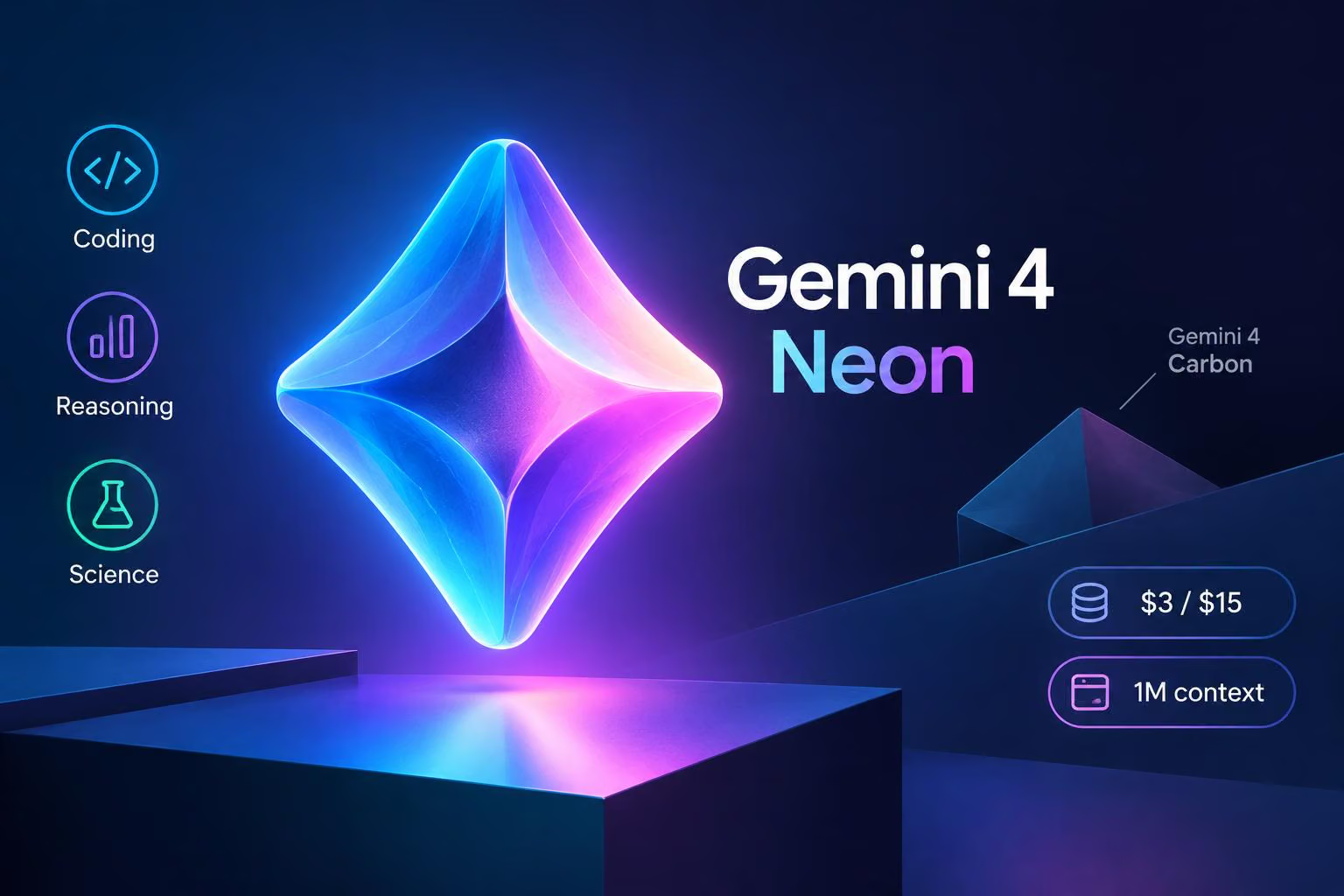
Gemini 4 Neon is Google's new model for complex coding, analytical reasoning and science work, built for users who need speed and cost control as much as raw capability. Google's announcement post gives its price as $3 per million input tokens and $15 per million output tokens, with a 1 million-token context window. It launched on November 18, 2026, across the Gemini API, Gemini for business, Google Antigravity and the Gemini app, though each route has its own plan requirements.

Media source Google AI Studio’s X Article
The short answer is that Neon sits just below the top of Google's lineup while costing less to run. The longer answer depends on the yardstick. Most figures here come from Google's announcement and from third-party benchmarks it chose to cite, and this article flags where independent sources disagree.
What is Gemini 4 Neon, and where does it fit?
Neon occupies the middle rung of the Gemini 4 lineup, between Hydrogen and Carbon, and 9to5Google reports that Argon is being succeeded by Neon. Carbon and Hydrogen arrived about a week earlier. Artificial Analysis counts Neon as Google's fourth model in roughly seven weeks.

Media source Google AI Studio’s X Article
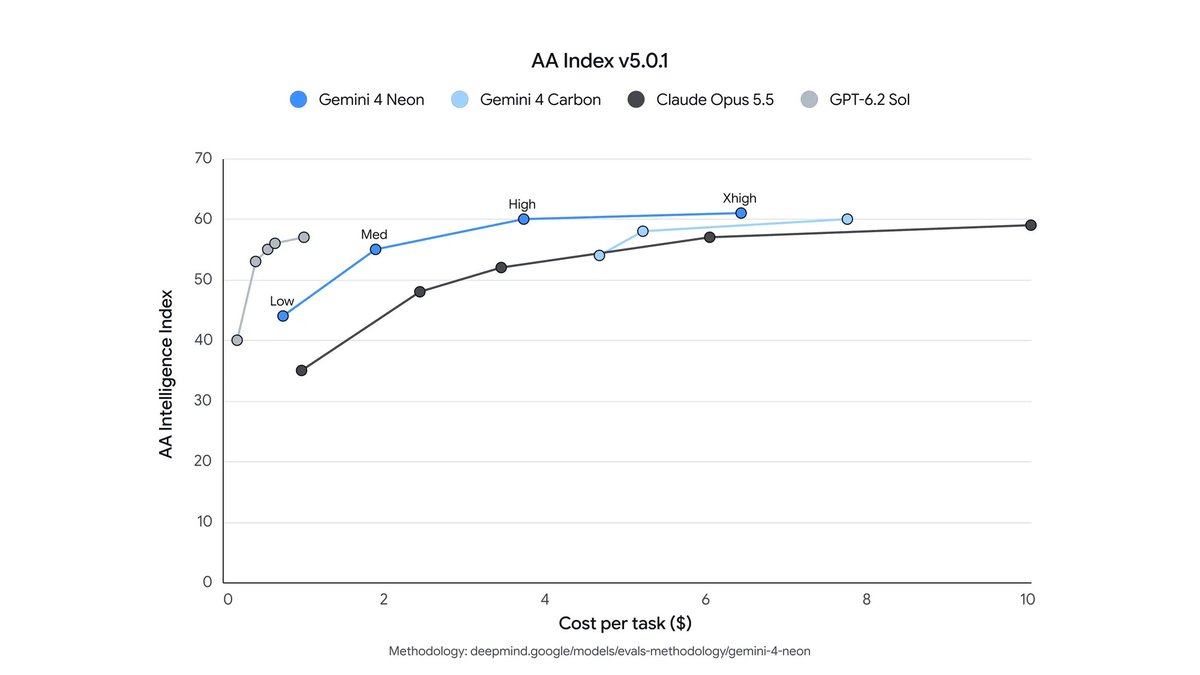
In Google's framing, Neon trades a little depth for speed and cost. The independent index is less clear-cut. Artificial Analysis places Neon's xhigh run at 61 points, third overall, behind two models it names: GPT-6.2 Astra and Claude Fable 5.2. That xhigh result is one point above Carbon's high setting, so on this measure the depth gap is hard to see. The announcement also ranks Neon third but says only that it lands just behind larger, slower models, without naming them.
The announcement adds two behaviour claims: second place on steerability, meaning how well the model takes corrections partway through a task, and a record-low fabrication rate in internal Antigravity tests.
How much does Gemini 4 Neon cost per token and per task?
Google lists $3 per million input tokens, $15 per million output tokens and $0.15 per million cached input tokens, which it calls a 95% discount. 9to5Google reports that the $3 and $15 rates are promotional and that prices rise to $4 and $20 once the promotion ends. Budget against the higher figures until the API documentation confirms the rate.
List price is only half the story. A cheaper model that spends many more tokens per job can cost more overall, so cost per task is the number to watch. Google says Neon at its default high setting costs 32% less per task than Carbon. Against leading rival models, it puts the saving at roughly half to four-fifths on the Vals Index and Agent Arena. Artificial Analysis reports a smaller gap of about 17% against Carbon, and says that at high effort Neon costs less than half as much per task when Carbon is measured at its standard, non-discounted pricing. Because the two baselines differ, the defensible conclusion is that Neon is clearly cheaper per task, by somewhere between about a sixth and more than half.
Media source Google AI Studio’s X Article
Who can use Gemini 4 Neon, and how do you start?
Access depends on where you work:
Developers: the paid tier of the Gemini API in Google AI Studio and Android Studio. The model ID is gemini-4-neon, as listed on Google Cloud's model page.
Antigravity users: paid Google AI Pro and Ultra subscribers can use Neon in the desktop app, the CLI and IDE extensions, according to Google's Antigravity blog.
Enterprises: Gemini for business, through the API or the model drop-down. Enterprise access is limited to verified customers in select regions, per the developer's guide.
Consumers: Pro and Ultra subscribers can choose Neon from the model drop-down in the Gemini app. Free accounts and AI Plus subscribers are left out, according to the Felloai guide.
Rollouts are staged, so the model may take time to appear in your account.
Developers moving off older models have a stated path. Google's developer guide names Neon as the upgrade target for Gemini 3.1 Pro and for Argon on the API. Under the API, input, output and thinking tokens draw on one budget of about 1,048,576 tokens, where Gemini 3 models kept separate allowances. Inside Antigravity, the Orchestrator feature lets Neon plan while Hydrogen carries out the steps, all within one session.
How does Gemini 4 Neon compare on benchmarks?
On the Vals Index, Neon places second with 70.9%. Google also reports first place on the Legal Research Bench, the Tax Agent Bench and Zapier's AutomationBench (56.3%). In Andon Labs' Vending-Bench 2, a simulation of running a business over the long term, the model scored $16,843. On Arena's new Agent Arena Index it is second, with a score of 1336 across more than 4,200 agent sessions.

Media source Google AI Studio’s X Article
Digital Trends describes Neon as topping the Vals Index, but the announcement places it second there, so check the figure you quote.
Two cautions apply. Most rankings are Google's readings of benchmarks it selected, and a first place on one leaderboard can sit beside a third place on another. The most useful independent number is the Artificial Analysis index, which puts Neon third. Google also says Neon sits on the Pareto frontier. In plain terms, that means no rival beats it on both quality and cost at the same time, on the Vals Index and Agent Arena at high.
What does Neon change for developers?
The announcement describes Neon as built for long agent runs that use many tools. It reads the same files less often, shares progress as it works, and handles context compaction in long sessions. It ranks first on the Artificial Analysis Coding Agent Index with 58.6, and scores 65.2% on Terminal-Bench 4.1 and 46.2% on FrontierCode 2.0 at its default high setting.
The harness effect is the most useful detail for teams. On SWE-sweep, the model scores 12.8% on the mini-SWE harness but 39.0% inside Antigravity. That more-than-tripling suggests the tool wrapper can matter as much as the model, so run your own evaluation inside the environment you intend to use.
The demonstrations are curated: a WebGL2 ski simulator, a 3D recreation of Alan Turing's 1936 study and a 100,000-cell spreadsheet, all built with /swarm. They show what the model can reach with a strong harness, not what a typical prompt will produce.
Media source Google AI Studio’s X Article
How do the four thinking levels change cost and speed?
9to5Google lists Neon's thinking levels as Low, Medium, High and Extra High. High is the default. Xhigh adds deeper multi-step reasoning, and it is the setting behind the 61-point Intelligence Index score. The best-known cost claim refers to High, so the headline ranking and the headline saving describe different settings. Route routine work to lower levels, reserve Xhigh for hard problems, and measure cost per task on your own jobs.
What does the cyber variant and safety data show?
Google is offering a cyber-focused version to trusted defenders through the Fairwind Program, with access arriving over the coming days. Google reports that it writes more secure code than Carbon on AutoBaxBench, reaching 76% on the hardest tier. It also reports 90.5% on SEC-bench Pro at roughly half the cost per challenge.


Media source Google AI Studio’s X Article
On safety, Google says Neon keeps the same protections against severe misuse and prompt injection as Carbon. It refused 1.98% of tasks on Terminal-Bench 4.0 and matched Carbon's 0.0% cheating rate there. On Gray Swan's indirect prompt injection benchmark, it resisted every attack at its highest thinking level. These are Google's own evaluations, so treat them as the company's account until outside testers publish their results.

Media source Google AI Studio’s X Article
Key takeaways
Gemini 4 Neon sits between Hydrogen and Carbon in Google's lineup, priced at $3 and $15 per million tokens with a 1 million-token window, and those prices are reported as promotional.
Google claims a 32% lower cost per task than Carbon at the default setting, while Artificial Analysis finds a gap nearer 17%.
Access runs through the paid Gemini API, Gemini for business, paid Pro and Ultra plans in Antigravity and the Gemini app, and free accounts are excluded from the app.
On Artificial Analysis's index, Neon at xhigh sits one point above Carbon at high, so its cost saving does not obviously come from a large drop in capability.
Most benchmark wins are Google's readings of selected tests, so run an evaluation on your own work inside the tools you plan to use.
Frequently asked questions
When was Gemini 4 Neon released?
Google's model page gives November 18, 2026 as the release date, the same day as the announcement post. The cyber variant follows separately, with Fairwind Program members receiving access over the next few days.
How much does Gemini 4 Neon cost?
The announced rate is $3 per million input tokens and $15 per million output tokens, with cached input at $0.15. 9to5Google reports these rates are promotional and that prices will rise to $4 and $20 afterwards. Confirm the current rate in the API documentation before you budget.
How is Gemini 4 Neon different from Carbon?
Google positions Carbon for the hardest long-horizon projects and Neon for complex work that runs more often. Google says Neon costs 32% less per task than Carbon at its default high setting, while Artificial Analysis reports a smaller gap of about 17%. Artificial Analysis also puts Neon's xhigh score one point above Carbon's high score.
Can I use Gemini 4 Neon for free?
The announcement lists only paid routes: the paid Gemini API tier, Gemini for business, and Pro and Ultra subscriptions for Antigravity and the Gemini app. The Felloai guide reports that free Gemini users and AI Plus subscribers do not get Neon.
Is Gemini 4 Neon better than other frontier models?
It depends on the test. Artificial Analysis ranks Neon third on its Intelligence Index, behind two named models, while Google's announcement highlights first-place finishes on several agent and coding benchmarks. Test it on your own tasks before choosing it over a rival.

0 comments
No approved comments yet. You can start the conversation.
Leave a comment