
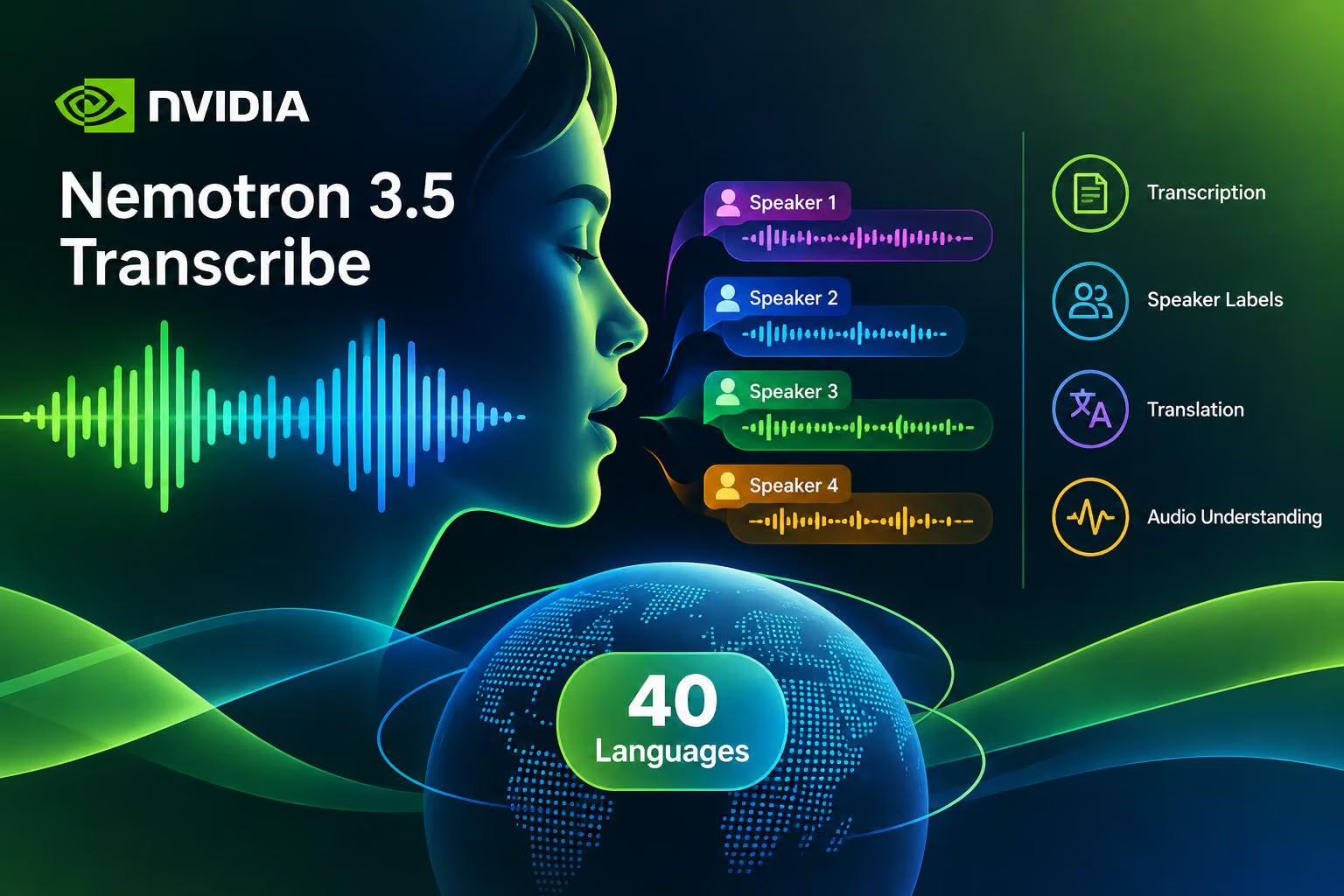
NVIDIA AI announced Nemotron 3.5 Transcribe, an open-weight speech model that handles transcription, speaker attribution, translation and audio understanding in one checkpoint. It is a 30B mixture-of-experts model with about 4B active parameters, released on October 28, 2026, and available on Hugging Face and ModelScope.
What it does
Languages: it transcribes 40 languages and translates 31 of them to or from English.
Speakers: it attributes speech to speakers in 13 languages, labelling up to eight speakers in recordings up to one hour long.
Prompt control: each request can include a natural-language instruction that sets the output style, with no retraining. Examples from the coverage include 'Transcribe this recording and label each speaker', 'Translate this audio into English' and 'Transcribe without disfluencies'.
Domain hints: users can pass terms such as drug names. The model should use them only when they actually appear in the recording.
NVIDIA says that giving the model a list of expected entities reduces named-entity errors sixfold on ContextASR-Bench.
Benchmarks and limits
On the Hugging Face English Open ASR leaderboard, the model ranks first among open-weight models, with an average word error rate of 5.33% and an RTFx of 462.09. Those figures come from benchmark test sets. How it performs on noisy calls, accented speech and non-English speaker attribution is not established by the reported results.
The model is offline only and is not designed for live streaming. The model card lists a 65,536-token context and BF16, FP8 and NVFP4 releases. NVIDIA says single-GPU builds are coming soon. Its single-GPU claims rely on specific hardware, such as an RTX PRO 6000 Blackwell running NVFP4.
Our read: for batch transcription of multi-speaker audio, the speaker labels and prompt control are the features to test. The leaderboard lead matters less than how the model performs on your own recordings.
Granary v2 and fine-tuning
NVIDIA is also releasing Granary v2, an open speech dataset of about 463K hours across 48 languages, with a curation pipeline and fine-tuning recipes. According to AlphaSignal's coverage, fine-tuning on medical speech cut held-out word error rate by 45.8% in about 14 GPU-hours on one GB300.
Who should care
Teams working with multi-speaker recordings (up to eight speakers, up to one hour) are the obvious fit to test. Check the OpenMDW-1.1 licence text before using the model commercially.
0 comments
No approved comments yet. You can start the conversation.
Leave a comment