
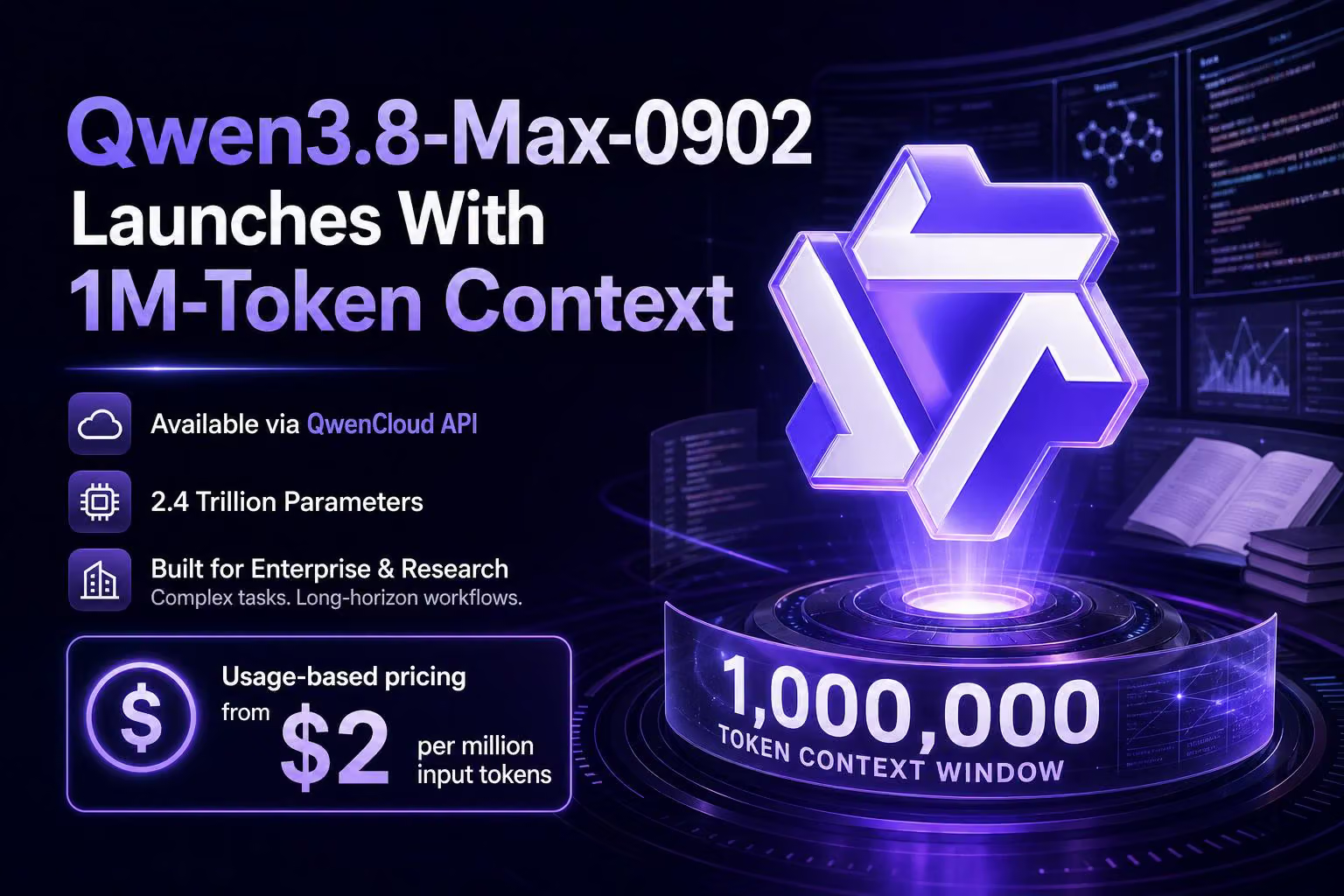
Qwen has announced Qwen3.8-Max-0902, an upgraded version of its Qwen3.8-Max model, with availability through the QwenCloud API. In a post dated September 2, 2026, @Alibaba_Qwen described the model as having 2.4 trillion parameters, a 1-million-token context window, and further training on coding and Cowork tasks. The announcement positions the release for complex enterprise work, scientific research, and long-horizon workflows.
For readers comparing recent Qwen releases, the Qwen3.8-Flash model announcement covers an open-weight multimodal model presented as an early preview of the Qwen4 architecture.
What Qwen3.8-Max-0902 offers
The headline capability is the model’s 1-million-token context window. In practical terms, that gives developers room to submit very large bodies of material in one interaction, such as extensive codebases, research collections, lengthy business documents, or multi-step project context. A large context window does not by itself guarantee accurate reasoning across every input, but it can reduce the need to split long tasks into smaller fragments.
Qwen also lists 2.4 trillion parameters for the model. Parameter counts describe the scale of a model, but they are not a standalone measure of output quality, speed, or cost. For API users, the more immediately relevant details are the available context length, task performance, and pricing structure.
The release was further trained on Coding and Cowork, according to the announcement. Qwen says that work is intended to strengthen performance on complex enterprise tasks, scientific research, and workflows that require progress over a longer sequence of actions rather than a single short response.
Benchmark figures in the accompanying graphic
A comparison graphic accompanying the announcement presents Qwen3.8-Max-0902 alongside Qwen3.8-Max and several other models across coding, agent, and multimodal categories. The displayed figures include:
69.3 on DeepSWE 1.1 for agentic coding.
64.9 on NL2Repo-Bench for repository-level code generation.
44.8 on SWE-Marathon for ultra-long-horizon software engineering.
66.3 on SWE-Atlas QnA for repository-level code understanding.
70.0 on QwenSWEBench V2 for complex real-world software engineering.
76.1 on CoWorkBench for long-horizon office work.
64.0 on JobBench for professional job tasks.
73.3 on Toolathlon Verified for real-world tool use.
1,468 on WorkArena, shown as an Elo rating for crowdsourced expert evaluation.
The graphic also shows results in multimodal evaluation, including 82.7 on MMMU-Pro, 78.3 on ERQA, 80.2 on ClawEval-MM, and 93.8 on BabyVision with confidence intervals. These are the figures from Qwen's comparison image; the announcement doesn't explain the testing method in detail.
Some rows use different benchmarks, scoring systems, and evaluation settings, so the numbers should be read within their individual test categories rather than combined into one overall ranking. The graphic’s notes also indicate that certain evaluations use specific agent harnesses, timeouts, context settings, or published scores from other sources.
QwenCloud pricing
Qwen3.8-Max-0902 is available through the QwenCloud API at the following rates per 1 million tokens:
Input tokens: $2.
Output tokens: $6.
Explicit cache hits: $0.17.
Implicit cache hits: $0.25.
The difference between input and output pricing matters for applications that generate large responses, while cache pricing may be particularly relevant to repeated workflows that reuse substantial prompt context. Developers evaluating the model should estimate both sides of their workload: the amount of material sent to the model and the amount of text or structured output it produces.
For long-context applications, caching can also affect the economics of repeated tasks. A system that repeatedly works from the same documentation, code repository, or project background may have a different cost profile from a system that submits a new full context on every request.
Who the release is aimed at
The announcement’s emphasis on coding, Cowork, enterprise tasks, research, and long-horizon workflows points to applications where the model must manage substantial context or maintain coherence across multiple stages. Potential use cases include:
Reviewing or modifying large software repositories.
Supporting research workflows involving lengthy source material.
Coordinating office and productivity tasks that span several steps.
Building API-based agents that use external tools.
Processing multimodal inputs alongside text-based reasoning.
Those use cases are a stated positioning of the release, not a guarantee that every implementation will perform equally well. The practical fit will depend on the application’s prompts, tools, latency requirements, data-handling needs, and tolerance for model errors.
Qwen3.8-Max-0902 is therefore best understood as an upgraded long-context model entering QwenCloud with a pricing model aimed at API experimentation and production workloads. Its combination of a 1-million-token context window, coding and workflow-focused training, and published benchmark figures gives developers several concrete factors to evaluate before deciding whether it fits their applications.
0 comments
No approved comments yet. You can start the conversation.
Leave a comment