

A viral X post says researchers found ChatGPT is "secretly writing a psychological profile of every user." The paper behind it is real, but it measures something narrower: how saved memory entries were created in 80 ChatGPT accounts. Our read: it is a useful audit, and the post inflates it.
In a post on X, @thesupermannx says 96% of what ChatGPT remembers about you was stored without you asking, and that the model tracks hesitation markers, syntax and an "emotional baseline" to build a persistent "user state." The paper, "The Algorithmic Self-Portrait: Deconstructing Memory in ChatGPT," supports a version of the first point and, in the sections we read, nothing resembling the second.
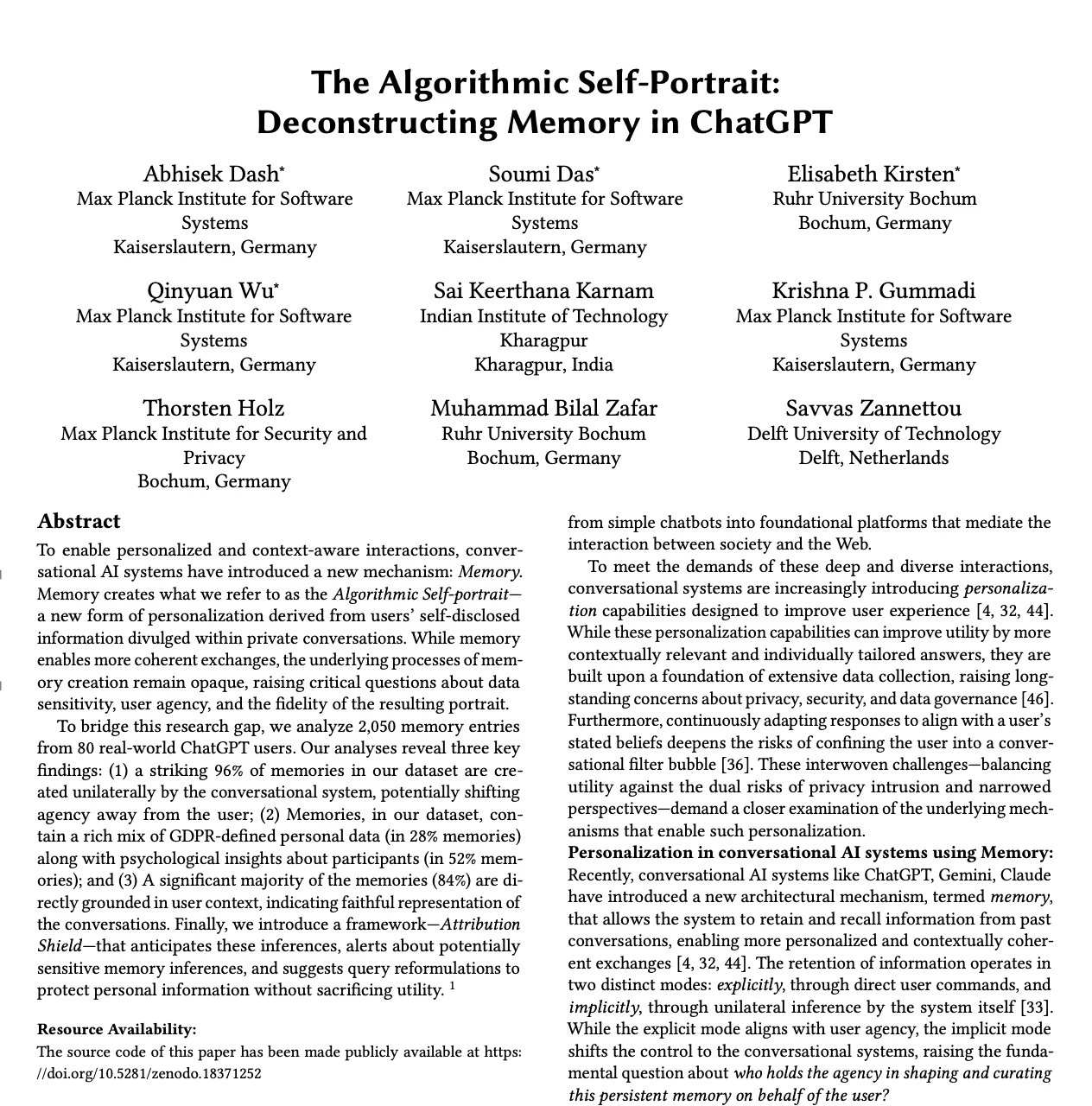
Image credit: @thesupermannx on X
What the paper is, and how old it is
The study is not new. Its arXiv page shows a first submission on 1 February 2026 and a latest revision on 23 February 2026, with a note that it was accepted at The ACM Web Conference 2026. The authors are affiliated with the Max Planck Institutes, Ruhr University Bochum, IIT Kharagpur and TU Delft.
The dataset is small and specific: 2,050 memory entries from 80 real ChatGPT users who shared their data exports. Memories appeared in 65 of those 80 accounts, triggered across 1,058 conversations. The authors identified memory entries by finding calls to ChatGPT's internal "bio tool" that updated stored context, then tracing back to the user message that preceded each one.
Claim by claim: the post against the paper
"96% stored without you ever asking." The paper's figure is "96% of all memory entries are unilaterally initiated by ChatGPT, without a detected direct command from participants." The detection was a regex-based search of user messages for trigger words such as remember, note that, store, save, add to memory and forget. Only 4% of entries (n = 84) contained one. Our read: a user request phrased without a trigger word would be counted as system-initiated, so the figure may overcount. It is a keyword-detection measure.
"Secret." The paper itself says OpenAI's documentation describes this behavior: "If you share information that might be useful for future conversations, ChatGPT may save those details as a memory without you needing to ask." It also notes that users can review, update or delete memories. Both are the paper's citations of OpenAI's documentation, which we have not checked directly. The authors' complaint is not secrecy but a gap between expectation and behavior: the documentation emphasizes explicit requests, while in their data the system overwhelmingly decides on its own.
"A psychological profile of every user." The paper does report psychological content in saved memories: its abstract says psychological insights about participants appear in 52% of memories. These are stored memory entries, visible in an account's memory list, rather than a live inference process running behind each prompt.
Hesitation markers, syntax analysis, prompt frequency, a persistent "user state" tracking your emotional baseline. None of this appears. The method examines saved memory entries and the conversations that triggered them. Our read: these details look like the post's own embellishment.
The finding the post misses
The more concrete result concerns OpenAI's own policy. As the paper describes it, ChatGPT's memory is not allowed to store sensitive data such as race, religion or health information unless the user explicitly requests it. Yet the authors report that GDPR-defined personal data appears in 28% of memories, and they examine how closely what gets stored matches that stated policy.
The paper also reports that 84% of memories were directly grounded in the user's conversation context, which the authors read as faithful representation rather than invention. The authors additionally propose a framework called Attribution Shield, which flags potentially sensitive inferences and suggests query reformulations.
What this means for ChatGPT users
The practical takeaway is smaller than the post suggests and more actionable. If you use ChatGPT for personal topics such as health, money or relationships, the study is a reasonable prompt to open your saved memories and look for those kinds of details. Then compare what is stored with what you actually asked ChatGPT to remember: entries you never requested are the ones the paper's 96% figure describes. Delete anything you do not want kept, and decide whether the setting suits you. The evidence does not support the conclusion that every prompt is being mined for a hidden mind-map.
The sample is 80 users who shared their data exports, so treat the numbers as a snapshot rather than a measure of every account today.


0 comments
No approved comments yet. You can start the conversation.
Leave a comment