
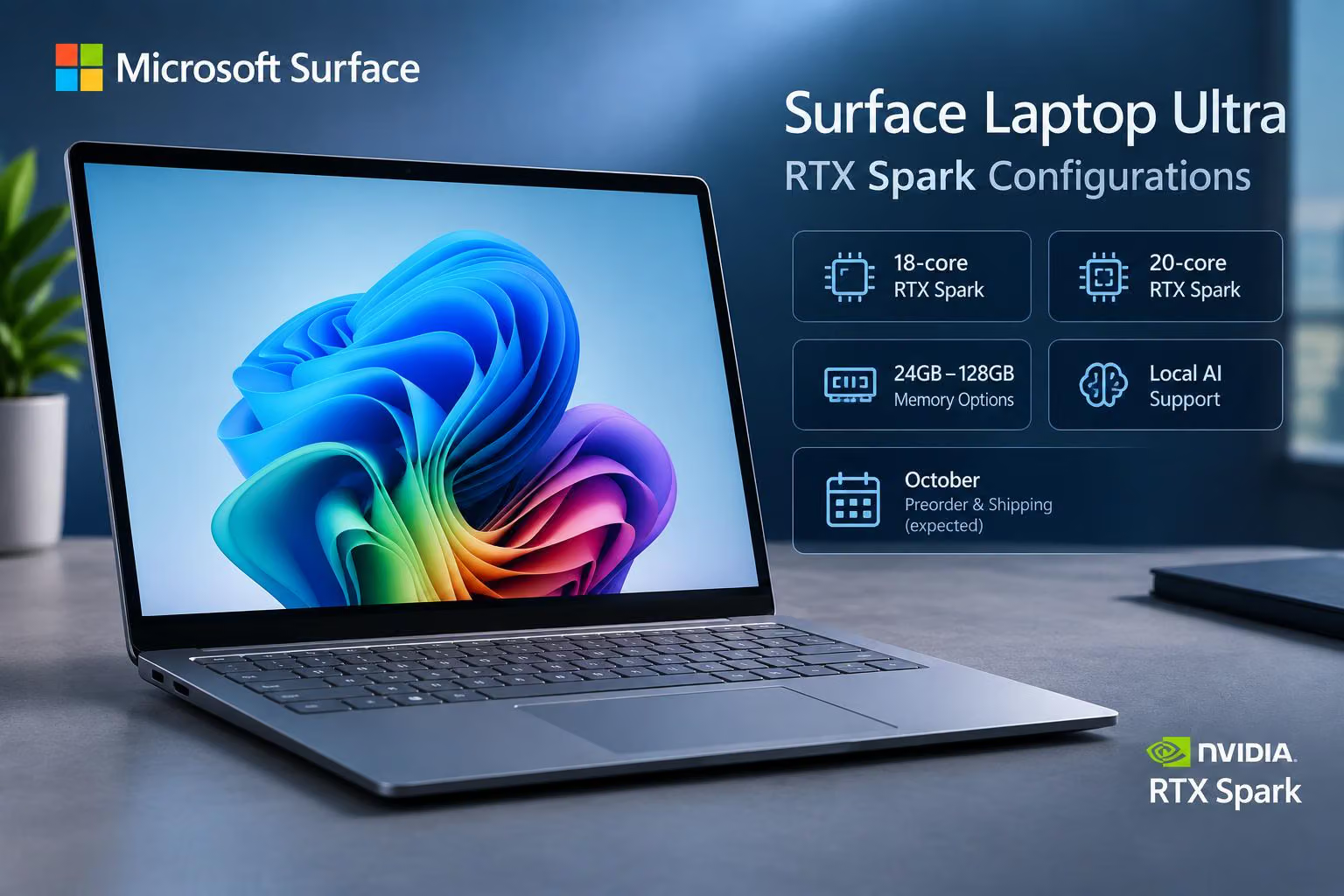
Microsoft is expected to reveal more about the Surface Laptop Ultra and NVIDIA’s RTX Spark platform at its Windows and Surface event on October 7, 2026. In a post on X, @zacbowden reports that the laptop will come in 18-core and 20-core RTX Spark configurations, with memory options ranging from 24GB to 128GB. The report positions the device for local AI workloads, developers and content creators.
The October 7 event is confirmed, but the product details reported so far are not a final Microsoft specification sheet. Pricing, complete retail availability and several hardware capabilities remain unconfirmed.
What has been reported about the Surface Laptop Ultra
The reported system uses NVIDIA’s RTX Spark superchip, described by Windows Central as combining a Grace CPU with a Blackwell RTX GPU and native CUDA support. The two reported versions differ in CPU and GPU core counts, memory choices and the Windows edition included on consumer configurations.
The reporting positions the laptop as a high-end machine for AI developers and creators who work with applications such as Premiere Pro and Blender. It also describes the system as intended to run local AI models and agentic workflows—software-agent tasks in which an AI system plans and carries out multiple steps toward a goal—without relying entirely on cloud processing. No benchmark results or application testing are reported for those capabilities, so the coverage does not establish how the laptop will perform in specific workloads.
The two reported RTX Spark configurations
Windows Central and Zac Bowden report the following configurations:
Reported configuration | GPU cores | Memory options | Reported Windows edition |
|---|---|---|---|
18-core RTX Spark | 5,120 | 24GB or 32GB | Windows 11 Home on entry-level consumer configurations |
20-core RTX Spark | 6,144 | 32GB, 48GB, 64GB or 128GB | Windows 11 Pro on higher-end configurations |
The linked report also describes a commercial configuration with Windows 11 Pro, but it does not establish the complete commercial lineup or final regional availability. The table therefore reflects reported information rather than confirmed final specifications.
Why the memory options matter for local AI
The most notable difference between the reported configurations is the amount of unified memory. A system with more memory can generally keep larger models or more data in memory, which is relevant when the CPU and GPU share a pool for local AI work. That makes the reported 64GB and 128GB options especially relevant to developers experimenting with larger local models or more demanding workflows.
Bowden reports that the laptop is intended to support local models of up to 120 billion parameters. The report does not specify the quantization settings—quantization uses lower numerical precision to reduce a model’s memory requirements—applications or response speeds that would apply, and it does not provide testing conditions. The model-size figure should therefore not be treated as a guarantee that every 120-billion-parameter model will run smoothly.
The 24GB and 32GB versions may be more appropriate for buyers whose workloads do not require the largest local models, but the reporting does not provide performance comparisons between the memory tiers. Buyers will need confirmed software support, memory-allocation details and real-world testing before choosing a configuration for a specific AI workload.
Who the reported laptop is for
The reporting points to three main audiences:
AI developers: people building or testing local models, applications and agentic workflows.
Content creators: users working with demanding creative tools such as video-editing and 3D applications.
Developers and builders who want local processing: users interested in reducing reliance on cloud services for some AI tasks.
That positioning does not establish that the laptop will outperform other professional systems. Performance, battery life, thermals and software compatibility still need to be evaluated in real-world use.
Preorders, shipments and the October 7 event
Microsoft has announced a Windows and Surface event in San Francisco for October 7, 2026, beginning at 10 a.m. PT. Windows Central says the event will focus on Windows, Surface and RTX Spark, with local AI described as a central theme. Microsoft’s event description also refers to new experiences for developers and builders. Windows Central reports on the event.
Bowden reports that preorders are expected to begin on October 7, with first shipments expected in mid-October. Those dates remain reported expectations rather than confirmed store availability. The reporting does not establish which countries will receive the laptop, whether every configuration will ship at the same time or how commercial models will differ from consumer versions.
Pricing and other details remain unconfirmed
A reply in the X thread suggests approximately $2,500 for the 18-core model and $3,000 for the 20-core model, but it is explicitly presented as a guess. Windows Central separately says the entry-level model is likely to cost well above $2,000. Neither figure should be treated as an official price.
Other reported or expected details also need confirmation, including:
display specifications and brightness;
battery life and performance while unplugged;
dimensions, weight and port design;
final availability by market;
supported applications and local AI performance;
whether every listed memory tier will be sold at launch.
The report describes features such as a PixelSense Ultra touchscreen, a larger haptic trackpad and a possible breakaway USB-C design, but Microsoft has not provided an official specification sheet covering those details in the reported material.
Windows AI features expected at the event
Windows Central expects Microsoft to discuss improvements related to local AI and agentic workflows. Potential topics include Windows K2 updates, better Prism emulation on RTX Spark systems, unified memory controls, locally running agents and the Aion Instruct, Aion Plan and MAI Code Flash models. The report also speculates about a more natural voice interface.
These are expectations about what Microsoft may show, not confirmed October 7 announcements. The reporting does not establish that all of these features will launch with the Surface Laptop Ultra, be available in every market or work on every RTX Spark configuration.
The current picture is of a reported high-memory Surface laptop family built around two RTX Spark tiers. Microsoft’s October event is expected to clarify the remaining questions, including official specifications, pricing, preorder terms, shipping markets, supported software and how the reported local AI capabilities perform. Windows Central’s event guide provides the reported livestream details.
0 comments
No approved comments yet. You can start the conversation.
Leave a comment