
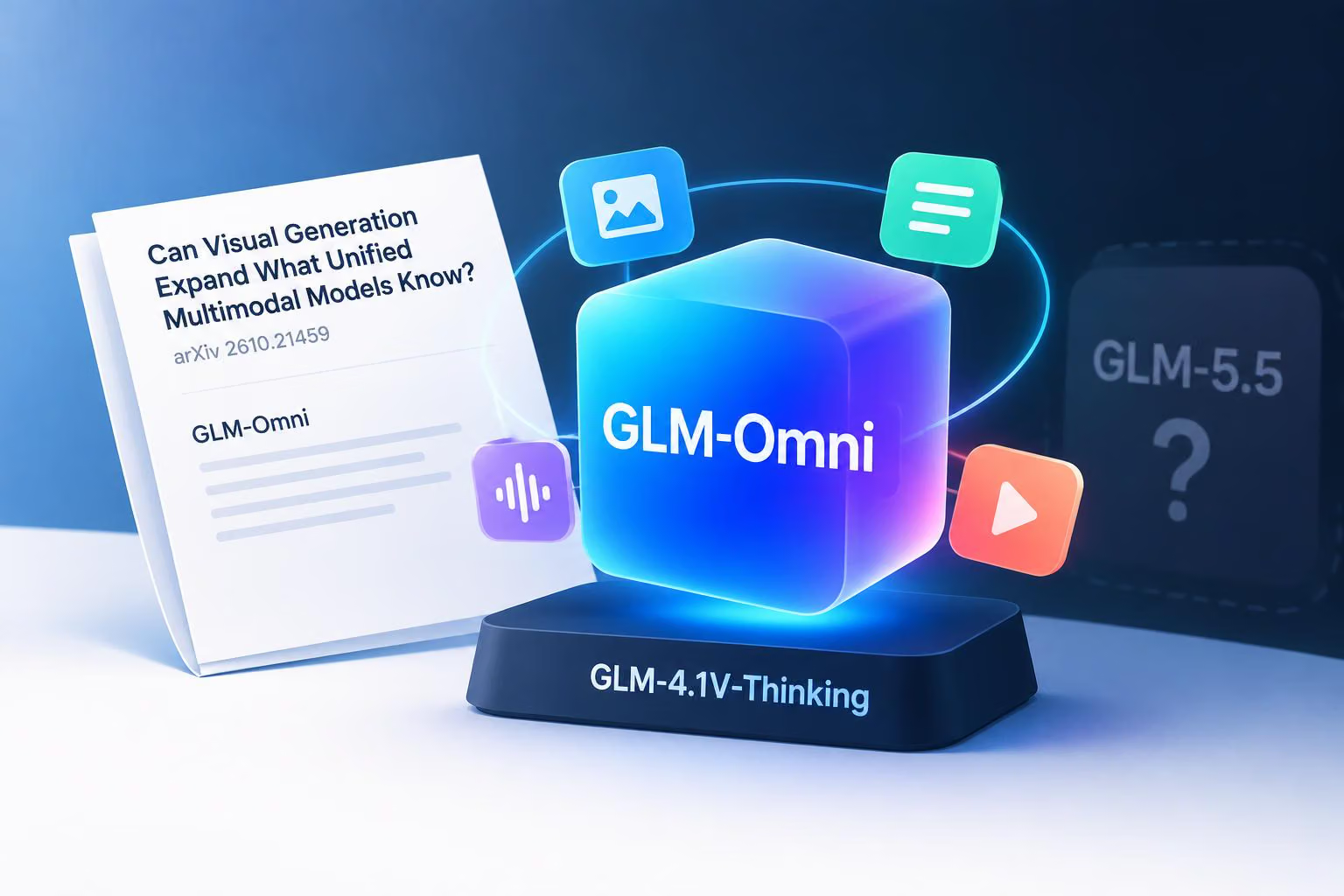
GLM-Omni is a real in-house Z.ai model, but the paper that names it describes a research build on a GLM-4.1V-Thinking base, with nothing pointing to a GLM-5.5 release. In a post on X, @NFT_Chen says Z.ai's internal unified multimodal model has leaked and is very likely GLM-5.5, citing a paper with Professor Jie Tang as corresponding author. The paper does name GLM-Omni, but never links it to GLM-5.5, and Z.ai's docs list neither.
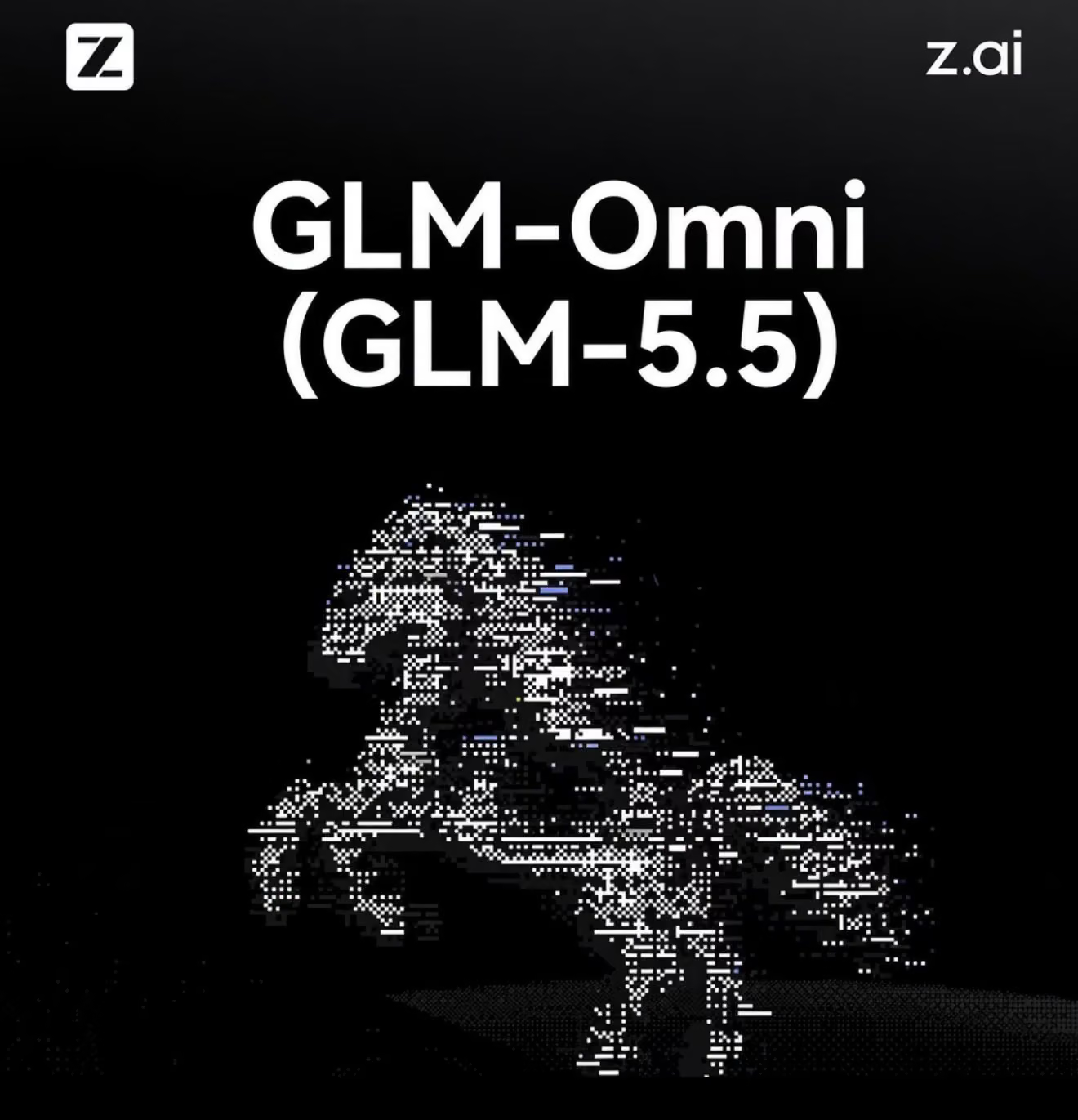
Image credit: @NFT_Chen on X
We could not trace this graphic to an official Z.ai channel.
The technical receipt: what the paper says about GLM-Omni
The paper is Can Visual Generation Expand What Unified Multimodal Models Know? (arXiv 2610.21459, submitted 15 Oct 2026). Its abstract never mentions GLM-Omni; the full text does. The listed affiliations are Tsinghua University and Z.AI, with Jie Tang as corresponding author. The model section says the authors study BAGEL, SenseNova-U1 and "an in-house GLM-Omni model", and that GLM-Omni is "initialized from the pretrain base checkpoint of GLM-4.1V-Thinking" with a discrete image tokenizer based on X-Omni.
So the name is genuine and internal. But the description is of a GLM-4.1V-era research model, not a 5.x flagship, and the paper gives no release plan, price or API ID.
Is GLM-Omni GLM-5.5?
Nothing in the paper says so. The GLM-5.5 name predates it: APIMart's tracker says the name traces to a late-June JPMorgan forecast that Reuters reported, which predicted an August launch, followed by social posts moving it to September. APIMart says both windows passed with no launch, and that the only next-generation name Z.ai has used publicly is GLM-6.0. Our read: the post attaches an old rumour to a new paper.
The 12.57% → 26.86% figure
The numbers are real, but they are not a model leap. In the paper's Table 2 (also on the project page), 12.57 and 26.86 are GLM-Omni's average text-only accuracy under two training conditions, textual alignment and interleaved image–text alignment, on fictional "MagicWorld" entities. Direct transfer, with no alignment, scores 14.57, so textual alignment actually lowered GLM-Omni's average; the paper notes that it declines for GLM-Omni while improving for BAGEL and SenseNova-U1.
Most of the jump comes from two categories: shape rose from 12.0 to 64.0 and spatial from 0.0 to 40.0 between textual and interleaved alignment.
Category | Direct | Textual alignment | Interleaved alignment |
|---|---|---|---|
Shape | 20.0 | 12.0 | 64.0 |
Spatial | 0.0 | 0.0 | 40.0 |
Average (7 categories) | 14.57 | 12.57 | 26.86 |
The test is small: 50 knowledge units per task and 8,552 training examples in total, built from invented entities to avoid pretrained knowledge. It probes how knowledge transfers from image generation to text answers; it is not a general capability benchmark.
Z.ai's docs list GLM-5.3 as the flagship, with no GLM-Omni or GLM-5.5
Z.ai's docs overview lists GLM-5.3 as its "Flagship Model" and GLM-5.3-Flash as a "Native Multimodal Model". Featured models are GLM-5.3-Flash, GLM-5.3-FlashX, GLM-5.3 and GLM-5.2, each with 1M context; image generation lists only GLM-Image. For context on that lineup, see our coverage of GLM-5.3-Flash on the Artificial Analysis index and the GLM-5.3 open-weight release.

0 comments
No approved comments yet. You can start the conversation.
Leave a comment