

OpenAI's platform now appears to list two GPT-6.2 healthcare models, gpt-6.2-sol-healthcare and gpt-6.2-astra-healthcare. The claim comes from a post by TestingCatalog on X, and it is unconfirmed: no launch announcement for these specific variants turned up in the material reviewed. The names are better supported than the purpose, because OpenAI's own pricing page lists them.
The post says the models are "now available on the OpenAI platform and APIs" and expects a formal announcement the same day. It also guesses that the healthcare versions are aimed at healthcare institutions and use different guardrails. Those guesses are the least checkable part of the report, and this article treats them that way.
What the post claims, and what it does not show
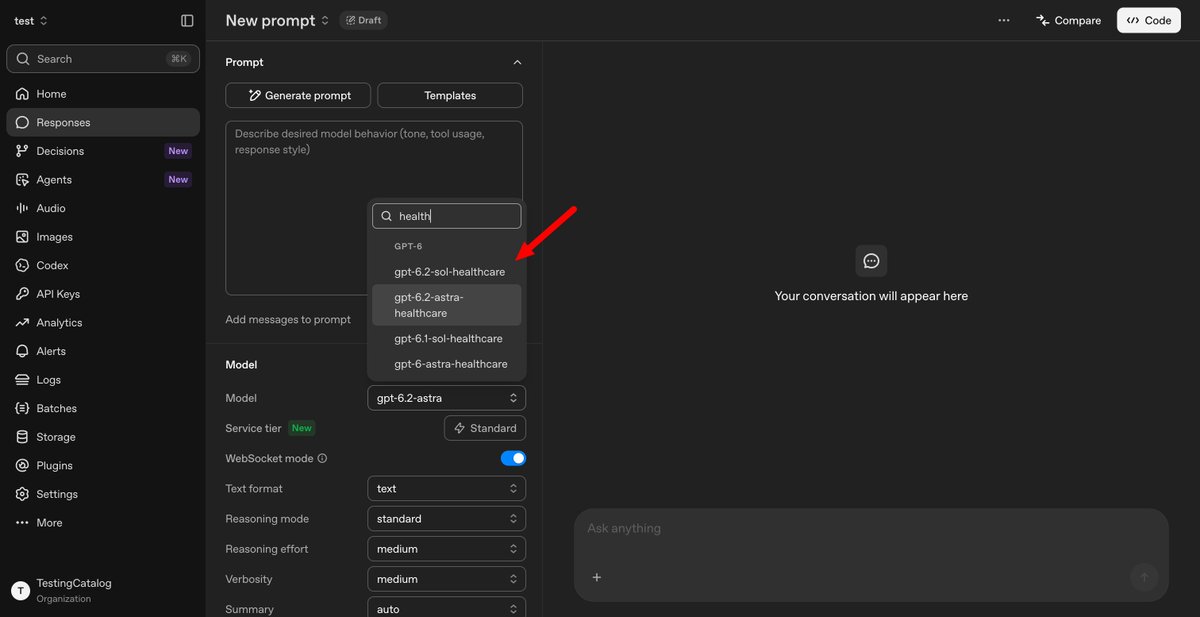
The post makes three points. The models are available now. A launch of GPT-6.2 Sol and Astra for Healthcare is expected that day. The healthcare versions are probably built for institutions with different guardrails. The first point is a factual claim that OpenAI's own documents can test. The second and third are inferences. The attached photo shows the model names in the dashboard, which supports the first point only in part. It shows the names exist in the interface, not who can use them.
Where the GPT-6.2 healthcare models already appear
The screenshot shows the model picker in OpenAI's developer dashboard. Typing "health" returns four entries under a GPT-6 heading: gpt-6.2-sol-healthcare, gpt-6.2-astra-healthcare, gpt-6.1-sol-healthcare and gpt-6-astra-healthcare. The two older 6.0 and 6.1 entries sit beside the new pair. The model field behind the picker is set to gpt-6.2-astra, a standard model.
Media source: x.com
The listing is not limited to the dashboard. OpenAI's API pricing page has a "Healthcare model configurations" table with the same four names. That makes the screenshot hard to dismiss as a mock-up. It does not show when the models went live, what changed in them, or whether they are generally available. A price table is not a launch notice.
What the listed prices suggest
The pricing table lists gpt-6.2-astra-healthcare at $8.00 and $40.00, and gpt-6.2-sol-healthcare at $2.00 and $10.00. OpenAI's developer community announcement gives the same figures for the standard Astra and Sol models, quoted per million tokens. On paper, the healthcare variants carry no price premium.
Two points temper that. The pricing page says promotional pricing for several healthcare configurations applies at least through December 31, 2026, so these rates may not be permanent. The healthcare line is also not uniform: the older gpt-6-astra-healthcare is listed at $10.00 and $50.00. Price alone therefore tells a buyer little about whether the models behave differently, and that difference is what healthcare customers would need to know.
Background: GPT-6.2 and OpenAI's healthcare push
According to OpenAI's developer community announcement, the pair reached ChatGPT Work and Codex first, with API access under the names gpt-6.2-astra and gpt-6.2-sol. Emergent dates the release to November 17, 2026. The same announcement says the models launched with tighter safeguards for higher-risk cybersecurity assistance. That is the only safeguard change named in the material, and it concerns cyber use, not clinical use.
Healthcare has been a steady focus for OpenAI. OpenAI for Healthcare launched with ChatGPT for Healthcare and an API for building healthcare tools, and the company said its products then ran on GPT-5.2. When GPT-6 Astra arrived, Healthcare IT News reported that OpenAI said Astra topped several rival models on healthcare benchmarks. A healthcare variant of GPT-6.2 would continue that pattern.
What "healthcare guardrails" would have to mean
The guardrail claim carries the most weight. Clinical questions, patient records and documentation carry different risks from general chat, so a model sold to institutions could plausibly handle them differently. Likely areas include how the model answers diagnostic questions, which disclaimers it adds, and how it handles data. None of these is described in the material.
Caution is already on the record. Healthcare IT News reports that OpenAI said doctors' conversations are not used to train its models. The same article quotes a life sciences consultant who advised providers to be careful with the company's clinical AI tool. That advice concerned the GPT-6 Astra report, not these variants, but it is the closest public guidance available.
What would confirm or disprove the report
The post expected an announcement on the day it was published, November 24, 2026. If none appears, that expectation was wrong. Several checks would settle the wider question:
An OpenAI announcement or model page that names the healthcare variants and gives a release date.
Documentation, such as a system card, that explains how they differ from gpt-6.2-sol and gpt-6.2-astra.
Access terms showing whether any developer can call them, or only approved institutions.
If the names disappear from the pricing page without an announcement, the listing may have been a test. That would be an inference, not a finding.
Key takeaways
OpenAI's pricing page and dashboard both list gpt-6.2-sol-healthcare and gpt-6.2-astra-healthcare, which supports the post's claim that the names exist.
No announcement for these variants was found, so the claim that they are built for institutions with different guardrails remains the poster's inference.
Listed prices match the standard Sol and Astra rates, so price reveals no difference, and promotional rates run through at least December 31, 2026.
The base GPT-6.2 models launched on November 17, 2026 with tighter cyber safeguards. A healthcare-specific safeguard would be a separate, unconfirmed change.
Frequently asked questions
Are the GPT-6.2 healthcare models officially available?
The pricing page lists them, and the dashboard shows them as selectable. No launch announcement for these specific names was found in the material reviewed, so general availability has not been confirmed.
What makes gpt-6.2-sol-healthcare different from gpt-6.2-sol?
No source describes the difference. The listed prices match the standard model, and the claim about guardrails is an inference. Only OpenAI's documentation can settle it.
How much do the healthcare models cost?
The pricing page lists $8.00 and $40.00 for gpt-6.2-astra-healthcare, and $2.00 and $10.00 for gpt-6.2-sol-healthcare, per million tokens. Several healthcare configurations carry promotional pricing through at least December 31, 2026.
Should clinicians rely on these models?
The material reviewed contains no clinical validation for these specific models. A consultant quoted by Healthcare IT News advised caution with OpenAI's clinical tool, and any use should follow institutional policy and the vendor's terms.



0 comments
No approved comments yet. You can start the conversation.
Leave a comment