
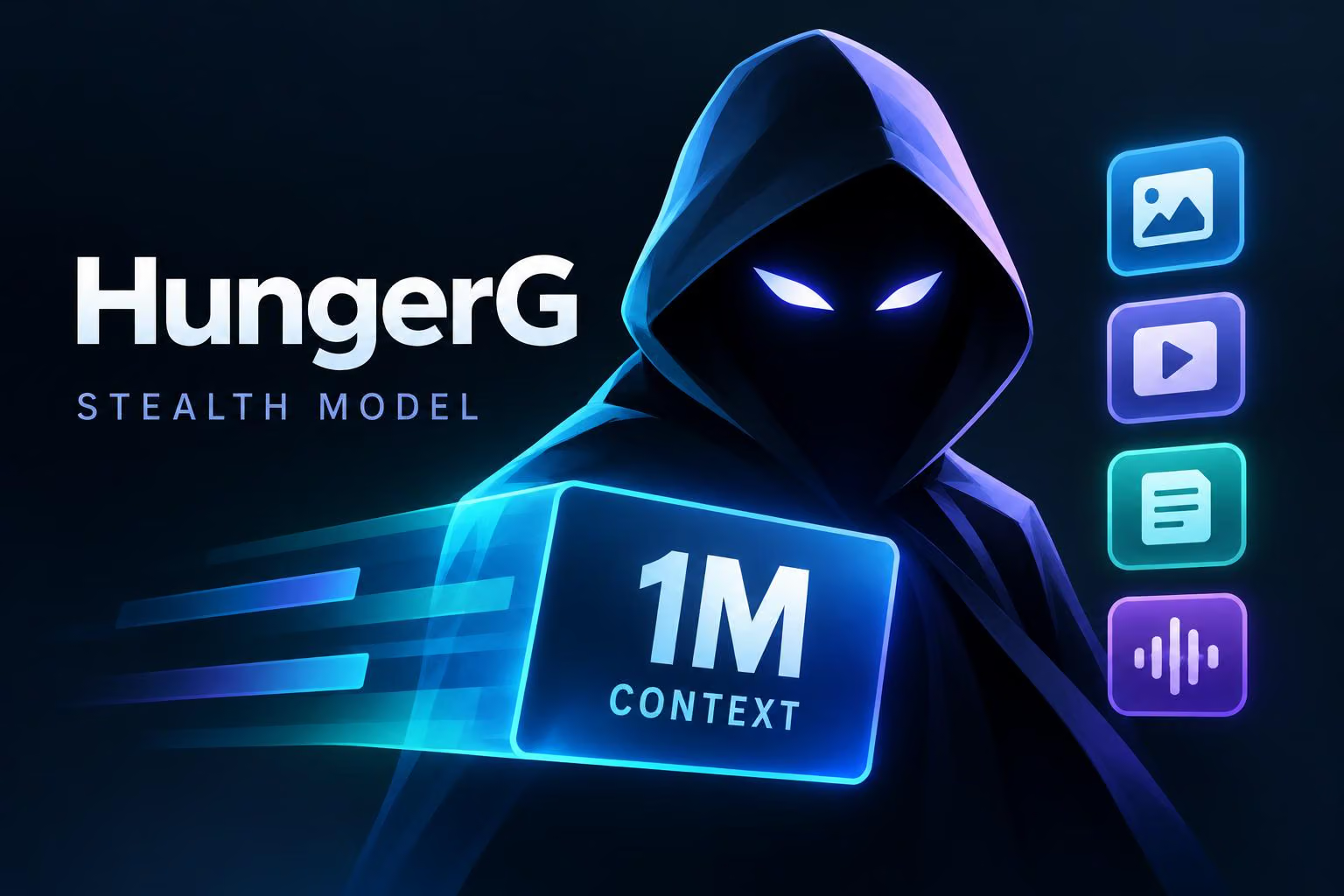
The HungerG stealth model is free this week for OpenCode Go subscribers, according to a post from OpenCode on X. The post, dated November 24, 2026, lists a 1M context window, multimodal input and "no training on data." It does not name the model's maker, and that remains unconfirmed.
This article separates what the post and OpenCode's own pages establish from what is rumour, and explains the cost, setup and listing history.
What the HungerG stealth model is
Stealth models ship under a codename while their developers stay hidden. Qoder's launch post offered HungerG from Nov 23 to Nov 30 and invited users to "guess who built it." OpenCode's documentation labels the model "HungerG Free," free for a limited time, and says prompts and completions are not used to train models.
Specifications are less settled. A bot review of a catalog change lists a 65,536-token output limit and image and video input, but flags those figures as unsourced, so treat them as unverified.
Who can use HungerG, what it costs and how to start
Access runs through OpenCode Go, a subscription to curated open-weight models. The Go page lists HungerG Free with an unlimited (∞) allowance for Go and Go Plus subscribers. Caprock's pricing guide puts Go at $10 a month, Go Plus at $40 and Go Teams at $20 per member. The promotion covers the model rather than the subscription, and the post sets no end date beyond "this week."
Start by creating a Go subscription in the OpenCode Console and copying the API key. In OpenCode's terminal interface, run the connect command, choose OpenCode Go and paste the key, then run the models command and select HungerG. The Go page adds that agents which send a session ID can use Go, and names Claude Code, Codex, Hermes and Pi as tested.
Why the launch has been messy
The listing has not been stable. A catalog pull request hid HungerG from the OpenCode catalog on Nov 23, and a bot review noted that the removal cited no announcement. A follow-up change restored it with a Nov 24 release date.
Qoder's launch post called HungerG exclusive to Qoder, so an OpenCode listing sits awkwardly with that framing. One X post says the earlier OpenCode specs were suspected to match StepFun's Step-5 before being withdrawn. Nothing in the material confirms this, so treat it as speculation.
How HungerG differs from earlier OpenCode free models
OpenCode has run stealth models before. A catalog review names crouton-alpha-free, cat-jam-free and space-bunny as comparable, and a sibling, tidepool-alpha-free, has a Nov 18 release date in the later catalog change.
The clearest practical difference is the allowance. The Go page says ordinary free models have a daily request limit, while HungerG shows no cap for subscribers this week. A third-party overview reports no official benchmark scores yet, though that small site makes it a lead rather than proof.
That makes context size the spec worth testing. A 1M window can hold a large codebase in one session, but it only helps if the model uses that context accurately. One task on your own repository will tell you more than any headline figure.
Key takeaways
HungerG is free for OpenCode Go subscribers this week, according to OpenCode, which also cites a 1M context window and multimodal input.
Subscribers pay nothing extra for the model, but no end date is given, so check OpenCode's model list before building on it.
The maker is unconfirmed and the StepFun link is a rumour. Watch for a reveal, a catalog change or an extension of the free window.
Frequently asked questions
Is HungerG free for everyone?
No. OpenCode's post offers it free to Go subscribers this week, while Qoder's launch offered it free on its own apps from Nov 23 to Nov 30.
Does OpenCode train on HungerG prompts?
OpenCode says not: its documentation states that prompts and completions are excluded from model training. The Qoder posts in the material do not address data use.
Is HungerG really StepFun's Step-5?
Unknown. The claim comes from one X user, and Qoder lists the model's identity as classified.

0 comments
No approved comments yet. You can start the conversation.
Leave a comment