

Claude Ship is a beta workflow that lets Claude take over a pull request once it is opened: it reviews the code, works on fixes, and approves changes when the team's own policy allows. ClaudeDevs announced it on X on November 23, 2026, with the stated aim of helping teams ship code "as fast as you can write it."
It is open to Claude Team and Enterprise customers who host code on GitHub. Developers can try it on a single change by updating Claude Code and running `/ship`, while admins can switch it on across a whole repository. This article covers what the tool is made of, how its approval rules work, what it costs and where its limits lie.
What Claude Ship is made of
Claude Ship has three parts. Anthropic's launch article describes Code Review as already generally available, with PR Steward and Claude Approvals as newer agents still in beta. Together they handle the stretch between an open pull request and a merge decision.
The launch article frames the problem as a familiar cycle: a developer moves on to other work, returns to old code when a review arrives, pushes a fix, and waits for another round. Human approval fits that cycle when people write every line. When agents write much of the code, the same cycle becomes the bottleneck. The article notes that on the Claude Code team, Claude writes most of the code, and the team wanted the steps after the pull request to move at the same pace.
How the review, fix and approve steps work
Review. The Code Review agent examines a pull request against the wider codebase from several angles. It checks each finding before writing it up, sorts the findings into categories, and posts them on the PR. Each repository can use a Quick, Standard or Deep review level.
Fix. PR Steward watches for failing CI checks, merge conflicts and review comments, whether they come from Code Review, other tools or teammates. After each push it explains what it changed and how to undo it. Developers can steer it with `@claude`, or halt it with `@claude stop`. By design it cannot approve or merge.
Approve. Claude Approvals reads the policy the team keeps in the repository and decides whether a change qualifies. The post's diagram shows the loop: findings go to the fix step, fixes are pushed, review runs again, and once no issues remain, the change is approved under team policy and marked ready to merge.
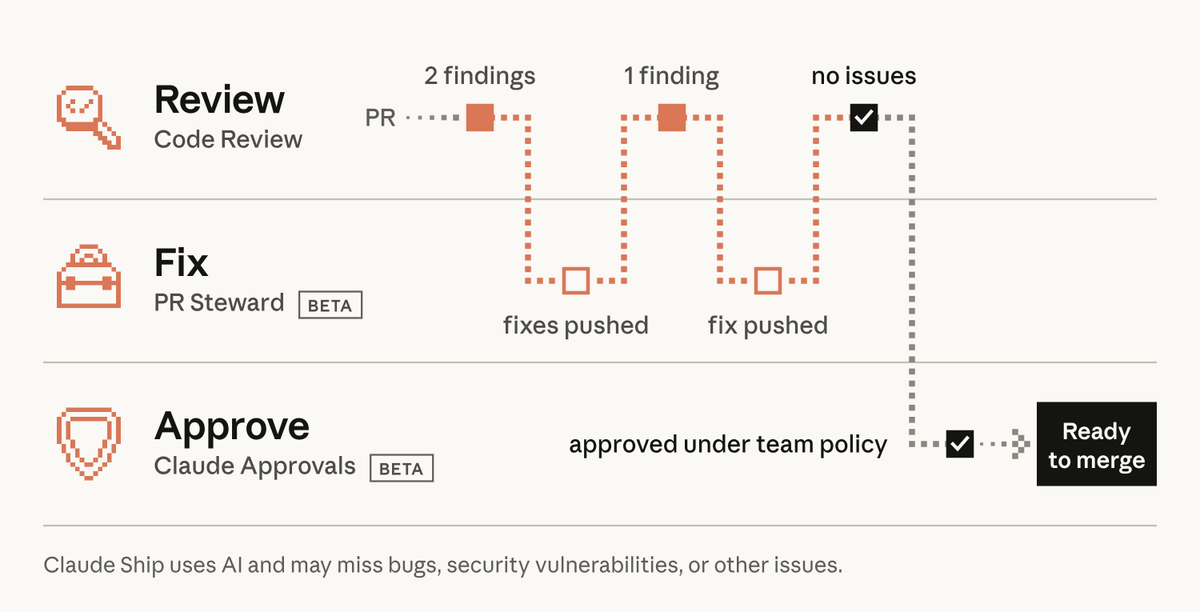
Media source: x.com
How the approval policy file works
Approval rules are written as a file in the repository. The post's example, labelled illustrative, places one at `.claude/approvals.yml` in a web app. Each rule has a purpose, the file paths it covers, and a verdict on how many human approvals are needed and whether Claude can approve alone.

Media source: x.com
In the example, most code needs two people, or one when Claude's review passes. Documentation needs no human approval once Claude's review passes. Billing changes need two people who are not the authors, plus one non-author from the payments group. The post calls the file a "smarter CODEOWNERS file," and the approval step can weigh Code Review findings or classifiers a team writes in plain language.
Keeping the rules in the repository has a side effect worth noticing: loosening a rule becomes a change that can itself be reviewed. The documentation rule shows how far that trade can go, since a passing review there replaces every human seat. Teams should start with their lowest-risk paths and watch how the rules behave before enforcing them.
How to start using Claude Ship
Developers can update Claude Code and run `/ship` on their next change. The developer starts the process, and Claude does the pushing and PR creation, then reviews the change and works through feedback and failing checks. Admins take a different route: they turn Code Review and PR Steward on for each repository, then set how deep reviews go, when they run, and how much they can spend.
Claude Approvals begins once a repository has a policy file on its default branch, and admins can turn it off. The launch article advises running the policy in observe-only mode first, then requiring Claude Approvals' green light through branch protection once the team trusts it. Claude Ship works with existing branch protection and required checks, so current rules still apply.
Pricing, limits and availability
Claude Ship is available on Claude Team and Enterprise plans for repositories on GitHub. Organizations using Zero Data Retention, the HIPAA configuration or customer-managed encryption keys cannot use it, a serious constraint for regulated firms. Eligible Claude Enterprise organizations can claim at least $10,000 in Claude Ship credits, to use within 30 days of claiming and by January 15, 2027.
Billing is token-based, so the bill tracks the work: the number and size of pull requests, the review level, how often reviews run and how much PR Steward does. Admins can set spend limits for Code Review and PR Steward. Claude Approvals has no base fee, but classifiers used in a policy are billed by the tokens they consume. One trap: a policy that relies on Claude's review triggers a billed Code Review even in observe mode, so an observe-only trial is not free.
How it differs from earlier review tools, and what to watch
Code review bots are not new. What changes here is the chain: review findings feed an agent that pushes fixes, and a policy can let AI satisfy an approval requirement. Commenting on a diff is advisory. Approval changes who is allowed to merge, which is a larger step and where most of the risk sits.
The evidence so far is Anthropic's own. The launch article reports that merged pull requests on the Claude Code team more than doubled between June and September, while the share of reverted changes fell by over 40%. It also describes Claude's review as one layer of a broader process, so independent measurement is still missing. The post's graphic adds a plain warning: Claude Ship uses AI and may miss bugs, security vulnerabilities or other issues. Observe-only mode, human seats on sensitive paths and branch protection that stays in place are the sensible guardrails.
Key takeaways
Claude Ship bundles Code Review, which is generally available, with PR Steward and Claude Approvals, which are in beta.
Developers can start with `/ship` in Claude Code, while admins can enable it for a GitHub repository on Team or Enterprise plans.
Approval rules live in a repository file, and observe-only mode lets a team test them before enforcing.
Billing is token-based, and a policy that uses Claude's review adds billed reviews even in observe mode.
Frequently asked questions
What does the /ship command do?
It has Claude push your change, open the pull request, review it, and work on feedback and failing checks. Whether the change can merge still depends on your permissions and the repository's branch rules.
Can Claude merge code without a human?
Only if the approval policy allows it. PR Steward is designed not to approve or merge, while Claude Approvals can approve routine changes and can require human sign-off for sensitive scenarios.
Is Claude Ship generally available yet?
No. The post introduces it as a beta, and only Code Review is generally available, while PR Steward and Claude Approvals remain in beta.
How much does Claude Ship cost?
Usage is billed on tokens, so costs rise with pull request volume, review depth and fix activity. Admins can cap spending on Code Review and PR Steward.



0 comments
No approved comments yet. You can start the conversation.
Leave a comment