
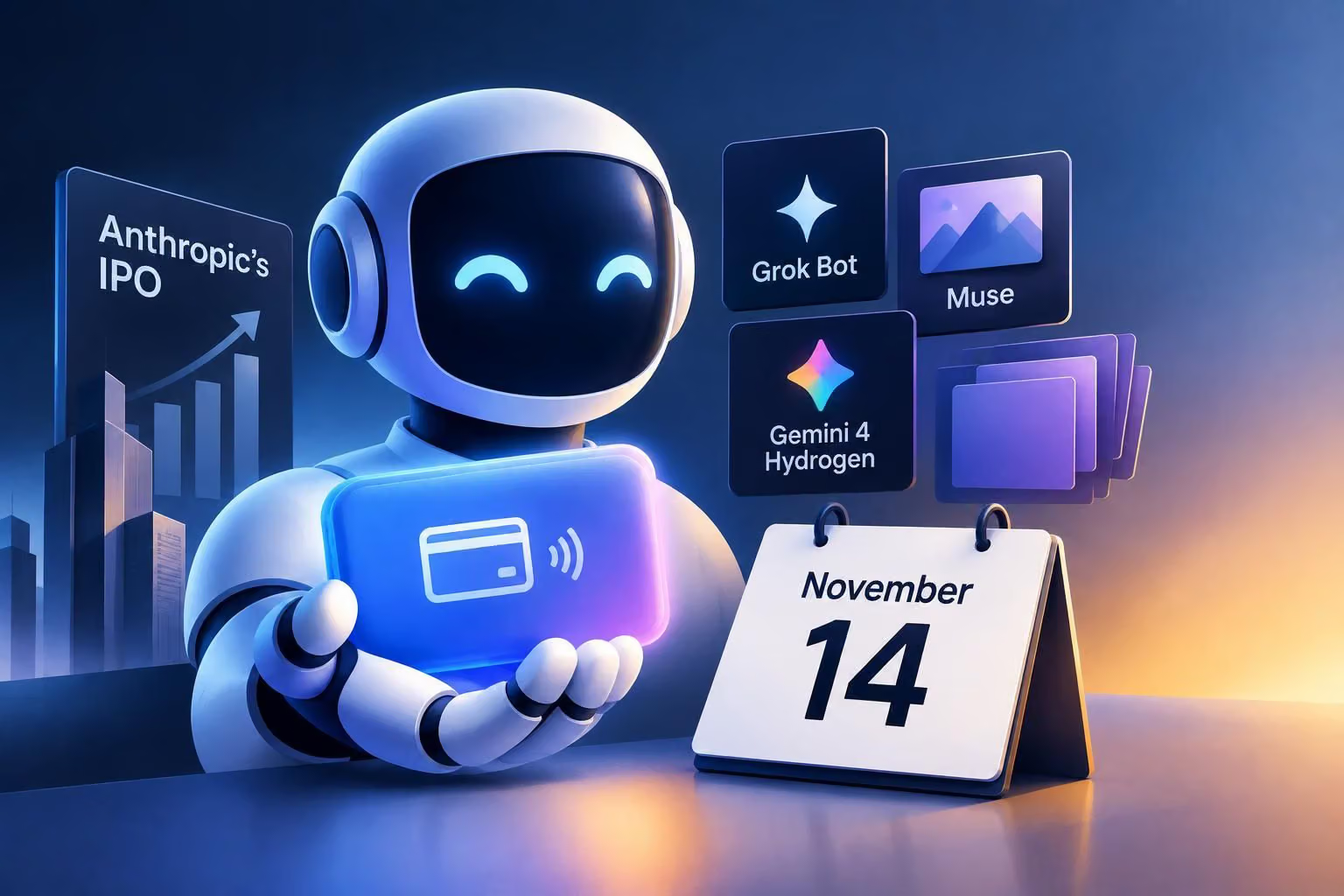
The main AI news on November 14, 2026 is a single daily brief from the X account TestingCatalog, which lists eighteen releases, leaks and market items from ten companies. The most consequential are OpenAI's ChatGPT Wallet, which lets AI agents pay without seeing a card number, and Anthropic's initial public offering, which the brief says prices on November 18.
The brief packs many unrelated updates into one post, so this article takes them one company at a time rather than building around a single story. Where other reporting exists, it is cited. Where it does not, the item rests on the brief and is labelled that way. The brief also says it was composed with Grok, with the news cherry-picked and post-edited, so it is a selection rather than a full record of the day.
ChatGPT Wallet on Dots: how agents pay without your card number
According to the post, ChatGPT Wallet is rolling out on Dots for US Pro subscribers, with the stated aim of letting agents pay without exposing a card. OpenTools reports that Dots is the agent product that OpenAI unveiled in late September, and the brief lists the wallet under OpenAI. OpenAI's announcement describes the wallet as a way for agents to pay without access to a user's actual card details, with a security check on every purchase.
Under the hood, the card network generates a stand-in number with its own security code and expiry date. MartinCid compares this to the principle that keeps real card numbers hidden from shops when people use Apple Pay or Google Wallet. GSMArena describes the approval step as a Face ID or fingerprint check for each purchase.
Access is narrow: US Pro subscribers aged 18 and over with eligible US-issued cards. OpenTools says OpenAI expects to let users hand over purchases more fully later, using spending limits and purchase categories. Websites are the weak point. MartinCid quotes OpenAI saying that sites need to avoid blocking agents, so a purchase can fail at checkout. The design choice matters most. An agent that never holds the card has less to leak, and cardholders keep rewards and dispute protections, according to OpenAI's announcement.
Google's Antigravity workflows, the Wallet link and an Omni spec
According to the post, Google's Antigravity coding tool is getting Dynamic Workflows. Instead of the model working through each step in conversation, the feature has it generate a Python program that coordinates helper agents. That makes the plan visible and repeatable, because the order of steps lives in code that can be read, saved and rerun. The brief offers no benchmark, so any reliability gain is a reasoned expectation rather than a measured result.
The second Google item concerns Google Wallet. The post says Personal Intelligence now reaches Google Wallet for US users of Gemini. A daily audio digest describes that link as read-only. If that is accurate, Gemini can see wallet information without being able to spend from it, which is a narrower design than ChatGPT Wallet's.
The third item is an "Omni LoRA tuning" entry that, according to the brief, appeared in the Vertex AI API for fine-tuning Gemini Omni video models. The brief credits the sighting to aitrackerbot. LoRA trains a small set of added weights rather than the whole model, which makes tuning cheaper. The post reports a spotted spec, not an announcement.
Anthropic's IPO: the price range, the $64.4 billion figure and the Claude updates
The Anthropic listing is the most market-moving item, and it is not a rumour. Anthropic made its filing public on October 26 and named ANT as its planned Nasdaq ticker. On November 10, it set a range of $70 to $78 per share for 825 million shares, according to Yahoo Finance's report on the updated filing. At the top of that range, the offering would raise about $64.4 billion, including stock sold by existing shareholders. That matches the post's "up to $64.4B" figure.
CNBC reporting, which cites people familiar with the deal, gives the same dates as the brief: pricing on November 18 and trading from November 19. CryptoTicker says that at the top of the range the listing would exceed any IPO except SpaceX's June deal. The Motley Fool reports that SpaceX raised $75 billion at pricing. Why it matters: a public listing would put the company's revenue, losses and compute commitments under regular disclosure, which private funding rounds never required.
The skeptical view has support in the same news cycle. A Techrights link roundup points to reporting that OpenAI keeps losing money even as its revenue climbs, and that SoftBank lost $7 billion on data-center bets.
The post also lists two smaller Claude items: custom themes for Claude Code on desktop, delivered through mods, and invitations to Claude Duet for every US waitlisted Pro, Max and Ultra subscriber. The previous day's brief put Duet's allowance at three invites per user, plus a free month of Pro for eligible US users.
Grok Bot's meetings, docs and bot factories
The post files the Grok Bot items under a SPACEXSI heading, which appears to refer to SpaceX's AI operations. A market newsletter reports SpaceX committing more than $74 billion to its own AI compute campuses.
Grok Bot can now sit in on meetings, where it answers questions and records decisions. Its answers inside documentation now include page links and diagrams. The third item is still a test: according to the post, bot factories would chain bots in a fixed order, run them on a schedule, or start them on demand.
The pattern is the notable part. Google's Dynamic Workflows and Grok's bot factories both package agent work as fixed, repeatable sequences that can run without someone prompting each step. Two companies choosing that shape in the same brief suggests the industry is moving toward scheduled chains rather than open-ended chat.
Meta's Muse agent, a leaked model name and a prediction-market test
Meta has three items, and only the first is a stated plan. The post says Muse is getting a Chrome extension agent that can act on open web pages. Muse is already a visible product. CNBC reported that Meta's Muse topped the App Store charts shortly before OpenAI introduced dots in late September.
Browser agents face a practical obstacle: some sites refuse them. MartinCid cites a report that Amazon blocks outside AI agents, including Muse, and another that Delta and United have banned agents from making purchases.
The other two items are unconfirmed. According to the post, a model name, Muse-Spark-1.4-internal, was spotted in a Meta GitHub pull request, per the LuminaBench account. A name in a pull request signals work in progress, not a release date. Meta is also reportedly testing an internal prediction-market app called Takes, according to DegenerateNews.
Smaller launches: Perplexity, Microsoft, DeepSeek, Sesame and Manus
Perplexity. According to the post, Teammates has reached the Perplexity Mac app for Max subscribers. The brief gives no detail on what the feature does.
Microsoft. GitHub Copilot now offers Gemini 4 Hydrogen as generally available. A market newsletter lists the model's price at $1.50 and $7.50 per million tokens and its AA Index score at 51. Model choice is becoming a product feature when a Microsoft coding tool routes users to a Google model.
DeepSeek. Developers calling DeepSeek's API can now reach the app's search, file and voice features, along with separate tools for OCR, speech recognition and text-to-speech.
Sesame. The company is leaving its preview phase with paid Plus ($20) and Pro tiers, while keeping a free plan.
Manus. A new Side chat lets users ask questions while a task runs, without filling the main thread.
The case for and against reading this as an agent boom
The popular reading is that AI products are moving from chat toward agents that act for users. The brief supports that reading: payments, browser agents, meetings, scheduled bots and coded workflows all appear in one day's items.
The case against is about scope. Most agent features are limited to US Pro users or sit in preview, beta or testing. Websites are also pushing back, so a feature can ship and still be blocked on the sites people most want to use.
Trust is the other open question. Another item in the same news cycle, reported by the Daily AI Caffeine newsletter, describes Claude erasing a law professor's syllabus files by mistake. Claude admitted the error, and Dropbox recovered everything. Agents that can spend money and act in browsers raise the cost of mistakes like that.
The strongest version of the agent argument is about design, not adoption. The brief shows features arriving with payment checks, fixed workflows and approval steps. It does not show many people relying on them yet. That gap is the thing to watch.
Which AI news from November 14, 2026 is confirmed, and what to watch
Only a few items have checks beyond the brief. ChatGPT Wallet is backed by OpenAI's announcement and CNBC's report, and the Anthropic IPO dates match CNBC's reporting on the price range. Most of the rest rests on the post alone.
Treat these as unconfirmed: the Omni LoRA entry, the Muse-Spark-1.4-internal name, the Takes app and the Grok bot factories, which the post describes as a test. None has an official announcement in the sources cited here.
November 17: Microsoft Ignite starts, and Microsoft AI is teasing new models, according to the previous day's brief.
November 18: Anthropic's expected pricing date. The final price will show where demand lands within the $70 to $78 range.
November 19: The expected first day of trading for ANT.
ChatGPT Wallet: How many merchants accept agent purchases, and when spending limits arrive.
Gemini and Google Wallet: Whether the access stays read-only.
Key takeaways
ChatGPT Wallet, launched for US Pro users on Dots, lets agents pay with a stand-in card number and a per-purchase security check.
Anthropic's IPO is the most market-moving item, with pricing set for November 18 and trading expected on November 19 at a $70 to $78 range.
Google's Dynamic Workflows and Grok's bot factories share a design: fixed, repeatable sequences of agent steps.
The Omni LoRA spec, Muse-Spark-1.4-internal and Takes are sightings or reports, not announcements.
Most of the day's features are limited to US Pro users, previews or testing, so check availability before relying on one.
Frequently asked questions
What is ChatGPT Wallet on Dots?
ChatGPT Wallet is a payment feature for Dots, OpenAI's agent product, that lets agents buy things without seeing the card number. OpenAI says each purchase needs a security check, and coverage describes it as a Face ID or fingerprint approval. It is limited to US ChatGPT Pro subscribers aged 18 and over with eligible US-issued cards.
When does Anthropic's IPO price and start trading?
Anthropic is expected to price its shares on November 18, 2026, and begin trading on Nasdaq under the ticker ANT on November 19. The company set a range of $70 to $78 per share, which would raise about $64.4 billion at the top of the range. Those dates come from CNBC reporting, and the public filing names ANT as the planned ticker.
What are Dynamic Workflows in Google's Antigravity?
According to the post, Dynamic Workflows is rolling out in Google's Antigravity tool. A /run-workflow command produces a Python program that coordinates subagents, so the sequence of steps is written as code. The brief gives no benchmarks, so any reliability gain is still to be measured.
Is Gemini 4 Hydrogen available in GitHub Copilot?
According to the brief, Gemini 4 Hydrogen is now generally available in GitHub Copilot. Google launched the model the day before in the Gemini app, Search, AI Studio and the API. A market newsletter lists its price at $1.50 and $7.50 per million tokens.
Which AI news items from November 14 are unconfirmed?
The Omni LoRA tuning entry, the Muse-Spark-1.4-internal model name and Meta's Takes prediction-market app come from sightings or reports. Grok's bot factories are described as a test. None has an official announcement in the sources cited here, so treat them as signals rather than facts.


0 comments
No approved comments yet. You can start the conversation.
Leave a comment