
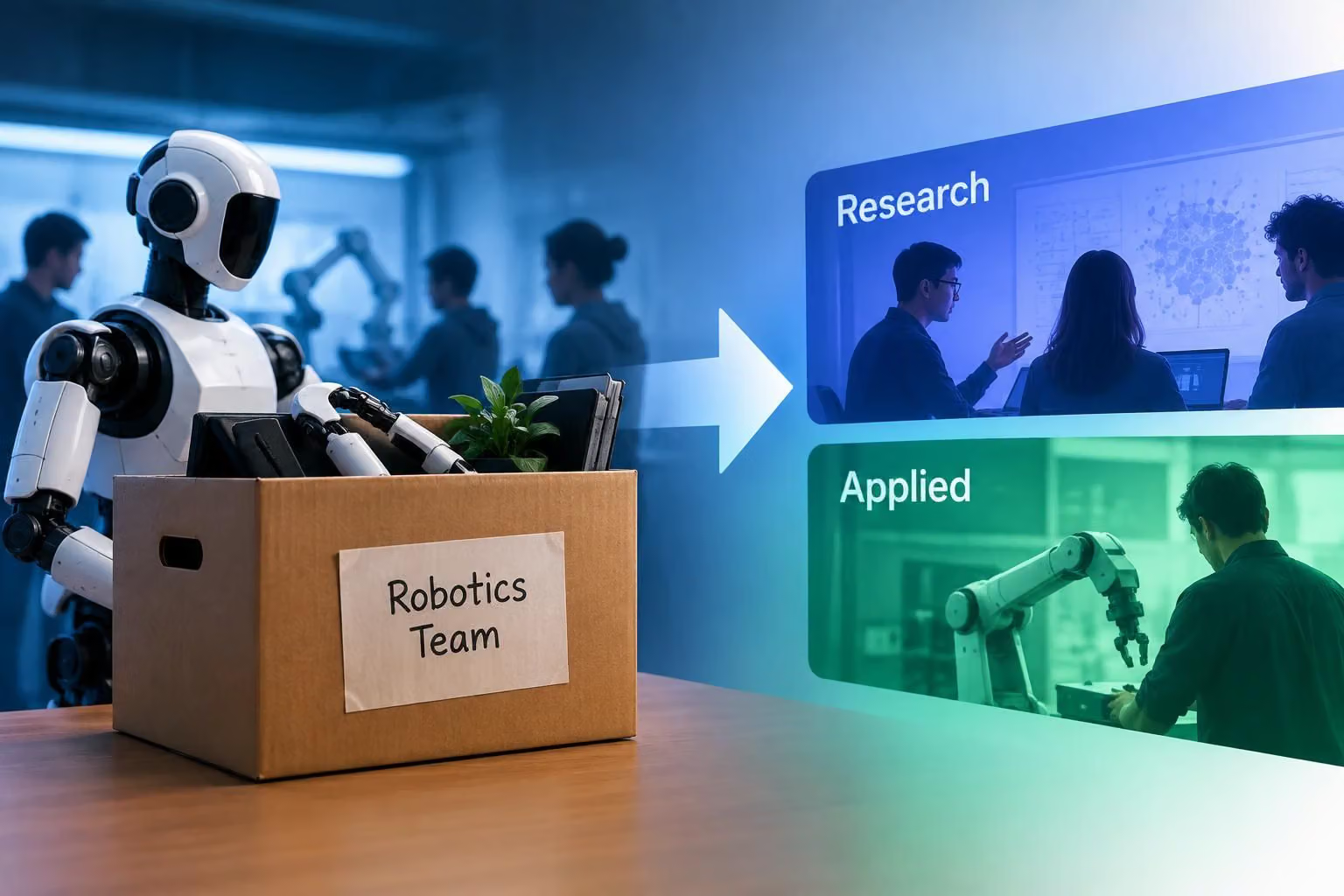
OpenAI has disbanded its stand-alone robotics team and placed its researchers in other groups. Fortune reported the change on November 13, 2026, and OpenAI confirmed it when asked. The company says the reshuffle is meant to speed robotics up, not end it.
The change was flagged on X by NIK (@ns123abc), who called it breaking news and wrote "it's over." Whether that reading holds depends on where the people went and why, and the reporting answers part of that.
What OpenAI moved, and where
Fortune's account says the robotics research group now sits inside the main research team, under Chief Research Officer Mark Chen. The applied robotics and hardware teams went into the larger Applied organization, which reports to President Greg Brockman. PANews summarised the same split.
Hardware engineers are still at the company, but they now answer to a different chain of command. The coverage describes reassignments rather than job cuts, and none of it mentions layoffs.
The timing is also telling. The change came recently enough that OpenAI had already booked a booth at CoRL, a robot-learning conference in Austin. When Fortune visited booth #208, it was empty and carried no OpenAI branding.
Why OpenAI says it made the change
Fortune reports that researchers were surprised by how well GPT-6 Astra, a general-purpose model, performed some robotic tasks when connected to a robot directly. If a general model can serve as a robot's decision-making layer, a separate team building specialised models for that job matters less.
Guanya Shi, a robotics professor at Carnegie Mellon, told Fortune he reads the move as a sign that robotics is "no longer a special problem." On that view, a robot becomes one more downstream task for a general model, much as coding and legal tools already are.
The explanation rests on Fortune's reporting, a company statement, and one outside expert's reading. The reporting does not include a detailed internal rationale.
The team's earlier rise and fall
This is not the first time OpenAI has wound down a robotics group. Its earlier team trained robot hands to solve a Rubik's Cube. VentureBeat reports that OpenAI said it had decided in October 2020 to stop robotics research, and the closure became public in July 2021. Co-founder Wojciech Zaremba, who led that group, later cited a shortage of training data as the main obstacle.
OpenAI rebuilt a stand-alone team in 2024 and announced a partnership with the startup Figure to develop AI models for humanoid robots. According to UA.News, that collaboration ended in February 2025, when Figure said it would develop robot AI on its own.
NIK's post says the team was relaunched five months before this change. The reporting dates the stand-alone rebuild to 2024, so the post's five-month figure most likely refers to a newer relaunch. The recruiting post from the @sama account describes that effort as growing out of world-simulation research.
The case for and against "it's over"
The stronger reading has real support. The stand-alone team no longer exists, and this is the second time OpenAI has broken up its robotics work. The 2024 Figure partnership also ended within about a year, and the empty booth at a major conference does not help the argument for a committed effort.
The case against is also real. OpenAI says robotics is still central to its long-range plans, and PANews reports that its goal of a first public humanoid robot demonstration remains set for 2027. Fortune's researchers were split: one said it is unclear any existing model will dominate robotics in the long run.
The most defensible view sits between the two. OpenAI has stopped treating robotics as a separate research bet and is wagering that its general models will carry it. That is a real strategic shift, not a retreat, but it is an unproven wager. The reporting describes demonstrations, not dependable deployment, and it does not say how reliable those results are.
What to watch next
Whether the 2027 humanoid demonstration happens on the stated timeline.
Whether OpenAI keeps hiring for robotics roles, and which division those roles sit in. The recruiting post asked for hardware, operations, systems and machine-learning engineers.
Whether senior robotics researchers stay or leave.
Whether OpenAI publishes robot results from general models, which would support the shift in strategy.
Key takeaways
OpenAI has moved its stand-alone robotics team into its main research group and its Applied division, according to Fortune's report.
The company says this speeds robotics up and that the field remains central to its plans.
The reasoning is that general models such as GPT-6 Astra can already run some robot tasks, which is early evidence rather than proof.
The 2027 humanoid demonstration is the real test of whether "it's over" is the right reading.
Frequently asked questions
Did OpenAI shut down its robotics program?
No, according to the company. OpenAI disbanded its stand-alone robotics team and moved staff into its research and Applied organizations. A spokesperson said robotics remains a core part of its long-term vision.
Who do OpenAI's robotics researchers report to now?
Robotics researchers sit in the main research team under Chief Research Officer Mark Chen. Applied robotics and hardware teams report through the Applied organization, which reports to President Greg Brockman.
Is OpenAI still aiming for a humanoid robot?
The reporting says the company's goal of a first public humanoid robot demonstration remains set for 2027. The reporting does not describe any such demonstration having happened yet.
Why did OpenAI disband its earlier robotics team?
Co-founder Wojciech Zaremba, who led the group, said a lack of training data was holding the work back. OpenAI had decided in October 2020 to stop robotics research, and the closure became public in July 2021.



0 comments
No approved comments yet. You can start the conversation.
Leave a comment