
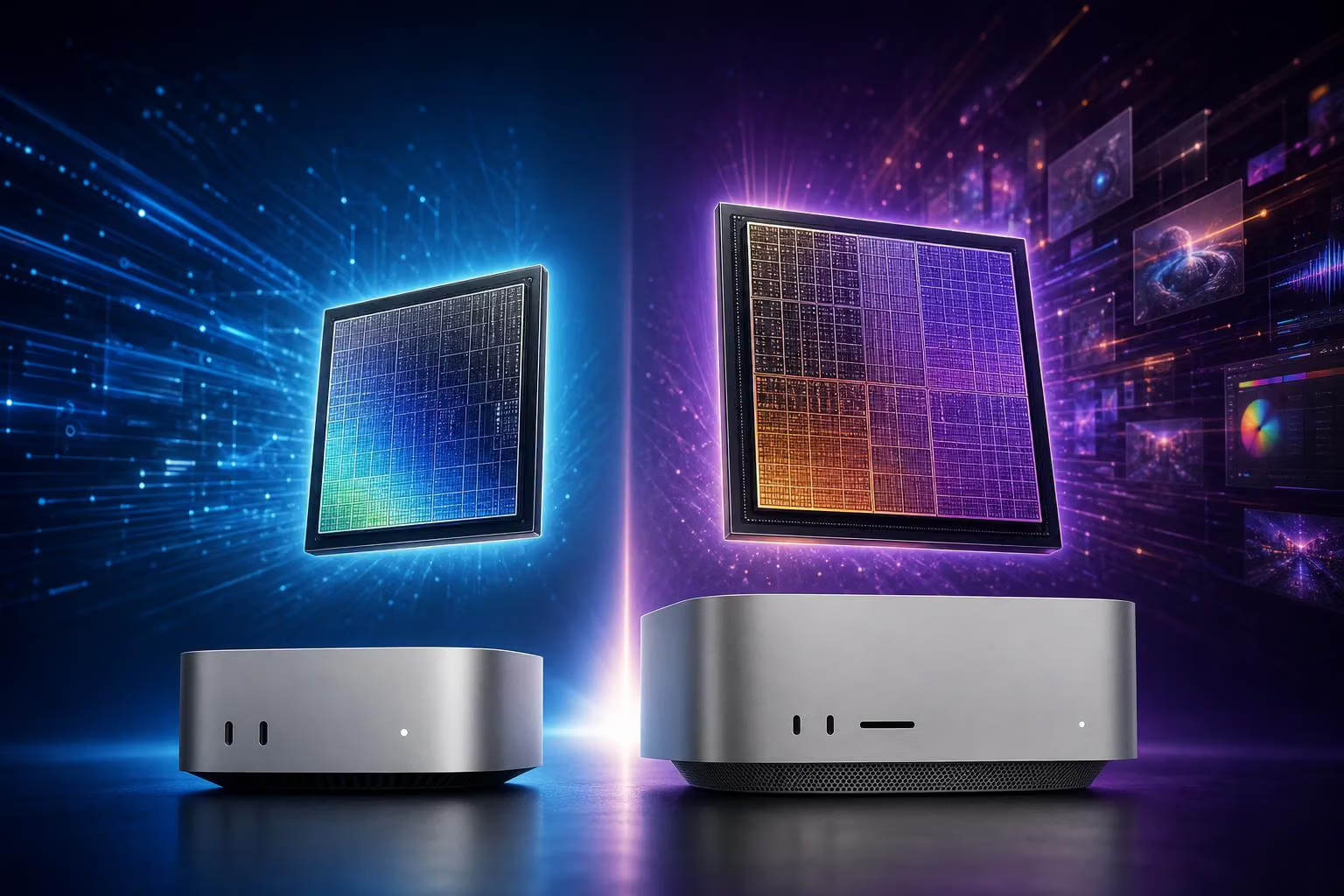
Apple has introduced the M6 chip in a new Mac mini and M5 Ultra in a new Mac Studio, positioning the two processors for different levels of desktop computing, according to Apple Newsroom. The announcement presents M6 as a more efficient platform for everyday work, coding, creative projects, and on-device AI, while M5 Ultra is designed for professional workloads that require substantially more compute and memory bandwidth.
Source: Apple introduces M6 and M5 Ultra for a big leap in performance and AI compute · Apple Newsroom
M6 brings more performance to everyday desktop work
M6 is built using a 2-nanometer process, which the report says enables greater transistor density in a smaller die. Its redesigned 12-core CPU adds two cores over M5 and combines two super cores, four performance cores, and six efficiency cores. This arrangement is intended to balance fast single-threaded work, demanding parallel tasks, and background activity without treating every workload as equally intensive.
Apple says M6 delivers the company’s fastest single-threaded performance, up to 1.2 times the multithreaded performance of M5, and up to 2.4 times the multithreaded performance of M1. The source identifies image editing, code compilation, file indexing, and agentic AI workloads as examples of tasks that can benefit from the updated CPU.
The chip also includes a 12-core GPU, with a Neural Accelerator in each core. Apple reports nearly 30 percent higher peak GPU compute for AI than M5 and more than eight times the peak GPU compute of M1. Updated shader architecture, Dynamic Caching, hardware-accelerated ray tracing, and a 50 percent increase in geometry rates are aimed at improving rendering, visual effects, and demanding games.
M6 supports up to 32GB of unified memory and up to 170GB/s of memory bandwidth. That combination gives the Mac mini room to handle demanding applications while also running supported language models locally. For developers, the announced hardware is intended to speed up activities such as compiling code, indexing files, and running multiple simulators in Xcode.
M5 Ultra raises the ceiling for professional workloads
M5 Ultra takes a different approach. It uses next-generation UltraFusion technology to connect two dual-die M5 Max chips, creating a quad-die architecture described in the report as a first for an M-series system on a chip. Apple says the interconnect provides more than 4.4TB/s of inter-die bandwidth and allows the four dies to operate as one unified processor.
The chip offers up to a 36-core CPU and an up-to-80-core GPU. Compared with M3 Ultra, Apple reports up to 1.25 times higher single-threaded CPU performance, up to 1.3 times higher multithreaded performance, and up to 40 percent faster graphics performance. The GPU also includes a Neural Accelerator in every core, which Apple says provides up to 4.5 times the peak GPU compute for AI compared with M3 Ultra.
This level of hardware is aimed at work such as complex 3D rendering, visual effects, scientific analysis, high-resolution video editing, and compute-intensive AI models. The updated Media Engine adds dedicated H.264 and HEVC support, four ProRes encode and decode engines, and hardware-accelerated AV1 decoding for video workflows.
The largest difference is the memory capacity. M5 Ultra supports up to 512GB of unified memory and up to 1.2TB/s of memory bandwidth, which is 50 percent higher than M3 Ultra according to Apple. The report says this can allow users to keep huge datasets in local memory and run language models with hundreds of billions of parameters on the device.
On-device AI is central to both chips
M6 and M5 Ultra use different amounts of hardware, but both are designed around local AI processing. M6 introduces a Dual 16-core Neural Engine, which Apple says can provide up to twice the peak compute of previous generations. System frameworks can use both engines at the same time, allowing supported applications to execute models faster.
M5 Ultra combines its 32-core Neural Engine with Neural Accelerators across its large GPU. That design is less about simply accelerating a small local model and more about providing the parallel compute and memory capacity needed for larger models, image generation, simulations, and other demanding AI workloads.
Apple’s Core AI, Core ML, Metal, and Xcode frameworks are designed to use the CPU, GPU, and Neural Engine together. Developers can use those tools with Apple Foundation Models, App Intents, or their own models to build and run AI features on the Mac. The report also says developers can fine-tune large AI models locally.
In practical terms, the announced designs suggest two different kinds of local AI benefit. M6 is intended to make AI-assisted everyday work, development, and prompt processing more responsive on a compact desktop. M5 Ultra is built for users who need to keep substantially larger models, datasets, and media projects in local memory rather than working within a smaller hardware budget.
Taken together, the two chips separate Apple’s desktop offerings by workload scale rather than by speed alone. M6 focuses on efficient responsiveness for common desktop and development tasks, while M5 Ultra is aimed at keeping very large professional and AI workloads on one machine.
How to read Apple’s performance claims
The performance figures in the report are Apple’s own comparisons. Apple says its testing was conducted in August 2026 using preproduction Mac mini and Mac Studio systems, selected industry-standard benchmarks, and specific memory and CPU or GPU configurations. The M6 comparisons used systems with M6, M5, and M1, while the M5 Ultra comparisons used systems with M5 Ultra, M3 Ultra, and M1 Ultra.
Those results describe the tested configurations and provide Apple’s stated view of the generational gains. Actual results can vary by application and workload, particularly because the two chips are designed for different kinds of work. The central distinction in the announcement is clear: M6 brings newer efficiency, graphics, and local AI hardware to everyday desktop use, while M5 Ultra combines extreme parallel processing with a much larger unified memory pool for professional-scale projects.


0 comments
No approved comments yet. You can start the conversation.
Leave a comment