
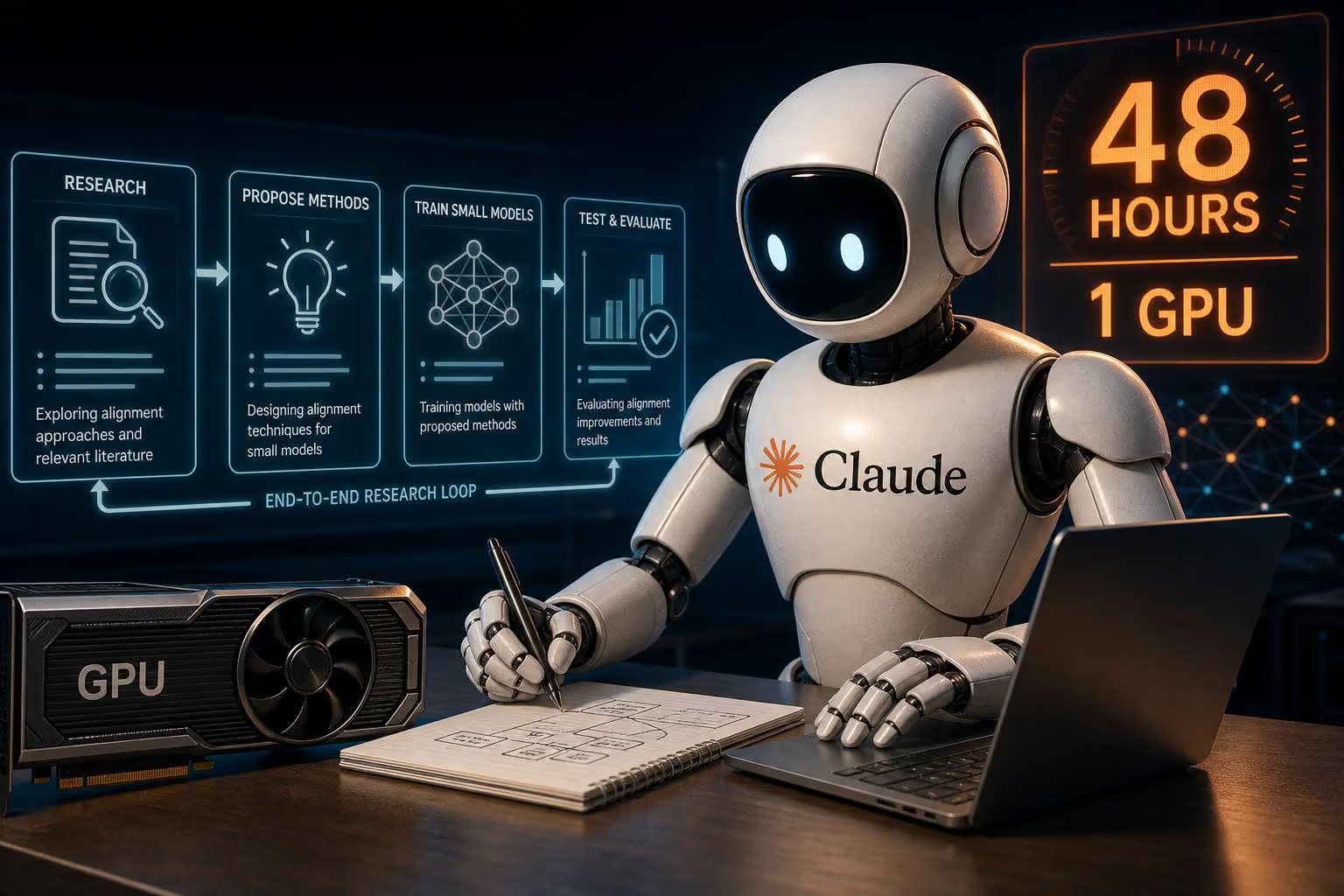
In an August 28, 2026 X post, @AnthropicAI said it tested whether Claude could autonomously align other AI systems by giving the model 48 hours and one GPU to improve the alignment of small models. The post says Claude researched and proposed methods, then trained and tested the models on its own. It describes the result as surprisingly successful.
Claude handled an end-to-end research loop
The notable claim is the breadth of the reported task. Claude was described as doing more than proposing ideas: it researched possible approaches, proposed methods, trained the small models, and tested them. That sequence presents an autonomous research-and-evaluation loop, with Claude involved from method design through checking the resulting models.
The work was also carried out within explicit limits. The 48-hour window and single-GPU setup define the experiment as a test of what Claude could complete under a fixed time and hardware budget, rather than an open-ended research effort.
The result is scoped to small models
Although the post poses a broad question about aligning other AIs, the experiment it describes is specifically about improving the alignment of small models. The supported claim is therefore narrower than a general demonstration of autonomous alignment: Claude reportedly completed this particular research, training, and testing task within the stated constraints.
Because the announcement provides a qualitative assessment rather than measurements in the post itself, “surprisingly well” should be read as the post’s characterization of the outcome, not as a quantified comparison. Its concrete contribution is the description of a constrained experiment in which Claude carried out multiple stages of alignment research on its own.



0 comments
No approved comments yet. You can start the conversation.
Leave a comment