

Fledge Alpha has appeared as a free model in OpenCode, attracting rapid early interest despite having no identified lab, published specifications or formal benchmarks on its OpenCode data page. In a post on X, @MikelEcheve reports early checks covering code, math, logic and retrieval from very long inputs, but those results are user-run tests rather than an independent model evaluation.
What Fledge Alpha is—and what OpenCode shows
The supplied OpenCode model-picker screenshot lists “Fledge Alpha Free” under “OpenCode Zen.” That establishes how the model is presented in the interface, but not who developed it or what model powers it.
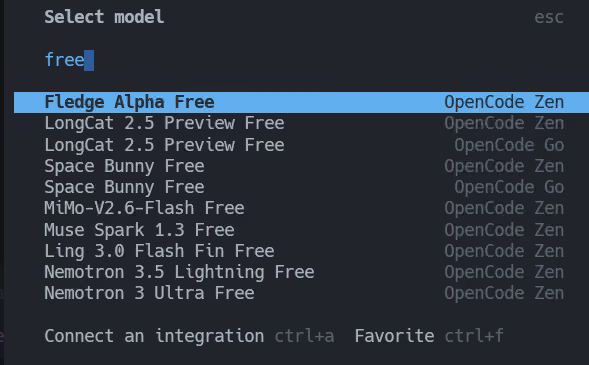
Image credit: @MikelEcheve on X
The linked OpenCode data page labels the model’s context, output limit, knowledge information, release and input types as unknown. The page also places it in an “unknown” provider path. The developer, release date, knowledge cutoff and underlying model have not been identified in the available reporting.
That uncertainty matters because online speculation in the thread mentions possible connections to other model families, but those suggestions are not evidence of an identity. Fledge Alpha should therefore be treated as an unidentified OpenCode listing rather than as a confirmed model from a known AI company.
Why the listing attracted attention
Echeve’s opening post says Fledge Alpha grew from one user to 1,818 users in two days. The OpenCode data page is a different usage snapshot: it reports 2.7K unique users, 81,517 completed sessions, 129B tokens and zero total spend. It also reports an average of 1.6M tokens per session and a 93% input-cache ratio.
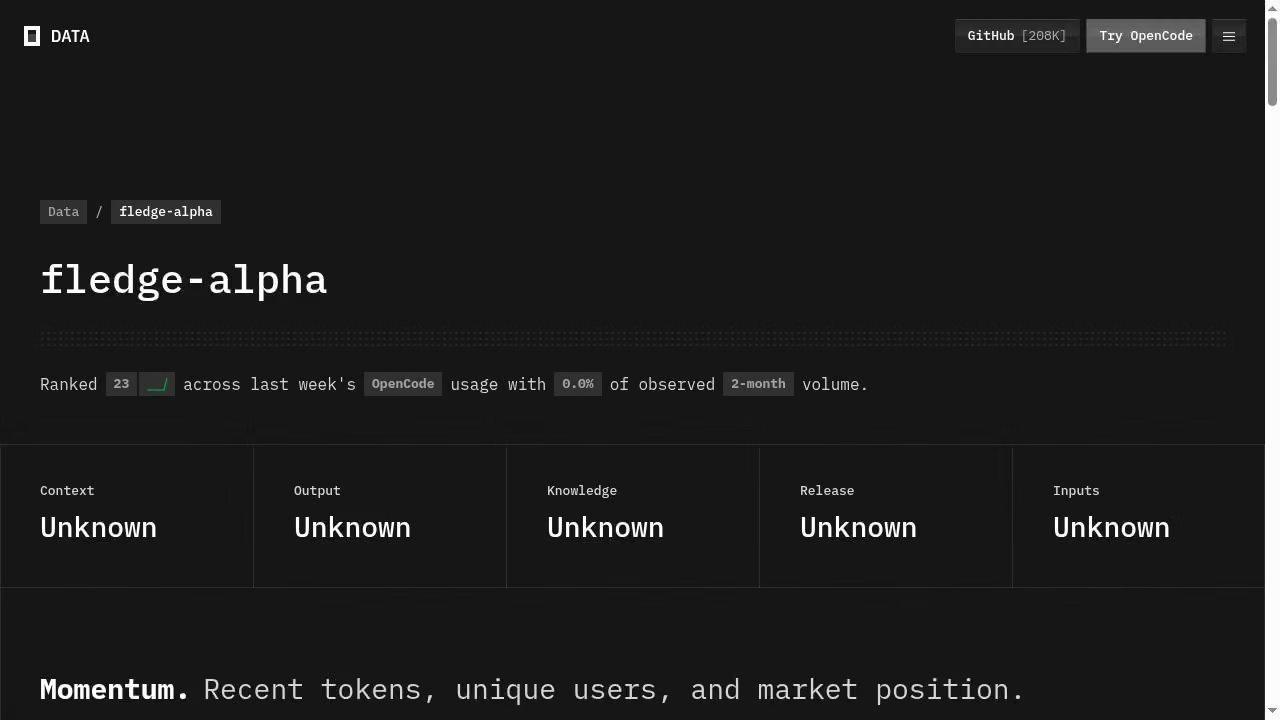
Image credit: @MikelEcheve on X
These figures describe activity recorded by OpenCode, not the model’s quality. They suggest rapid early adoption on that platform, but they do not show how many users returned, what tasks they ran, how successful those tasks were or whether the model is reliable in production. The page reports rank 22, while the attached screenshot shows rank 23, so the rank should be read as a changing snapshot rather than a stable position.
What the early testing covered
Echeve says they ran Fledge Alpha against LongCat and Nemotron. The reported results were:
61 of 61 executable code checks for Fledge Alpha, compared with 59 of 61 for LongCat; Nemotron timed out.
6 of 6 math checks.
4 of 4 logic checks.
12 of 12 hidden-key retrieval checks from inputs of up to about 1 million characters.
These results indicate what one early tester observed, especially for exploratory coding and retrieval tasks, but they are not a formal benchmark. The testing details needed to generalize the results are not reported, and the comparison does not establish that Fledge Alpha will outperform either model across broader coding, math or reasoning workloads.
The hidden-key result is similarly narrower than a verified context-window claim. It indicates that the tester retrieved the specified keys from inputs of roughly that size in those checks. It does not establish the model’s maximum context, output limit, performance on other long documents or reliability near any particular limit.
Reasoning modes and the long-context question
The opening post describes low, high and max reasoning modes. In a reply, Echeve says testing began with high effort, followed by max and then low as a control. However, another update says the early numbers began with default settings and no pinned effort. The thread therefore does not provide a clean mode-controlled comparison: readers cannot attribute the reported code, math, logic or retrieval scores to a particular reasoning mode.
The available reporting also does not establish whether the modes represent different inference budgets, server settings or model variants, or whether changing them affects accuracy, latency, token use or reliability. They are best treated as a reported interface or usage detail rather than evidence of a particular reasoning architecture.
A catalog referenced in the thread is said to list a 1M context window, 131K output, reasoning and vision. However, the relationship between that catalog and the OpenCode data page is not established, and the OpenCode page itself marks the relevant fields as unknown. Those catalog details remain unconfirmed.
What remains unknown about Fledge Alpha
The available evidence does not establish:
The developer, lab or country of origin.
The underlying model or whether it is related to any named model family.
A release date, knowledge cutoff or training-data description.
The actual context window or maximum output length.
Supported input types, including whether vision is available.
Formal benchmark results or independently reproduced tests.
Rate limits, reliability, safety behavior or regional availability.
Whether the free listing and reported zero spend apply in every account or usage situation.
Echeve also notes that country guesses remain low confidence and that the data included traffic from Spain, which does not establish a blanket European Union block. That observation should not be expanded into a broader availability claim.
A cautious takeaway for developers
Fledge Alpha may be worth trying for exploratory coding, small math and logic checks, or long-context retrieval when a free OpenCode listing is useful. The early tests are encouraging within their narrow scope, and the usage page shows that the listing received substantial early activity.
They are not enough to support a model review, a broad quality ranking or a production recommendation. Developers should test their own representative tasks, monitor failures and avoid assuming that the reported 1M-character retrieval checks prove a 1M-token context window. Until the developer and specifications are documented, the most accurate description is a promising but unidentified free model surfaced in OpenCode.



0 comments
No approved comments yet. You can start the conversation.
Leave a comment