
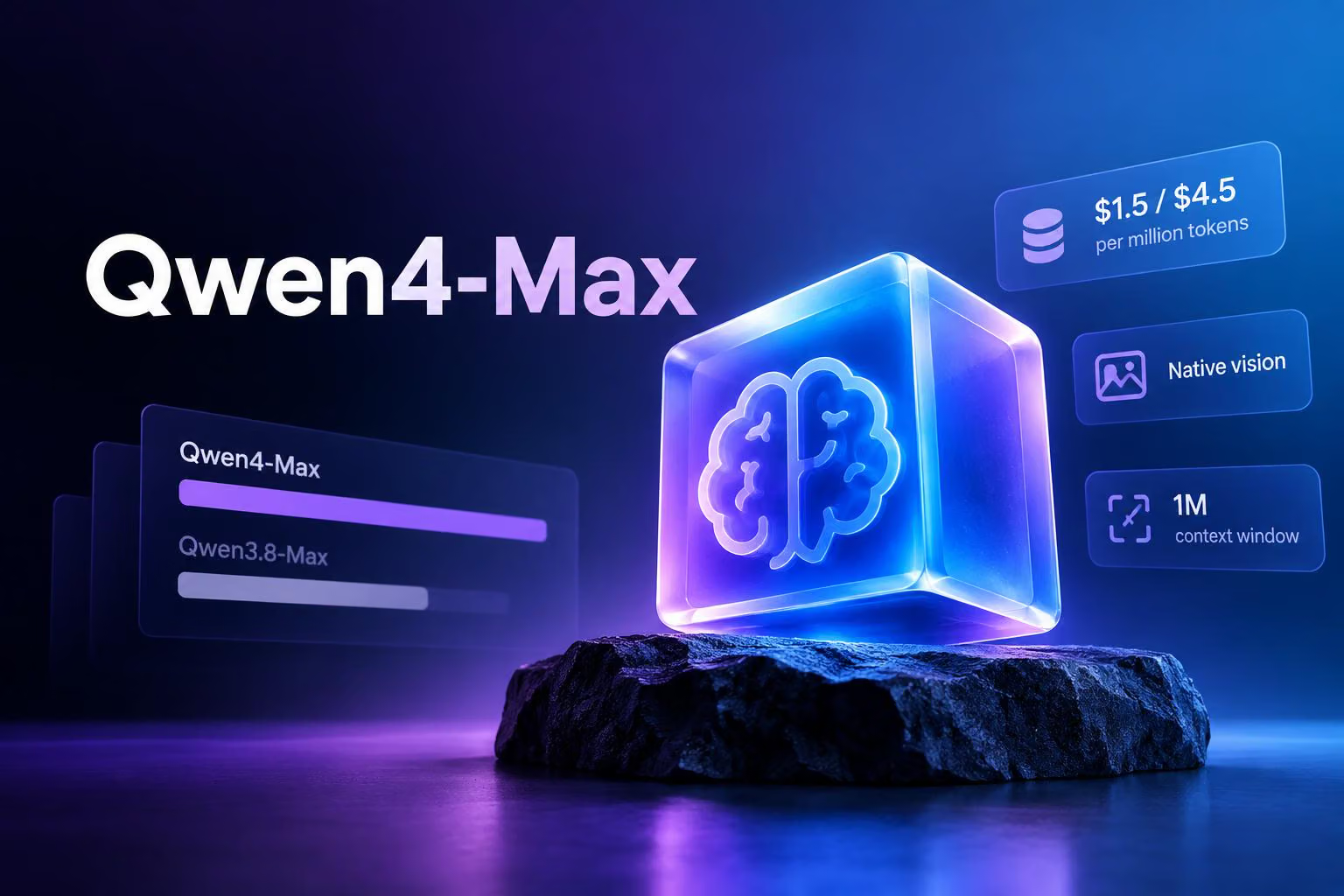
Qwen4-Max is Alibaba's new flagship model, and access is open through the QwenCloud API at $1.5 per million input tokens and $4.5 per million output tokens. The Qwen team announced it on X on November 16, 2026. Its central claim is about efficiency: the model reaches higher scores on up to about 50% fewer tokens than Qwen3.8-Max, a saving Alibaba puts at more than 60% lower cost per task in its own internal testing.
The post also credits the model with native vision and a one-million-token context window. Those figures deserve careful reading, because nearly all the evidence behind them comes from Alibaba. Below: what the model is built on, what it costs, how it compares with its predecessor and rivals, how to start using it, and what remains open.
What Qwen4-Max is built on and what it handles
The post describes a new mixture-of-experts (MoE) architecture. In that design, only part of the network runs for each token, which keeps serving costs below what the total parameter count suggests. The launch blog puts the backbone at 2.4 trillion parameters, with about 71 billion active per token and 328 billion more N-gram Embedding parameters on top.
The QwenCloud listing accepts text, images and video as input and returns text. Among the tasks the post says it handles are 3D modeling and game development, along with work in manufacturing, finance, law, healthcare and science. On game engines, the blog names Unity, Unreal Engine and Godot as ones it handles well. It also points to financial research, legal work and clinical settings as demanding areas where it is meant to help.
These examples are demonstrations rather than measurements. The post attaches short videos on 3D design, manufacturing and a coolant-materials project, but it gives no accuracy figures for those tasks. Readers in those fields should treat them as a starting point for their own tests.
What does Qwen4-Max cost per token?
The QwenCloud model page lists these rates per million tokens:
Input: $1.5
Output: $4.5
Implicit cache input: $0.075
Explicit cache creation: $1.875 for 5 minutes, or $3 for 1 hour
Explicit cache read: $0.075
Alibaba frames these as cuts against Qwen3.8-Max, and says implicit cache pricing fell 70% in the same step. OpenRouter's listing matches those rates and gives the same release date.
The predecessor's price is where sources disagree. One Yotta Labs explainer lists Qwen 3.8-Max at $2 input and $6 output per million tokens. Yotta Labs' own gateway listing gives $1.50 and $4.50, which would equal the new model's rates and undercut the "lower" claim. Check the live rate card before budgeting.
A lower per-token price only helps if the model also finishes work in fewer tokens. That is why the per-task figures in the post matter more than the price sheet.
How much better is Qwen4-Max than Qwen3.8-Max?
In the thread, Alibaba says its Work360 tests used about 24% fewer tokens at the Xhigh effort setting and 35% fewer at High. On Terminal-Bench 4.0 the reduction is about 48% and 49%. In Alibaba's figures, an average Work360 task drops from $4.43 to $1.67.
Work360 is Alibaba's taxonomy for professional work, organized in three levels with 26 top-level domains, 182 subdomains and 721 specialized fields. The launch blog reports a score of 52.69 for Qwen4-Max in its latest evaluation, against 47.74 for Qwen3.8-Max. That matches the roughly 10% gain the thread describes.
The charts attached to the thread show the trade-off clearly. At each effort setting, Qwen4-Max sits up and to the left of its predecessor, meaning higher scores on fewer tokens. On Terminal-Bench, it reaches a score near 48 at roughly 150,000 tokens per task, while Qwen3.8-Max needs close to 290,000 tokens to reach the high 30s.
The efficiency result matters more than the score bump. A 10% gain on a self-built benchmark is modest. But if the token savings hold for your work, the same budget buys more finished tasks, which is what a team paying per token actually feels.
How does Qwen4-Max compare with Opus 5.5, GPT and Kimi?
The benchmark chart in the post compares Qwen4-Max with Qwen3.8-Max-0902, Opus 5.5, GPT6.1-Sol, GPT6-Astra and Kimi K3.1 across 16 tests. Qwen4-Max posts the top score on four: DeepSWE v1.1 for agentic coding (75.7, against 75.5 for Kimi K3.1), Agents' Last Exam v1.1 (46.7 against 43.4), HLAB-Vals-1.1 legal agent work (21.3 against 15.4 for its predecessor) and BioMysteryBench (85.0 against 84.4).
It trails on most of the rest. Opus 5.5 leads CodeArena (1816 to 1750), ProgramBench (65.0 to 31.5), JobBench (75.4 to 68.5), APEX-Agents v1.1 (73.5 to 72.1) and Humanity's Last Exam (59.8 to 51.7). Kimi K3.1 leads Terminal-Bench 4.0 (67.2 to 48.5) and Automationbench-AA (73.3 to 72.5). GPT6-Astra leads HealthBench Professional (66.0 to 60.0), Chartography (71.1 to 54.2) and Video-Index (76.7 to 68.1).
That makes Qwen4-Max a strong specialist rather than a clear overall leader. Its best results come in agentic and professional work, and its widest gaps are in ProgramBench, Terminal-Bench and visual tasks. The chart is Alibaba's own selection of benchmarks and rivals, so it is not a neutral league table.
How to start using Qwen4-Max
Developers can call the model as qwen4-max through the QwenCloud API. The model page includes sample code using an OpenAI-compatible client with thinking switched on, and it says the API works with OpenAI and Anthropic interfaces. Its listed limits are a 991K-token maximum input, a 393K-token maximum output and 5 million tokens per minute. Supported features include function calling, structured outputs, batch processing, context caching and web search.
No coding is needed to try it. The post says the model is available in Qwen Studio, QwenWork and Qoder. For a subscription route, the Token Plan has Lite, Essential, Standard and Pro tiers. Essential gives 2.25 times Lite's credits, Standard 4 times and Pro 10 times, and concurrent agents rise from one or two on Lite to six to eight on Pro. The plan works with tools that support OpenAI and Anthropic protocols, including Claude Code, Cursor, Cline, Codex, OpenCode and Qwen Code. A promotion lets new customers start from $3.
The pricing page's model table did not load in the copy reviewed, so which Token Plan tiers include qwen4-max is not confirmed here. Check that before you subscribe.
What changed from the preview, and what is still open
The model did not arrive all at once. On November 11, Alibaba said on X that Qwen4-Max was in preview on its Token Plan, with early access in several apps. A Yotta Labs explainer says the preview used the ID qwen4-max-preview, ran until November 25, and had no per-token price. The post now lists a standard qwen4-max API with per-token rates, so access has moved from a subscription-only preview to pay-per-token use.
On open weights, the post says the smaller Qwen4 models will be released, and says nothing about Max. A roundup citing Tech Times reported on November 12 that no weights, licence or per-token price had been published for the preview. The precedent is disputed. The Yotta explainer says that in the Qwen3.8 generation, Max launched first and its weights followed about ten days later. An analysis on the RITS site at NYU Shanghai argues that every Max-tier Qwen release since September 2025 has been API-only. The two accounts conflict, so weights for Max should be treated as unannounced.
How to weigh the claims before switching
The efficiency figures come from Alibaba's internal evaluation, and Work360 is a benchmark the company built. Treat them as a strong hypothesis rather than settled fact. A model that wins four of 16 tests picked by its maker is a credible specialist, not a proven leader.
Early outside testing points the same way. A hands-on test of the preview found less excessive overthinking than Qwen 3 and better accuracy on fine visual details. That supports the efficiency claim qualitatively, but it covered the preview, not the current API release.
The practical test is simple. Run a sample of your real tasks through both models. Record input and output tokens and the total cost of each task that finishes correctly. Per-token prices alone can mislead, because a cheaper model that writes longer answers can cost more.
Key takeaways
Qwen4-Max is available through the QwenCloud API as qwen4-max at $1.5 input and $4.5 output per million tokens, with a 1M-token context.
Alibaba says it uses up to about 50% fewer tokens than Qwen3.8-Max and cuts cost per task by more than 60%, based on its own tests.
On Alibaba's 16-test chart, Qwen4-Max posts the top score on four and trails on most of the others.
Open weights are promised only for smaller Qwen4 models, and none are announced for Max.
Before switching, measure cost per finished task on your own workload, since per-token prices alone do not settle it.
Frequently asked questions
What is Qwen4-Max?
Qwen4-Max is Alibaba's flagship multimodal model in the Qwen4 family. It accepts text, images and video as input and returns text, with a 1M-token context window. Alibaba positions it for coding, office work, frontend design and agent tasks.
How much does Qwen4-Max cost?
The API lists $1.5 per million input tokens and $4.5 per million output tokens. Implicit cache reads cost $0.075 per million, and explicit cache creation costs $1.875 for 5 minutes or $3 for 1 hour. Third-party sources disagree on Qwen3.8-Max's price, so compare against your current bill.
Is Qwen4-Max better than Qwen3.8-Max?
Alibaba says yes: it scores 52.69 against 47.74 on Work360 and uses fewer tokens per task. Those results come from Alibaba's own tests, so independent checks matter. Running both models on your own tasks gives the fairest answer.
Are Qwen4-Max open weights available?
No weights have been announced for Qwen4-Max. The post promises open weights only for smaller Qwen4 models. Sources disagree on what Qwen3.8 did, so no release date for Max can be inferred.
How do I start using Qwen4-Max?
Developers can call qwen4-max through the QwenCloud API, which works with OpenAI and Anthropic-style clients. Non-developers can try it in Qwen Studio, QwenWork and Qoder. Subscribers can also reach it through the Token Plan, which works with coding tools such as Claude Code and Cursor.



0 comments
No approved comments yet. You can start the conversation.
Leave a comment