
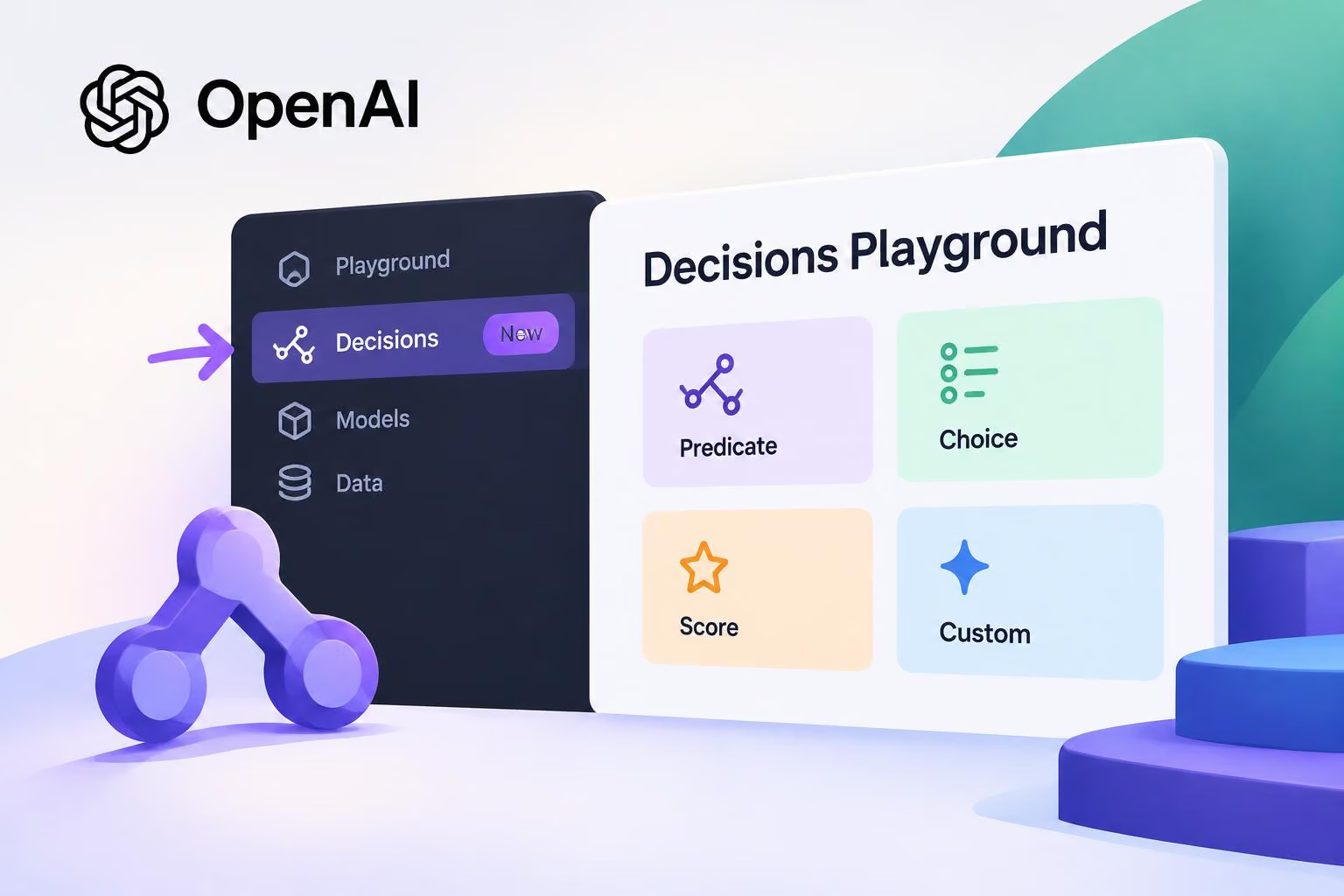
OpenAI's Platform sidebar now has a Decisions tab marked "New", opening a playground for the Decisions API, according to a post by @testingcatalog on X. OpenAI's own guide says developers can use that Playground to try questions and inputs before writing code.
The screenshot in the post shows the Decisions item marked "New" and highlighted with an arrow, along with the playground it opens. The API behind it is not new: OpenAI's community announcement put the Decisions API in public beta on Oct 6, 2026.
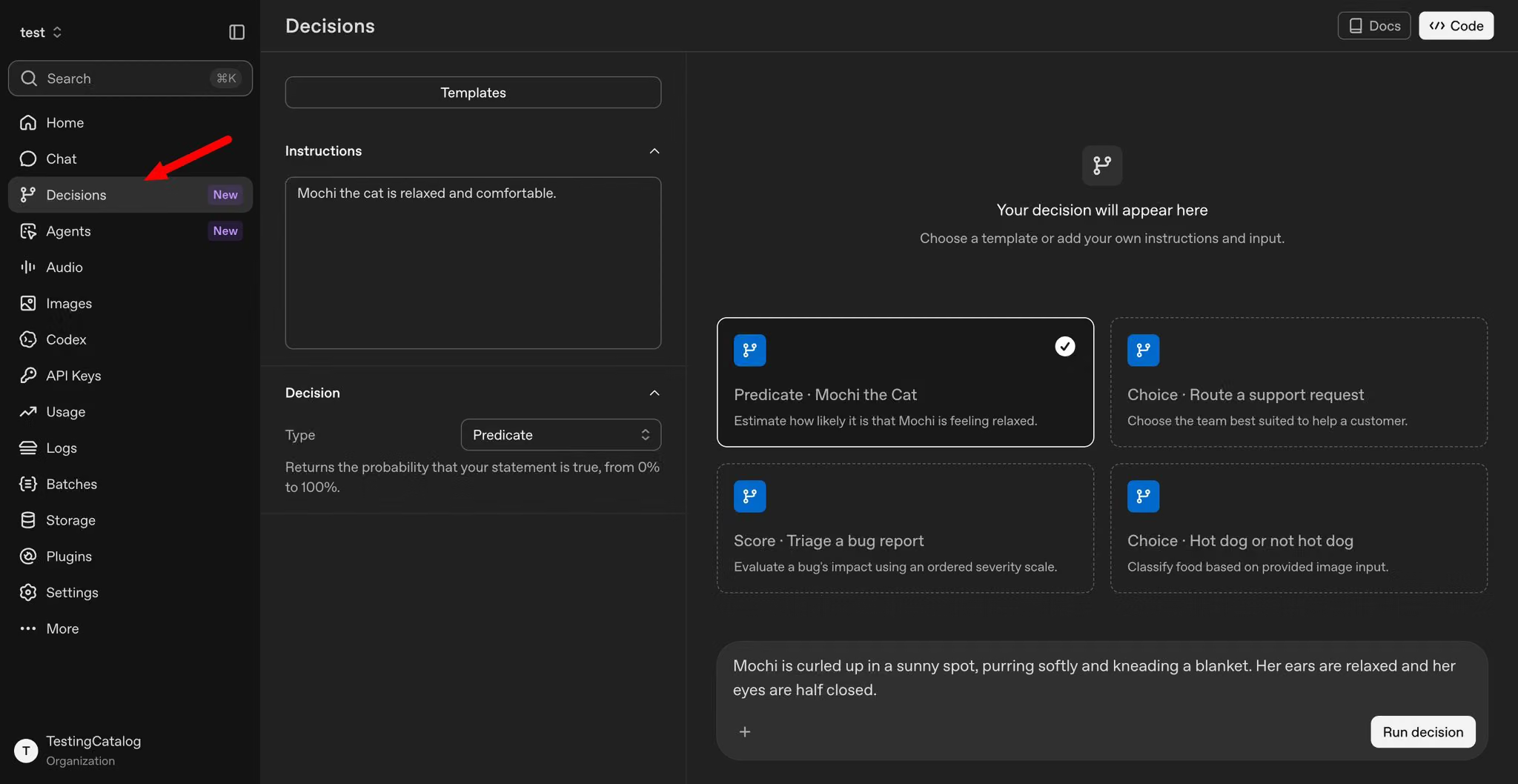
Image credit: @testingcatalog on X
What the Decisions playground shows
The screenshot shows a template picker with four starting points:
Predicate · Mochi the Cat: "Estimate how likely it is that Mochi is feeling relaxed." The instruction reads "Mochi the cat is relaxed and comfortable," and the input describes a cat purring on a blanket.
Choice · Route a support request: "Choose the team best suited to help a customer."
Choice · Hot dog or not hot dog: "Classify food based on provided image input."
Score · Triage a bug report: "Evaluate a bug's impact using an ordered severity scale."
The page has Instructions and Type fields, a Run decision button, and Docs and Code buttons at the top. The screenshot shows no run result, so the "Probability True" line in the post is the poster's caption, not output visible in the image.
What each question type does
OpenAI's Decisions guide describes the API as evaluating text, images or both and returning typed answers, and the templates map onto its three types:
Predicate returns a probability from 0 to 1 that a condition is true, as in the Mochi example.
Choice returns one of the values you supply, such as a department for a support ticket, with probabilities and a confidence field.
Score rates an input against ordered levels, such as bug severity, and returns the probability-weighted average of the level indices, so a score can fall between levels.
The guide says to try the Playground before writing code. The API itself is a dedicated POST /v1/decisions endpoint, in public beta, with general availability expected "in the coming weeks." gpt-6-luna is the only supported model. OpenAI says the API is about 10x faster than the Responses API.
Cost and a caveat
According to OpenAI's announcement, input on gpt-6-luna costs $0.10 per 1M tokens, and you pay only for input tokens, with no cache-read, cache-write or output-token charges. The standard pricing and model pages do not list Decisions separately.
One user on OpenAI's community thread says the playground's field descriptions for decisions are misaligned from the underlying API. That is a single user report, and OpenAI has not confirmed it, so check the guide's request format when moving from playground to code.
Our read: this is an interface change rather than new capability, but a useful one for teams that route tickets or classify content. They can try all three question types in the dashboard while the API is still in beta.


0 comments
No approved comments yet. You can start the conversation.
Leave a comment