
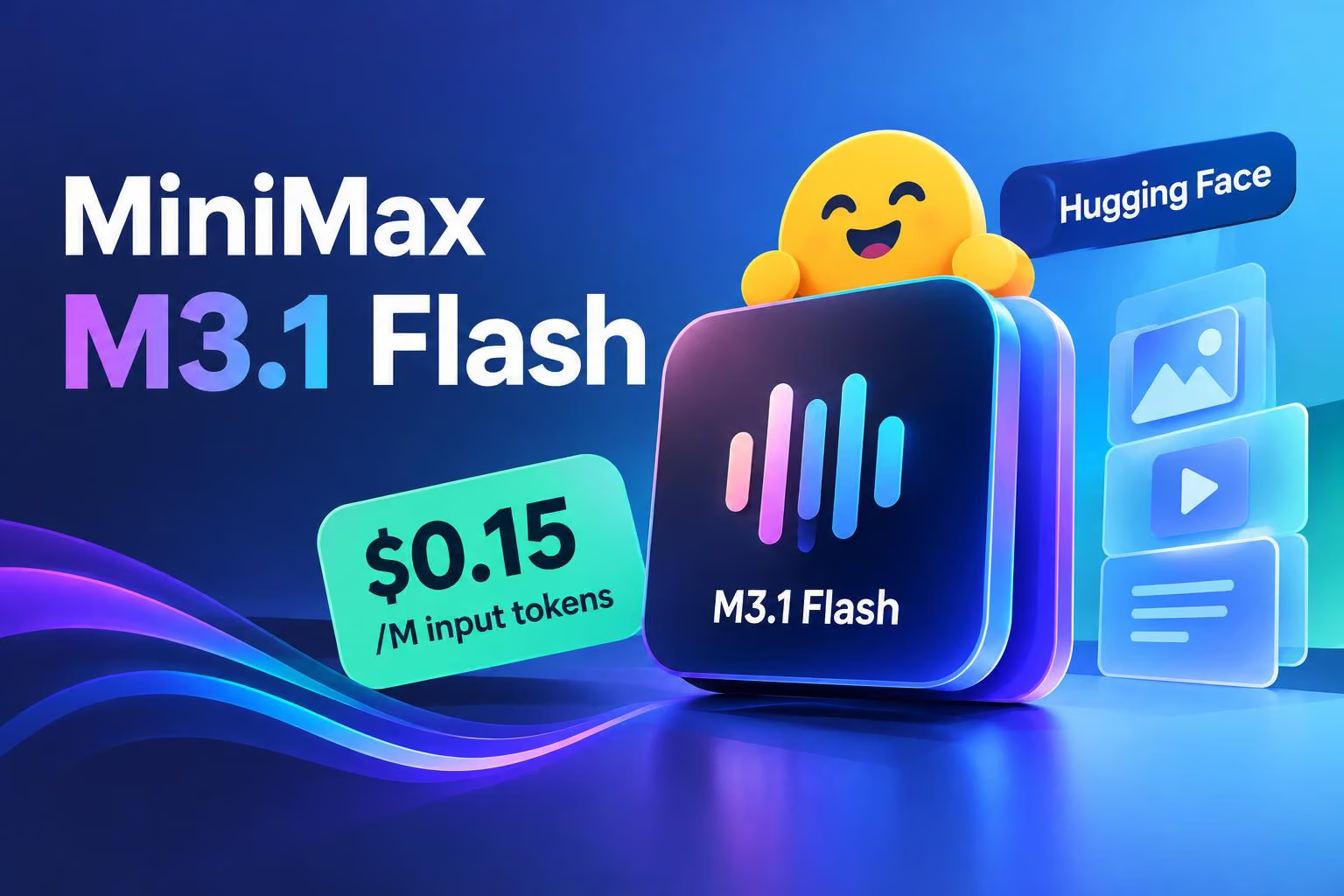
MiniMax M3.1 Flash is out with open weights on Hugging Face and an API price of $0.15 per million input tokens, a quarter of MiniMax-M3's list rate, according to @MiniMax_AI. The model card confirms the weights and specs, and MiniMax's pricing page lists the price. MiniMax's own benchmark table is mixed against rivals, with wins, ties and some clear losses.
What's new in M3.1 Flash
MiniMax-M3.1-Flash is a native multimodal mixture-of-experts model with about 428B total parameters and 23B activated per token. The model card says it accepts text, image and video input, produces text output and supports a context window of up to 1M tokens. Its stated focus is coding, agentic workflows, computer use and cybersecurity.
The card lists three changes from M3:
Sparse attention throughout: the first three full-attention layers are replaced with sparse attention.
Quantization-aware training: the routed MoE experts and attention paths are quantized during training, which the card says reduces memory footprint and improves serving efficiency.
DSpark speculative decoding: it replaces the earlier EAGLE-like MTP approach, and the release includes the draft head for compatible serving implementations.
Reasoning depth is tunable. Set reasoning_effort in the chat template to low, medium, high, xhigh or max. MiniMax recommends temperature=1.0 and top_p=0.95.
The launch blog adds speed and cost claims. MiniMax says online inference is nearly three times faster, with output speeds of 200+ tokens per second and a median above 170, and that overall usage cost on agentic tasks is 70% lower than its predecessor (the blog does not name which model). Those are MiniMax's figures; the model card publishes no latency or per-task cost data to check them against.
Price and access
The MiniMax pricing page lists MiniMax-M3.1-Flash at $0.15 input, $0.60 output and $0.015 cache read per million tokens, with one flat row and no separate long-context rate. The same page lists M3 at $0.60 / $2.40 / $0.12 for inputs up to 512k tokens, currently shown with a "Permanent 50% off" at $0.30 / $1.20 / $0.06.
Per 1M tokens | M3.1 Flash | M3 (discounted) | M3 (list) |
|---|---|---|---|
Input | $0.15 | $0.30 | $0.60 |
Output | $0.60 | $1.20 | $2.40 |
Cache read | $0.015 | $0.06 | $0.12 |
Our worked example, from those rates: a job with 1M input tokens and 200k output tokens and no caching costs $0.27 on Flash ($0.15 + $0.12). The same job costs $0.54 on discounted M3 and $1.08 at M3's list price. Flash's per-token rates are 25% of M3's list and 50% of its discounted price. That is a per-token comparison only; the pages do not publish how many tokens a given task uses on each model.
The API docs model list shows MiniMax-M3.1-Flash alongside M3. The post also points to the MiniMax API, M Plan and the MiniMax Code desktop app, and says day-0 serving support came from Inferact and SGLang.
Running the weights yourself
Download with hf download MiniMaxAI/MiniMax-M3.1-Flash --local-dir MiniMax-M3.1-Flash. The model card recommends SGLang, vLLM and TokenSpeed for serving, and lists Transformers, KTransformers, unsloth and ATOM as integrations in progress. Usable context length and throughput, the card says, depend on GPU memory and the serving configuration.
Separately, MiniMax's FlagOS multi-chip page says the FlagOS community provides W8A8 quantized versions for platforms from nine chip vendors: T-Head, NVIDIA, MetaX, Hygon, Huawei Ascend, Moore Threads, Iluvatar, Kunlunxin and Tsingmicro. It says FlagOS requantizes the original QAT NVFP4 weights into that common format.
How the benchmarks compare
The scores in the post match the model card's table, which is MiniMax's own, with harness details in its evaluation notes. It compares Flash against DeepSeek V4.1 Flash-1017, DeepSeek V4.1 Flash, Kimi K3, GLM-5.3, GPT-5.6 Sol and Opus 5. (Our earlier coverage of DeepSeek-V4.1-Flash-1017 has context on that rival.)
Benchmark | M3.1 Flash | Comparison in the card |
|---|---|---|
Automation-Bench v1.0.6 | 62.8 | Ahead of DeepSeek V4.1 Flash-1017 (60.5) |
LOCA-Bench 256K | 60.3 | Ahead of GPT-5.6 Sol (60.0) |
BankerToolBench | 76.2 | Ties Opus 5 (76.2) |
DeepSWE v1.1 | 73.7 | Behind DeepSeek V4.1 Flash-1017 (77.0) |
Terminal Bench 4.0 | 38.1 | Behind DeepSeek V4.1 Flash-1017 (42.3) and Opus 5 (51.8) |
OSWorld 2.0 | 61.7 | Behind Opus 5 (70.6) |
NL2Repo-Bench | 61.2 | Behind Opus 5 (75.3) |
Our read: Flash looks strongest on tool-driven workflow tasks and long-context retrieval, and weakest on terminal work, repo-level generation and computer use against the top closed model. The post's "generational leap" wording is MiniMax's framing. The card does not compare Flash with M3 on these tests, so it does not show how large the step up from M3 is.
Two details matter when reading the table. The post writes "OSWorld V2" where the card says "OSWorld 2.0". The card also compares against "Opus 5", and says its results are for the official weights and that third-party quantizations may differ. The harnesses vary by test (OpenCode, Codex, Claude Code, mini-SWE-agent), so the columns are not strictly like-for-like.
Who should care
Our view: API users running agent loops get the clearest gain, since the per-token price is well below M3's and MiniMax's own table shows it level with or ahead of some rivals on several agentic tests. Teams that need self-hosting can now get the weights, but the card gives no hardware requirements and says only that usable context length and throughput depend on GPU memory and the serving configuration. If your work leans on terminal tasks, repo-level generation or desktop computer use, MiniMax's own table shows rivals ahead, so run your own tasks before switching.
The features described in the earlier preview report, reasoning-effort levels, image and video input and DSpark, now match the released model card. The card does not confirm that report's "Wednesday" guess or its codename. The preview was covered separately when M3.1-Flash-Preview reached MiniMax Code.


0 comments
No approved comments yet. You can start the conversation.
Leave a comment