

A five-post thread from @LuminaBench reports that a model identified as “M3.1-preview” is undergoing partner serving tests. The thread describes selectable reasoning effort, image and video support, and DSpark speculative decoding, but it does not establish that MiniMax has publicly released the model. Source on X
The report predicts a Wednesday launch and connects the model with the possible internal codename “space bunny.” Those details remain speculation.
What the report says about the M3.1 preview
The thread presents the model as being tested through partner serving systems rather than as a generally available product. In this context, “partner serving tests” suggests that external or partner infrastructure may be handling requests to a preview checkpoint, but the source does not explain who the partners are, how broad the testing is or whether users can access it.
One attached screenshot appears to show a checkpoint named MiniMaxAI/MiniMax-M3.1-preview-private. That identifier is evidence of what the screenshot displays, not independent confirmation that the checkpoint is an official public release or that the model is ready for general use.

Image credit: @LuminaBench on X
Reported reasoning-effort controls
The thread says M3.1 supports reasoning effort ranging from low to max. Reasoning effort is a request-level choice that reportedly controls how much reasoning the model applies before producing an answer. Lower settings could be intended for lighter processing, while higher settings could allow more extensive reasoning, but the report does not show how the settings affect quality, speed, latency or cost.
A second screenshot appears to show a top-level reasoning_effort request field with expected values including max, xhigh, high, medium and low. It also appears to say that no validation or default is required and that MiniMax passes the field to the provider. These are details visible in a screenshot shared by the thread, not confirmed public API documentation.
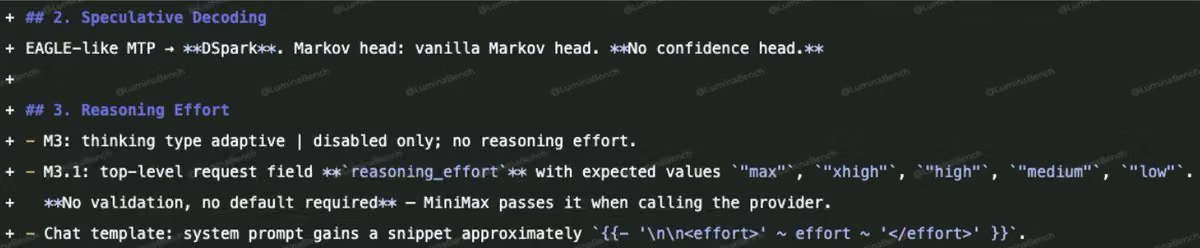
Image credit: @LuminaBench on X
The screenshot also appears to contrast M3.1 with an earlier M3 configuration, describing the earlier model as having adaptive thinking that could only be disabled. That comparison does not show how M3.1 behaves in practice because the report includes no request examples or measured results.
Image and video support is reported, but its scope is unclear
The opening post describes M3.1 as supporting image and video inputs, calling it multimodal. If accurate, that would mean the model is intended to process more than text. However, the thread does not specify supported file formats, video length limits, image resolution, input size, output behavior or whether these capabilities are available to every test user.
It is therefore too early to describe M3.1 as fully multimodal in a confirmed product sense. The available evidence supports only the narrower statement that image and video support was reported as part of the partner tests.
What the DSpark reference establishes
The report also names DSpark speculative decoding. Speculative decoding is a serving technique in which a faster auxiliary process proposes output tokens that the main model can check, potentially changing how generation is served. The source does not provide performance measurements, so it cannot show whether DSpark makes M3.1 faster, cheaper or more responsive.
The screenshot refers to an EAGLE-like multi-token prediction component leading to DSpark. In general terms, that describes an auxiliary component proposing multiple future tokens for the main model to check before they are accepted. The screenshot provides a configuration label, not evidence of how this setup affects M3.1’s quality, latency or cost.
Release timing and the “space bunny” name are unconfirmed
The thread says the poster is sticking with Wednesday as a guess for the drop. That is a prediction, not a confirmed launch date. Later replies identify “space bunny” as a possible codename associated with the model in OpenCode, but the report does not confirm that MiniMax uses the name officially or that it refers to M3.1.
Readers should therefore separate the reported testing status from the expected release. A model can appear in a private checkpoint or partner environment without having a public API, final specifications or a launch schedule.
What readers still cannot conclude
The report does not establish whether MiniMax M3.1 is publicly available, when it will launch, which users can access it or what it will cost. It also provides no benchmark or independent test showing the model’s quality, reasoning performance, multimodal accuracy or serving speed.
For now, the thread is evidence of reported partner testing, not confirmation of a public MiniMax release.


0 comments
No approved comments yet. You can start the conversation.
Leave a comment