
Muse Wonder, Meta's new family of frontier models for agent work, is available now through the Meta Model API and Muse Code, and Muse Wonder Full is available now for Muse Code subscribers, according to a launch post from @finkd on X and Meta's announcement. The Wall Street Journal reports the release came on Monday, and CNBC's coverage is dated October 12, 2026.
Meta's own benchmark chart puts Full ahead on several agent and coding tests and behind Claude Opus 5.5 on others. Every figure in it is reported by Meta.
What's new in Muse Wonder
Meta describes Muse Spark as its first model family and Muse Wonder as a much larger and more advanced class of models. The company says it trained them at its gigawatt-scale Prometheus data center. It is releasing two models. Muse Wonder is aimed at fast frontier performance, and Muse Wonder Full is the full version of the model.
Meta's research post names two capabilities it built the models around:
Active Memory means carrying important context about you across conversations and retrieving the details relevant to the task at hand. Meta does not name a single test for it; the chart's MemoryBench row, labelled "Remembering context", is the closest matching measure.
Active Focus means continuing toward a hard goal by trying alternative approaches, working through blockers, asking for clarification and checking in before important actions. Meta evaluates it with FocusBench and with SWE-Marathon, which tests work on long-running software projects.
The chart does not include a Muse Spark row, so it gives no like-for-like numbers against the previous generation (see our coverage of Muse Spark 1.3). Meta instead plots Muse Spark 1.3 against Muse Wonder Full on tasks it did not target in post-training. It says Full does better on those unfamiliar tasks than the Spark 1.3 trend would predict, and attributes that to larger base models. The post gives no figures for this comparison.
Meta also shows demos, including a playable 3D kitchen game built from image inputs and a running plan assembled across a browser and other apps. On safety, it says Wonder has its strongest safeguards so far against chemical, biological, radiological and nuclear (CBRN) and cyber misuse. A full report with additional safety evaluations is promised soon.
Price and access
Where you can use each model today:
Muse Wonder: the Meta Model API (Meta's developer API) and Muse Code (Meta's coding agent), available now.
Muse Wonder Full: Muse Code subscribers, available now. The Verge describes both models as available to Muse Code subscribers, while Meta's wording restricts only Full to subscribers.
The Muse app: Meta says Wonder will soon power more of Muse, rolling out first to subscribers. The X post says you can power your Muse with Wonder by subscribing today and that Meta will work to bring this level of intelligence to everyone over time. The two statements differ on timing, so check the app before subscribing for Wonder specifically.
CNBC reports that Muse app users need a monthly subscription of $20 or $100 to access the model. Over 12 months at the monthly price, that comes to $240 or $1,200. CNBC does not say which tier includes Wonder Full. For earlier background on the plans, see our post on the monthly Muse subscriptions.
No Wonder price for the Meta Model API appears in Meta's launch materials, so developers can't yet budget per task. The only API rates in Meta's materials are for a different model. Meta's developer blog lists Muse Spark 1.2 on standard pay-as-you-go pricing at $0.15 per million cached input tokens, $1.25 per million input tokens and $4.25 per million output tokens. Those are not Wonder rates.
How to read Muse Wonder's benchmark chart
Meta's chart compares Muse Wonder Full and Muse Wonder with Claude Fable 5.1, GPT-6 Astra and Claude Opus 5.5. Every column is labelled "max" for effort, except that Full's SWE-Marathon score carries an "xhigh" label. The rows are grouped into personal and professional agents, coding and one general index.
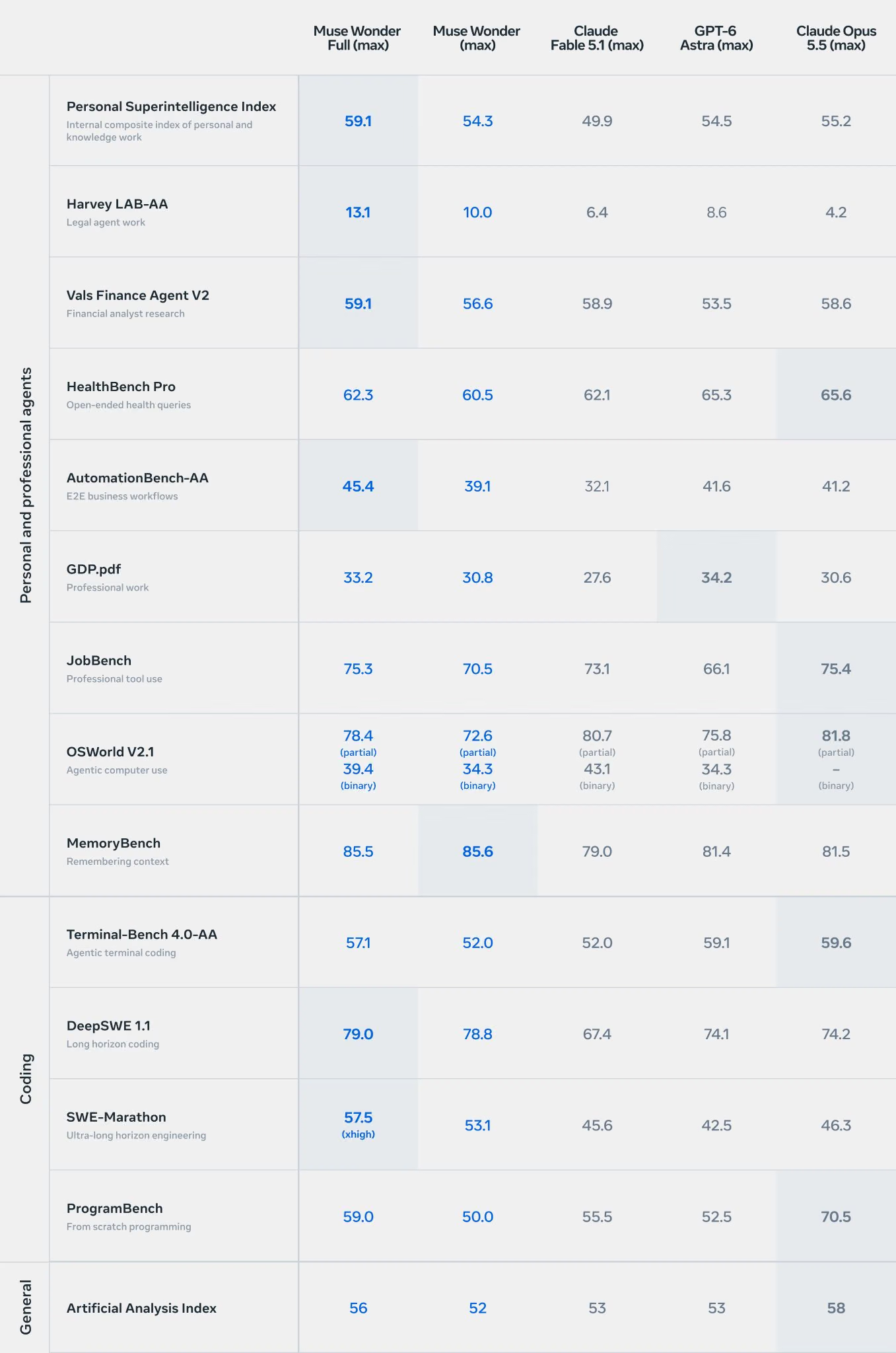
Image credit: @finkd on X
Where Full leads the columns shown:
Meta's Personal Superintelligence Index: 59.1, against 55.2 for Opus 5.5 and 54.5 for Astra. This is an internal composite of personal and knowledge work that Meta built itself.
SWE-Marathon: 57.5 (xhigh), against 46.3 for Opus 5.5, an 11.2-point gap.
DeepSWE 1.1: 79.0, against 74.2 for Opus 5.5. Standard Wonder scores 78.8, also ahead of every competitor.
Harvey LAB-AA (legal agent work): 13.1, against 8.6 for Astra, the best competitor.
AutomationBench-AA: 45.4, against 41.6 for Astra.
Vals Finance Agent V2: 59.1, only 0.2 points ahead of Fable 5.1 at 58.9.
On MemoryBench, the two Wonder models lead, with standard Wonder (85.6) just ahead of Full (85.5). Both sit above the 79.0 to 81.5 range of the other three.
Where it trails:
ProgramBench: 59.0 against 70.5 for Opus 5.5, an 11.5-point gap and the largest deficit in the table. Fable 5.1 (55.5) and Astra (52.5) score below Full here; only Opus 5.5 is ahead. Standard Wonder's 50.0 trails all three competitors.
Artificial Analysis Index: 56 against 58 for Opus 5.5.
Terminal-Bench 4.0-AA: 57.1 against 59.6 for Opus 5.5 and 59.1 for Astra.
HealthBench Pro: 62.3 against 65.6 for Opus 5.5 and 65.3 for Astra.
OSWorld V2.1 (agentic computer use): on the partial score Full has 78.4 against 81.8 for Opus 5.5. On the binary score it has 39.4 against 43.1 for Fable 5.1, and the chart shows no binary figure for Opus 5.5.
GDP.pdf (professional work): 33.2 against 34.2 for Astra.
JobBench: 75.3 against 75.4 for Opus 5.5, effectively level.
The standard model is a step down from Full on most rows. For example, it scores 50.0 on ProgramBench and 54.3 on the Personal Superintelligence Index, just below Astra and Opus 5.5.
Our read: the chart shows a strong showing on long-running software work and agent tasks, and a clear gap on from-scratch programming. It does not show Wonder ahead across the board, even though Meta describes the models as state of the art for personal and professional agents. Meta chose the benchmarks, effort settings and competitor versions, and one headline row is its own index. Treat the numbers as a guide to what to test, not a ranking. Meta points to its evaluation report for more detail on the tests.
Who should care
Developers who already use Muse Code can try Wonder now, and Full requires a Muse Code subscription. API developers can call Wonder through the Meta Model API, but Meta has not published a per-token price for it. Muse app users pay $20 or $100 a month, according to CNBC, and Wonder's wider app rollout is still to come.
Our view: if your work looks like the rows where Full leads, such as long-horizon coding and workflow automation, the chart is a reason to test it on your own tasks. If it looks like ProgramBench or terminal coding, the same chart suggests comparing it against Opus 5.5 first.
Sources
Meta Says New AI Model Is State-of-the-Art, Will Make Muse Agent Smarter - WSJ
Introducing Muse Wonder and Muse Wonder Full: Frontier Models for Agents
Meta debuts Muse Wonder AI model in test of users' willingness to pay
Meet Muse Spark 1.2 and Muse Code: a coding model and the agent built to run it | AI Developers blog



0 comments
No approved comments yet. You can start the conversation.
Leave a comment