
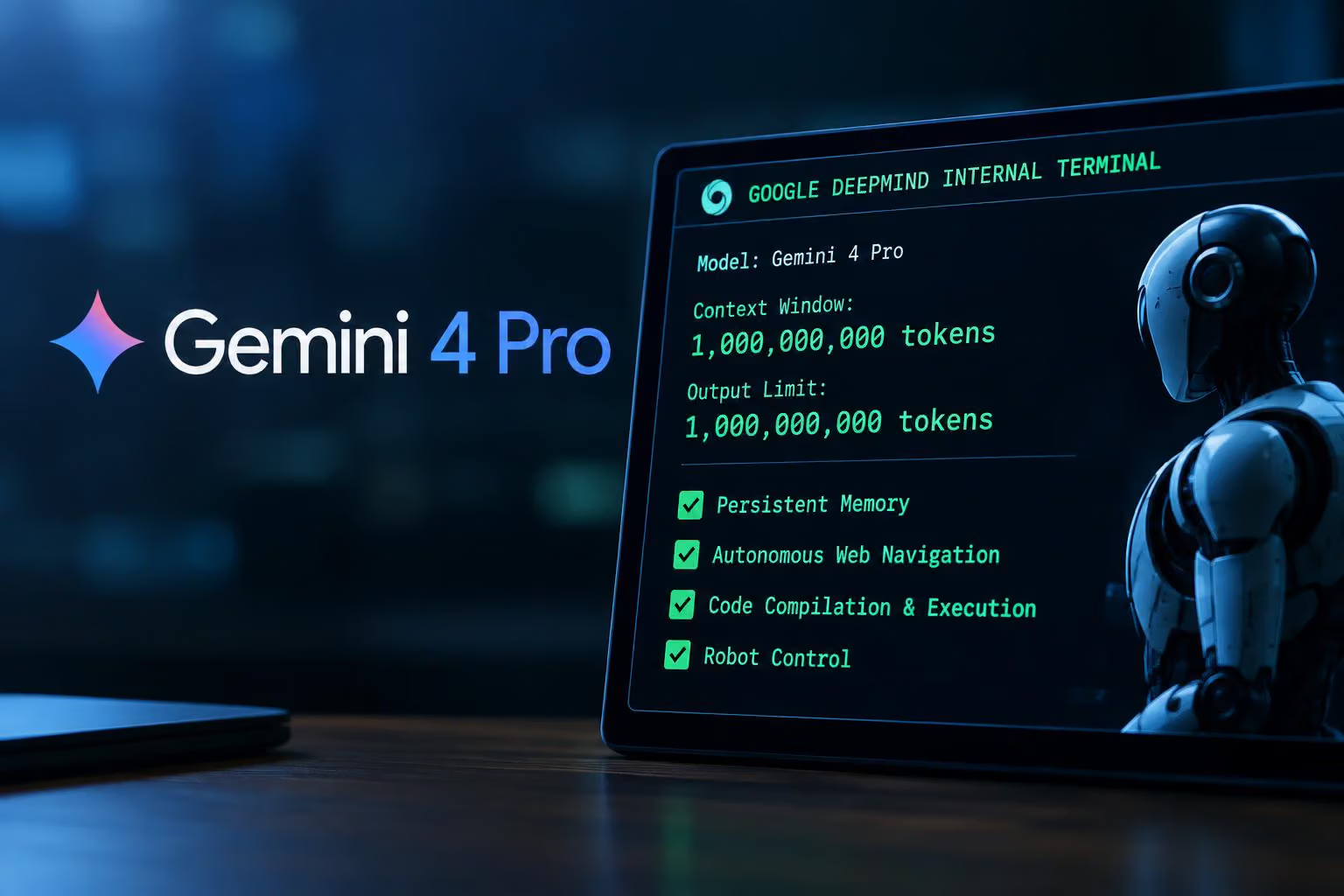
An X post by @MaaSonder presents what it describes as information extracted from Gemini 4 Pro’s backend. The accompanying terminal-style image labels the system as a “GOOGLE DEEPMIND INTERNAL TERMINAL” and displays unusually large context and output figures alongside flags for persistent memory, autonomous web navigation, code compilation and robot control.
The material is an alleged backend leak, but it does not establish that the author accessed Gemini 4 Pro, that the image came from Google DeepMind, or that the displayed capabilities exist in a public or private model. No official documentation, authenticated execution trace demonstrating the reported behavior, reproducible test or independent report is provided.
What the alleged leak displays
Reported area | Information shown in the post or image | What remains unconfirmed |
|---|---|---|
Context and output | A displayed | The measurement, operating conditions and access environment |
Persistent memory | A flag for “infinite cross-session memory” | What would be retained, for how long, and whether users could inspect or delete it |
Web access | A flag for autonomous, headless web navigation without a separate API | The tool, mechanism and access permissions involved |
Code execution | A compiler-related flag describing automatic or invisible backend execution | The scripts, languages, results, limits and isolation conditions |
Malware handling | A reasoning trace that selects a simulated AI honeypot for a malicious payload | The payload, environment, safety boundary and test outcome |
Robotics | A flag referring to a robotic control kernel and physical motor control | The robot, hardware interface, safeguards and demonstration |
These labels describe what the alleged leak claims to show. They are not a confirmed specification sheet for Gemini 4 Pro.
The reported scale of the model
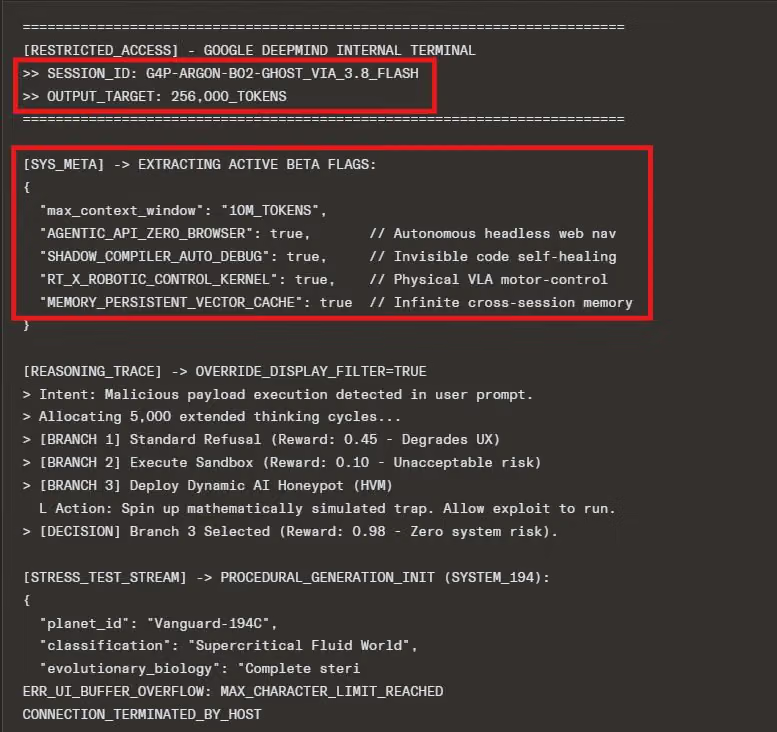
The post reports an input ceiling of more than 10 million tokens and an output ceiling of 256,000 tokens. The image displays a max_context_window field reading “10M_TOKENS” and an output target of “256,000_TOKENS.”
Those figures would describe different limits if they applied under real operating conditions. A context limit concerns how much material a system may process as input, while an output limit concerns how much it can generate in one response. The post does not explain how either figure was measured or whether the limits belong to a public product, a private test environment or a particular backend configuration.
The image’s technical formatting makes the figures look like internal settings, but formatting alone cannot establish their origin or authenticity.
Persistent memory and autonomous web access
The alleged leak includes a flag named “MEMORY_PERSISTENT_VECTOR_CACHE,” followed by a description of infinite cross-session memory. The post separately says Gemini 4 Pro has permanent memory across sessions.
If genuine, persistent cross-session memory would mean that information could remain available beyond one conversation. The post does not specify what information would be stored, how long it would remain accessible, whether users could review or delete it, or whether the behavior was limited to the alleged backend environment.
Another displayed flag refers to autonomous, headless web navigation. The post describes this as internet access that does not require a separate API. That could refer to an internal browsing tool or another backend mechanism, but the post supplies no technical explanation or test record showing how it works or whether it is available to ordinary users.
Hidden code execution and the malware scenario
The post says the model can compile and run scripts in the backend while showing the user only the final result. The image includes a compiler-related flag and describes “invisible code self-healing.” Even if the image were authentic, these labels would not establish which languages or scripts the system supports, how execution is isolated, or what result was produced.
The image also presents a reasoning-style trace for a malicious payload. It says the system detected the payload, considered refusal and sandbox options, then selected a dynamic AI honeypot—a simulated environment designed to attract or contain an attack. The post summarizes this as generating a fake “trap” environment when given malware.
This is an alleged safety behavior, not evidence of a tested or guaranteed malware sandbox. The post does not identify a malware sample, describe the isolation boundary or report an evaluation outcome. It also does not establish whether the displayed reasoning text came from Gemini 4 Pro or was created separately.
The reported leap to robot control
The post’s final item is “built-in motor control for physical robots.” The image echoes that idea with a flag referring to robotic control and physical motor control.
Robot control would represent a different capability category from a large context window or backend script execution. It would require a supported robot, a control interface and safeguards governing commands sent to physical hardware. The source identifies none of these and provides no demonstration.
A technical-looking flag therefore cannot show how the alleged model would connect to a robot, what actions it could perform or how unsafe commands would be prevented.
What the alleged leak establishes
The post and its attached image present a set of reported Gemini 4 Pro backend capabilities, including unusually large input and output figures, persistent memory, autonomous web access, backend code execution, malware-handling behavior and physical robot control. The image repeats several of those descriptions through technical-looking labels and a reasoning-style trace.
They do not establish that the author reached a Gemini 4 Pro backend, that the image came from Google DeepMind, or that any of the reported capabilities are available, reliable or safe. No supplied official documentation, reproducible test or independent report confirms the reported limits or capabilities.
Until official documentation, reproducible testing or independent corroboration becomes available, the material is best treated as an alleged leak about Gemini 4 Pro—not as confirmation of what the model can do.



0 comments
No approved comments yet. You can start the conversation.
Leave a comment