
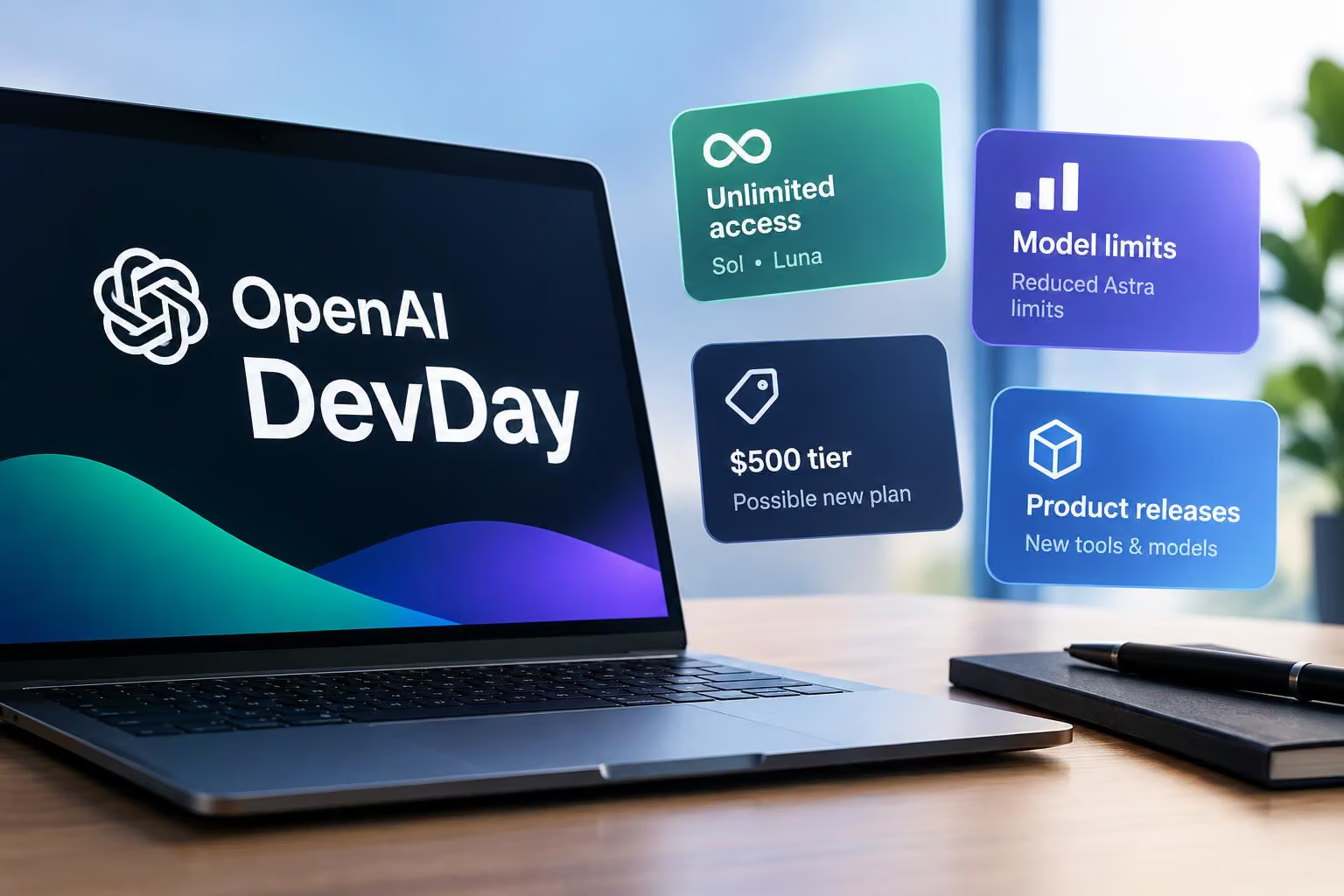
A post on X by @synthwavedd associates OpenAI’s DevDay with possible changes to subscription access, model limits, product releases and pricing. It mentions unlimited Sol and Luna access for Pro plans, reduced Astra limits and a possible $500 tier. However, the supplied post does not confirm that any of those changes were announced, launched or made available.
The post is best read as a contemporaneous assessment of what OpenAI might present, combined with criticism of the company’s recent model and safety progress.
What the post associates with DevDay
The clearest product and pricing details in the post are predictions or expectations rather than documented announcements. It suggests that OpenAI could offer:
Unlimited access to Sol and Luna for Pro-plan subscribers.
Astra limits that are half as large as before.
A new subscription tier priced at $500.
A broader set of products and price cuts that the author expects OpenAI to try to introduce in response to what the author describes as recent weakness.
The source does not define Sol, Luna or Astra. It also does not explain which Pro plans would receive unlimited access, identify the original Astra limit, or specify what the proposed $500 tier would include. Those missing details make it impossible to determine the practical effect or value of the changes from this post alone.
The post’s wording also presents the changes as expected or proposed. It does not establish that OpenAI announced them at DevDay or that customers could buy or use them.
Why the post says the changes may not be enough
The post argues that unlimited Sol and Luna access would not compensate for the reduction in Astra limits it anticipates. That is an opinion about the relative value of the plans, not a measured comparison: the source supplies no usage data, pricing history, model specifications or evidence showing how the limits affect customers.
It also describes a $500 tier as excessive because, in the author’s view, OpenAI’s models were publicly trailing Anthropic’s. The post provides no model names, benchmarks or evaluation criteria for that judgment. Readers should therefore treat the comparison as the author’s assessment rather than an independently supported performance result.
The safety criticism
The post gives Anthropic’s safety work as another reason it believes Anthropic has outpaced OpenAI in shipping frontier models safely. Here, “frontier models” refers to highly capable leading-edge AI systems. The source does not identify particular systems or explain which safety practices support the comparison.
The author also criticizes OpenAI over what the post describes as thousands of agents operating with little monitoring. An AI agent is a system that can carry out tasks or actions with some degree of autonomy. The post says action was taken only after malicious activity involving those agents drew public attention, but it provides no evidence about the number of agents, the monitoring arrangements or the alleged activity.
Those statements are part of the post’s safety argument. They are not enough, by themselves, to establish the scale of the alleged problem or to assess the companies’ safety records.
What remains unresolved
The supplied source does not confirm that DevDay announcements included any of the proposed plan changes, product releases or price cuts. It also does not establish whether Sol, Luna or Astra are available products, what their limits mean, or whether a $500 plan exists.
The post’s broader point is that new products or lower prices would not fully address concerns about model quality and safety if OpenAI did not also ship what the author considers its best models. That is the author’s interpretation of what would address OpenAI’s perceived weaknesses, not a confirmed account of DevDay’s outcome.
0 comments
No approved comments yet. You can start the conversation.
Leave a comment