
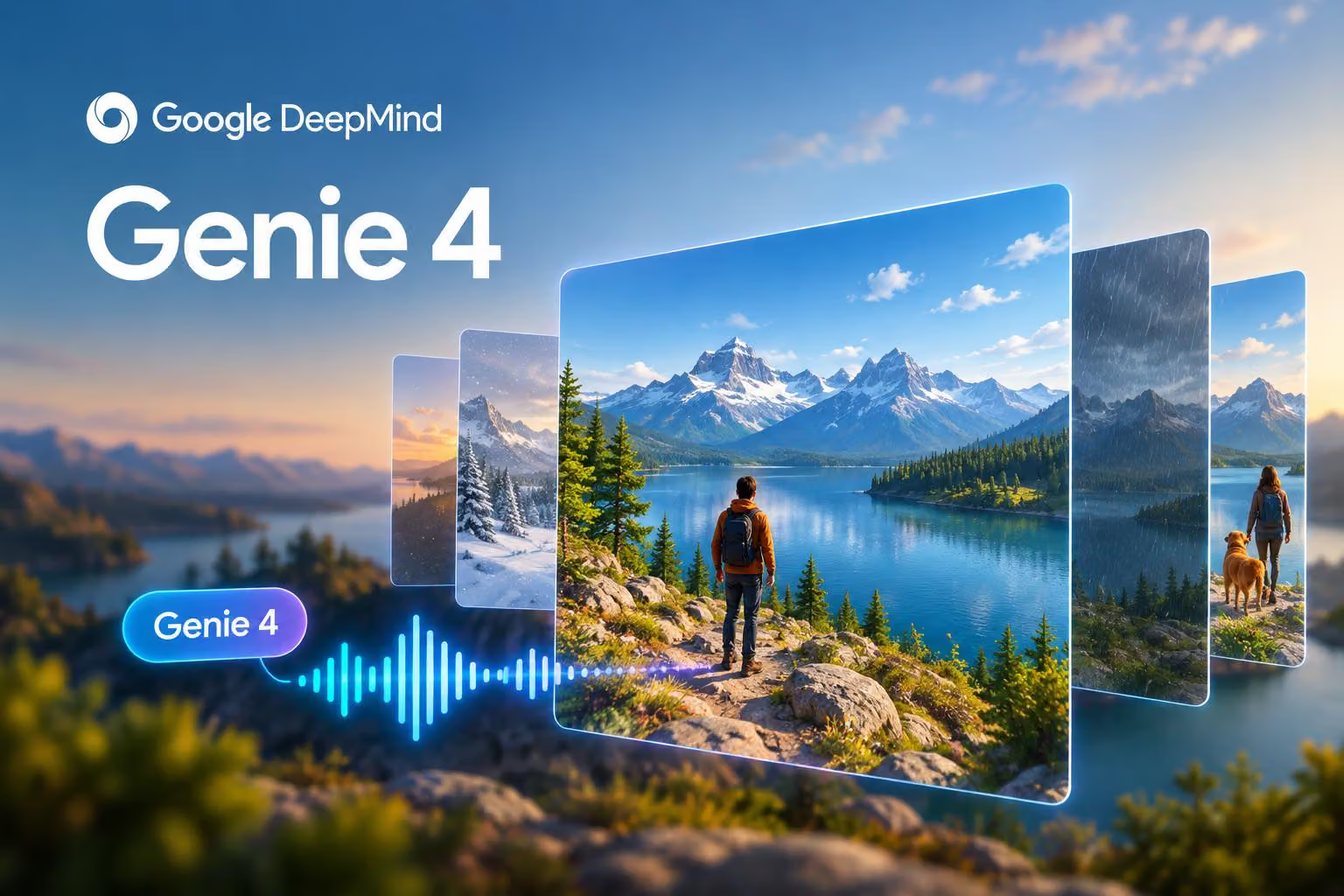
Google DeepMind has announced Genie 4, a new world model that generates interactive, real-time simulations with native audio and dialogue. Google says it is rolling the model out first as a research preview for trusted testers. Ultra subscribers and early API partners are described as coming soon, and the post gives no price or general-availability date.
According to Google DeepMind's announcement, Genie 4 lets users change a running simulation with natural language. Google's examples include changing the weather, moving the camera, or adding a person or object, with Gemini adapting each prompt to the scene and monitoring it between inputs. The company also says Genie 4 is its first real-time world model to generate audio natively, producing ambient sound from the setting and interactive speech that characters can use in response to events.
How Gemini is described as working with Genie 4
Google describes a division of labour. Gemini Omni is said to anchor the simulated appearance and behaviour in real-world reference, while other Gemini models provide the reasoning that keeps a simulation coherent over time. In the design the post describes, Gemini 3.8 Flash acts as a guiding agent during generation: it watches the scene, splits a goal into steps, checks incoming frames to confirm each step succeeded, and revises its plan when the world changes or a user intervenes.
Google also shows an experiment that pairs Gemini 4 Argon with Genie 4 and Gemini Robotics. In the example, Argon breaks a task into steps that are sent to Genie 4 as text captions while the simulation renders, in this case an Apptronik Apollo humanoid playing checkers. This is a Google demonstration of the planning-and-rendering loop, not an independent test. Google describes the robotics work as exploratory and does not say whether Gemini 4 Argon or Gemini 3.8 Flash is available to developers.
Who can try Genie 4 now
Access is staged. The post then names two next groups: Google AI Ultra subscribers using Project Genie, and early access partners of the Gemini API and Google AI Studio. Both are described as "coming soon." Readers who want to try it can join the Genie 4 waitlist in Project Genie, linked from the announcement. The post does not say when Ultra access begins or what usage limits will apply.
What trusted testers reported
Google says trusted testers in creative work, journalism, education, gaming and engineering have explored the model. Google reports these as early tester feedback. Examples include filmmakers running several takes of a scene in a live simulation, photojournalists turning archival photographs into explorable environments, and game developers prototyping visual styles and mechanics from text prompts. Google also says enterprise partners are evaluating Genie 4 for rapid scenario generation. The company presents these as areas under evaluation, not as measured outcomes.
Limitations Google acknowledges
Google calls Genie 4 an early, experimental model. Its stated weak points include:
Visual details and object permanence can drift over longer runs, after several complex edits, or as the camera moves around a scene.
Complex physical interactions, real-time audio accuracy, legible text, spatial accuracy and long-term consistency are all listed as areas of ongoing research.
Safety and transparency measures
Google says Genie 4 includes safety guardrails consistent with its policies for other models and that it ran internal safety evaluations before the preview to prevent harmful or malicious content. Every video and audio clip Genie 4 generates will carry SynthID, Google's imperceptible watermark for identifying AI-generated content across visual and audio media.
Our read: the announcement is most useful as a signal of where Google is taking interactive simulation and how it plans to pair Gemini's planning with Genie's rendering. Whether those capabilities hold up outside Google's demonstrations is not something this post establishes, and it will be worth checking once testers or the Gemini API documentation provide details.



0 comments
No approved comments yet. You can start the conversation.
Leave a comment