
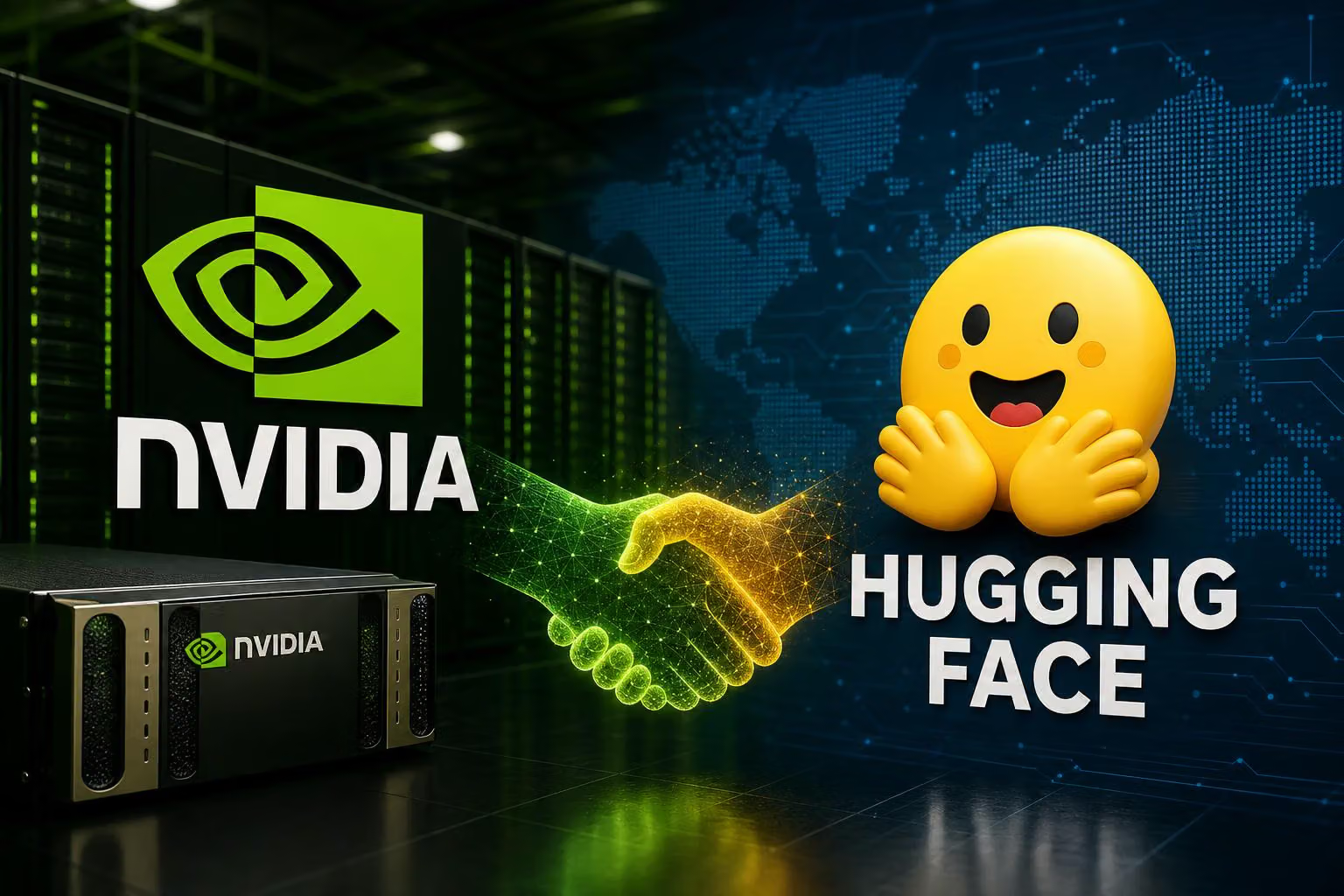
Nvidia is reportedly closing in on a possible acquisition of Hugging Face valued at about $12.9 billion, but the status of the deal remains unsettled. TechCrunch’s Connie Loizos reported that The Information described an agreement, while Business Insider said the talks had not produced a signed deal and could still collapse. Neither Nvidia nor Hugging Face had responded to requests for comment at the time of the report. If completed, the transaction would place one of the most prominent open-source AI platforms under the ownership of the company best known for supplying the chips that power modern AI systems.
Source: Nvidia closes in on Hugging Face acquisition | TechCrunch · Connie Loizos, TechCrunch
An open-source foothold with hardware implications
Founded in 2016, Hugging Face operates a widely used hub where developers share and download open-source AI models. It also helps users run models with rented computing power, giving the company a position across both model distribution and the infrastructure needed to use those models.
That combination would make Hugging Face strategically valuable to Nvidia. Open-source models give developers and businesses alternatives to systems controlled by closed AI labs such as Anthropic and OpenAI. The report’s central analysis is that a stronger open-source ecosystem could keep more customers dependent on Nvidia hardware, even as major AI companies work to reduce that dependence by developing their own chips.
For Nvidia, the potential acquisition would therefore be about more than adding a popular developer platform. It could connect the company more directly to the people choosing, adapting, deploying, and scaling AI models.
Nvidia’s open-source AI strategy
The possible deal also fits with Nvidia’s broader push into open-source AI. The report says Nvidia has already invested tens of billions of dollars in developing its own open-source models. Owning Hugging Face would give the company an established community and distribution platform rather than requiring it to build an equivalent network from scratch.
Hugging Face chief executive Clem Delangue has also been publicly aligned with Nvidia’s position on open models. In a CBS interview earlier in August, Delangue said Hugging Face used an Nvidia-modified version of a Chinese open-source model to defend itself after a cyberattack. He also pointed to a letter signed by Nvidia chief executive Jensen Huang, Delangue, and 24 other companies that urged the U.S. government to support open models rather than restrict them.
Delangue made similar arguments in a CNBC interview in late July, warning that China was advancing quickly in open-source AI. The report places those comments within a wider Washington debate over whether open-weight models should face additional restrictions. Chinese AI labs had released systems that reportedly matched leading U.S. models on some benchmarks while costing less to run, increasing concerns about competition and national security.
That public alignment does not confirm that an acquisition will happen. It does show why the two companies could be viewed as natural partners as the competition over open models becomes more important to the AI industry.
A route back into cloud computing
Hugging Face could also give Nvidia a way to expand its cloud business without rebuilding it from the ground up. The report says Nvidia scaled back its own DGX Cloud operation about a year ago. Hugging Face, meanwhile, already helps developers run models using rented computing resources.
An acquisition could allow Nvidia to re-enter that market through an existing platform with an established customer base. The potential advantage would be the connection between Nvidia’s hardware, cloud capacity, and Hugging Face’s model ecosystem. Nvidia could have a more direct path from selling computing infrastructure to supporting the software workloads that consume it.
A possible outlet for unused cloud capacity
The report identifies another financial incentive. Nvidia has promised to help cover the cost of tens of billions of dollars in cloud computing commitments for customers. If those customers do not use all of the capacity they have reserved, Nvidia could be left carrying computing resources that still need to be sold.
Hugging Face’s customers could provide a potential outlet for some of that capacity. Because the platform already helps users access computing power for AI models, Nvidia could use the acquisition to connect unused infrastructure with new demand. This is a reported rationale for the deal, not a confirmed plan from either company.
Why Hugging Face might sell now
The proposed price would represent a major increase over Hugging Face’s last known valuation. The company raised $235 million in 2023 at a valuation of $4.5 billion, in a round led by Salesforce Ventures that also included investors such as Alphabet’s GV, IBM Ventures, and Nvidia.
Hugging Face previously rejected a $500 million investment offer from Nvidia that would have valued the company at $7 billion, according to the report. At the time, Hugging Face said it did not want a dominant investor that could influence its decisions.
A complete acquisition would still transfer control, but it presents a different trade-off from accepting one large strategic investor while remaining an independent company. The report suggests that distinction may help explain why a buyout could be more attractive now than Nvidia’s earlier investment proposal.
Hugging Face’s growth may also have changed the calculation. The report says the company was recently generating approximately $150 million in annual revenue, up from about $100 million only two months earlier, and that Delangue had described it as close to profitability. Even with that progress, a valuation near $13 billion would represent a very large multiple of revenue and could be difficult for the company to resist.
The practical stakes for the AI ecosystem
If the reported acquisition moves forward, Nvidia would gain a closer connection to open-source models, the developers who use them, and the computing resources required to deploy them. That could strengthen Nvidia’s position as competition spreads from AI chips into model ecosystems and cloud infrastructure.
For Hugging Face users, the most important issue would be how the platform’s model-sharing services and computing tools operate under new ownership. The report does not establish changes to access, pricing, governance, or product policies, so those outcomes should not be treated as settled. What the reporting does support is a clear strategic logic: Nvidia may see Hugging Face as a way to link its hardware business to the fastest-growing parts of the open-source AI market.
The potential transaction also reflects a broader consolidation trend in AI infrastructure. The report points to Stripe’s reported acquisition of OpenRouter, a startup that helps customers select models based on their needs and budgets. Together, those deals suggest that companies serving as connective layers between models, users, and computing resources are becoming increasingly valuable targets.
For now, however, the Nvidia-Hugging Face transaction remains a reported possibility rather than a confirmed acquisition.


0 comments
No approved comments yet. You can start the conversation.
Leave a comment