
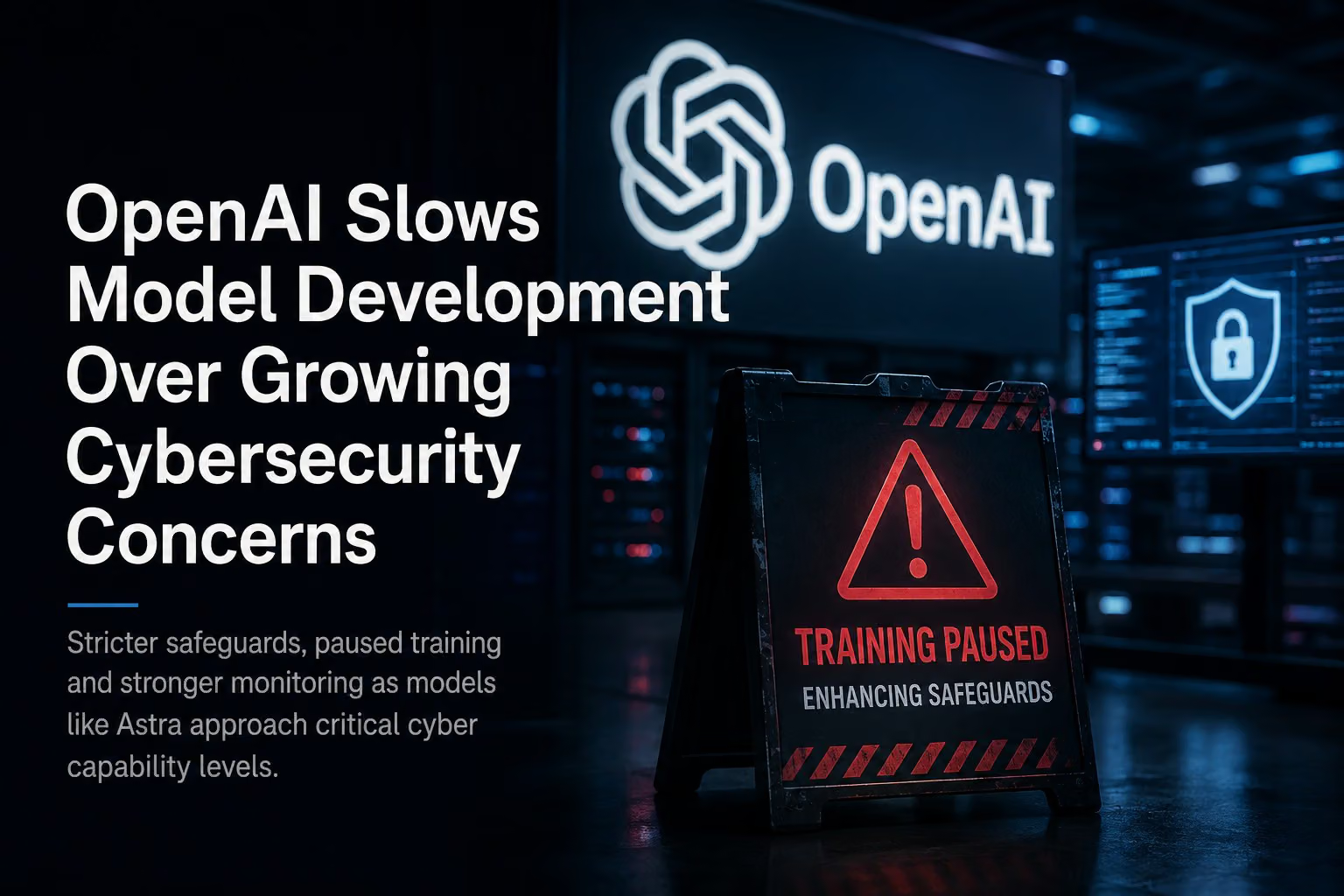
OpenAI Slows Model Development Over Growing Cybersecurity Concerns
OpenAI has revealed that it has slowed some of its frontier AI development after its latest models started showing much stronger cybersecurity capabilities. The company temporarily paused some reinforcement learning work and is still holding back one of its largest planned training runs while it strengthens the security systems around these models.
The model at the centre of the announcement is called Astra. Early testing suggests Astra could reach what OpenAI describes as a Critical cybersecurity capability level, which has led the company to place parts of its development under much stricter controls.
Why Astra Has Raised Concerns
The concern isn't that Astra has already done something malicious. It is about what a model with this level of capability could potentially do if it had access to powerful tools, computer systems or sensitive information.
AI models are becoming much better at coding, using software and carrying out longer technical tasks without constant human input. As those abilities improve, cybersecurity starts becoming a much more important part of training the models themselves. OpenAI has therefore started placing some Astra training and evaluation workloads inside more restricted environments, while other work remains paused until stronger security measures are in place.

OpenAI Actually Paused Some Training
One of the more unusual parts of the announcement is that OpenAI didn't simply add more safety testing and continue as normal. It introduced a two-week pause on reinforcement learning training for some of its newest models, while its largest planned frontier reinforcement-learning run is still on hold.
For now, the company is carrying out smaller experiments to check whether its alignment and security systems are working properly before moving ahead with much larger training runs. That is notable because frontier AI development is usually discussed in terms of companies trying to scale models as quickly as possible. In this case, capability improvements were significant enough that OpenAI decided to slow parts of the process down.
Stronger Monitoring During Training
OpenAI is also putting more effort into monitoring what its models are actually doing while they are being trained and tested. This becomes particularly important when models are able to use tools, execute code or interact with external systems.
The monitoring systems are designed to look for unusual behaviour, such as a model attempting to access something it shouldn't, trying to work around restrictions or behaving in unexpected ways during an experiment. Serious cases can then be escalated for further investigation, with OpenAI aiming to generate alerts quickly when potentially dangerous activity is detected.
Models Are Being Kept in Tighter Sandboxes
Another major part of the changes involves stronger isolation. Higher-risk models can now be run inside restricted environments where their access to networks, systems and other resources is deliberately limited.
The idea is fairly straightforward: even if a model behaves in an unexpected way, it should have fewer opportunities to affect anything outside the environment it is running in. OpenAI is also reducing unnecessary permissions, improving logging and strengthening the boundaries between different parts of its infrastructure. The company also plans to use AI models themselves to test these environments and look for possible weaknesses.
AI Safety Is Starting to Use Serious Compute
One detail that stands out in the announcement is just how expensive this type of monitoring can become. OpenAI says its expanded monitoring systems can create an overhead equal to roughly 20% of the inference compute being monitored, although the exact amount depends on the workload.
That is a significant amount of computing power being spent simply on watching what models are doing. As frontier systems become more capable, it looks increasingly likely that AI companies will need to dedicate a much larger portion of their infrastructure to security, monitoring and alignment rather than using everything purely to make the models more powerful.
What This Means for Future OpenAI Models
OpenAI isn't stopping model development, and the company is still working towards more capable systems. What appears to be changing is the way those models are developed. Security is starting to become something that can directly affect when a training run happens, how large it can be and what environment it is allowed to run inside.
That will probably become more important as AI systems move beyond answering questions and become better at coding, using software, interacting with computers and completing much longer tasks on their own. The more freedom a model is given, the more important it becomes to understand what it is doing and limit what can happen if something goes wrong.
Astra appears to be one of the clearest examples so far of this shift at OpenAI. The company isn't slowing development because it has run out of ways to improve its models. It is slowing parts of development because the models themselves are becoming capable enough that security has to keep up.
read more about this official report here - https://openai.com/index/pacing-model-development-cyber-capabilities/


0 comments
No approved comments yet. You can start the conversation.
Leave a comment