
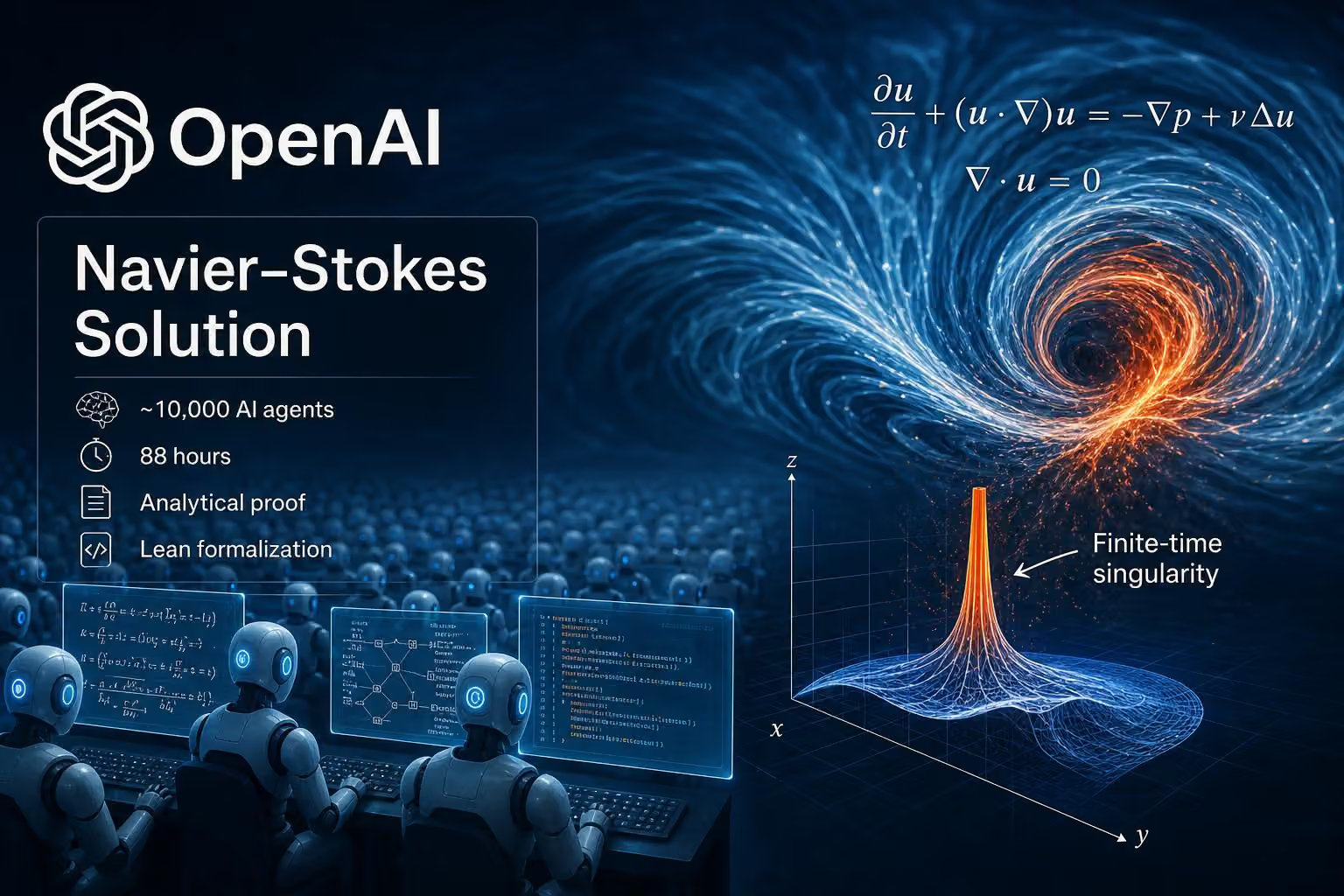
OpenAI says an internal model group has produced what it describes as a solution to the Navier–Stokes Millennium Prize Problem. In a four-post announcement, @OpenAI said the effort used around 10,000 coordinating AI agents over 88 hours and generated both an analytical proof and a Lean formalization. OpenAI hasn't published the proof or the Lean code, and nobody has independently checked it, so treat this as a claimed result rather than a confirmed solution.
What OpenAI says its agents produced
The Navier–Stokes problem asks whether the equations used to describe smooth three-dimensional fluid motion can develop a breakdown. OpenAI’s posts describe the proposed result as a finite-time singularity: a situation in which the fluid dynamics become singular after a finite amount of time rather than remaining smooth indefinitely.
According to the announcement, the internal model group produced two forms of the result:
An analytical proof intended to establish the proposed fluid behavior mathematically.
A formalization in Lean, a proof assistant used to express mathematical statements in a machine-checkable form.
The announcement therefore establishes what the company says its group produced, not whether mathematicians or an independent verification process have confirmed that the result satisfies the full Millennium Prize requirements.
The reported singularity is an inward-spiraling vortex
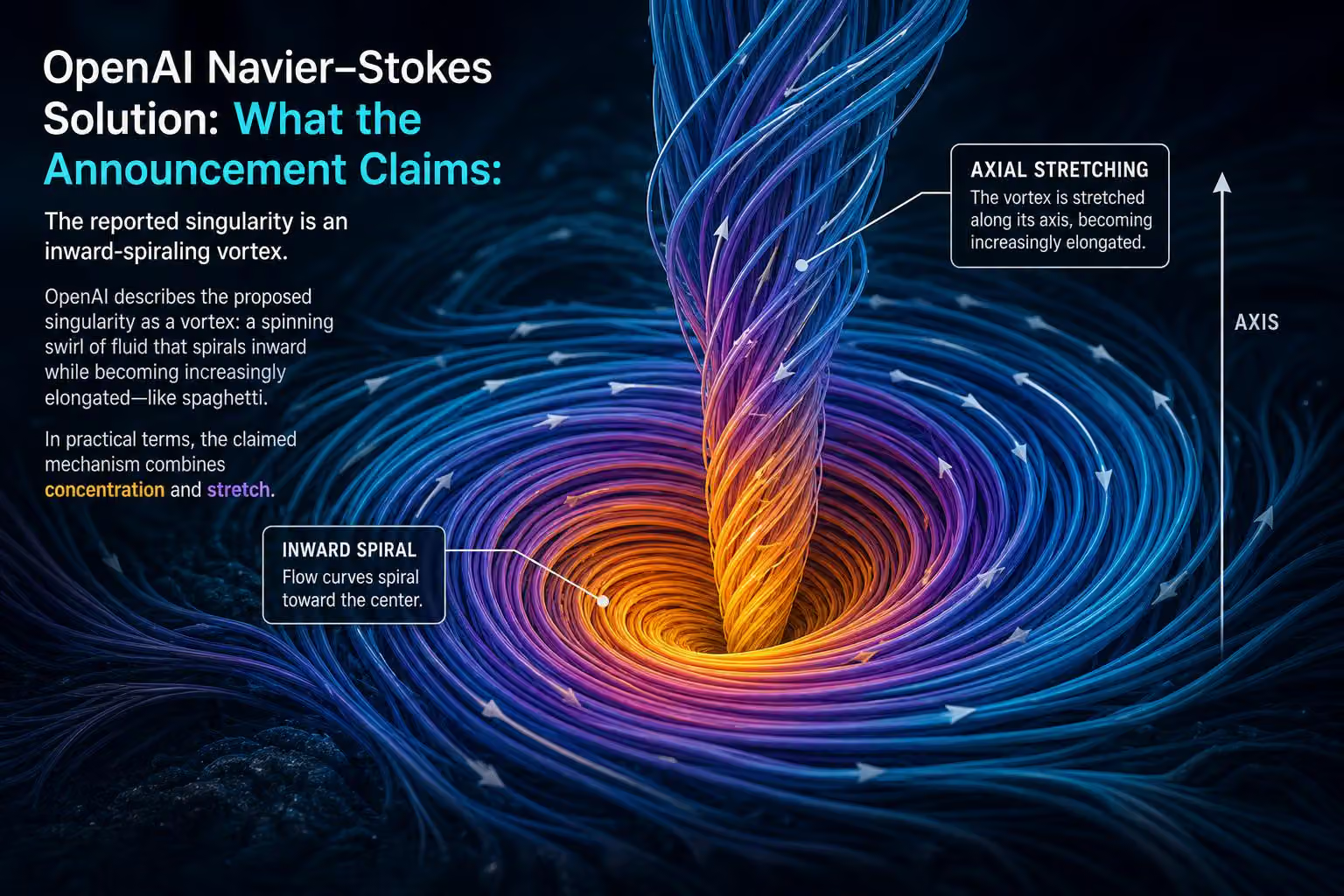
OpenAI describes the proposed singularity as a vortex: a spinning swirl of fluid that spirals inward while becoming increasingly elongated. The post compares the shape to spaghetti.
The attached visual presents a dense, three-dimensional bundle of colored streamlines. Labels identify an “inward spiral” and “axial stretching,” matching the two features highlighted in the announcement. The image is an illustration of the reported flow structure, not the proof itself.
In practical terms, the claimed mechanism combines concentration and stretching. Fluid motion is described as drawing the vortex inward while also extending it along its axis. OpenAI says this process leads to a singularity in finite time, but hasn't published the equations or steps needed to check that conclusion.
The effort used around 10,000 coordinating agents
OpenAI says its internal model group reached the result in 88 hours with around 10,000 coordinating AI agents. The company describes the model behind the effort as a next-generation system significantly more capable than GPT-6 Astra, whose training is still ongoing.
That wording does not identify the internal model by name, and the announcement does not say that GPT-6 Astra produced the Navier–Stokes result. A separate attached chart compares GPT-6 Astra with an unnamed “Internal Model” on a curated set of open mathematics problems. It shows a higher plotted pass rate for the internal model across the displayed test-time-compute points, but the chart is not a direct validation of the Navier–Stokes proof.
OpenAI also says the effort retained the safeguards it uses for frontier evaluations, including monitoring and isolation. The company frames the work as part of its effort to understand and pace the capabilities of its internal systems.
Why the formalization matters, and what remains unresolved
A Lean formalization can be useful because it translates a mathematical argument into a form that a proof assistant can check against its formal rules. That can help expose missing steps or ambiguities in an argument. It does not, by itself, establish that the formalized statement matches the exact Navier–Stokes Millennium Prize Problem unless the definitions, assumptions, and theorem correspond to the problem’s requirements.
OpenAI hasn't said. It does not provide the formal statement, the Lean source, the proof dependencies, or the analytical argument. It also does not identify any external mathematicians or institution that have reviewed the result.
The supported conclusion is therefore limited: OpenAI says its internal model group generated an analytical proof and Lean formalization for a finite-time singularity in three-dimensional Navier–Stokes dynamics. Whether that work constitutes a correct solution to the Millennium Prize Problem remains to be established from the underlying proof and formalization.




0 comments
No approved comments yet. You can start the conversation.
Leave a comment