

Mercury 3, Inception's latest diffusion LLM, is out today. The company says it matches or beats Claude Haiku 5.5 and GPT-6 Luna on quality while running 4–8x faster, at more than 1,000 tokens per second. It is available through the Inception API, Baseten, OpenRouter and Vercel. List pricing is $0.20 per million input tokens and $0.70 per million output tokens, with half off at launch.
In a post on X, @_inception_ai says Mercury 3 "outperforms" both models "across a range of benchmarks." Inception's press release is more measured: it describes quality as "on par or better than frontier speed-optimized models like GPT-6 Luna and Claude Haiku 5.5." Our read: the real pitch is Haiku-class quality at roughly four times Haiku's speed, and the chart's approximate readings are consistent with that.
What's new in Mercury 3
Inception calls Mercury 3 the most capable diffusion LLM released so far and its fourth model since Mercury 1 launched in June 2025. Mercury 2 added reasoning, Mercury 2.5 added tunable reasoning and a 260,000-token context window, and Mercury 3 raises the context window to 1 million tokens. Inception describes it as the largest jump in intelligence of any Mercury release.
The company says Mercury 3 is more than 40 times the size of Mercury 1 yet runs at comparable speeds, above 1,000 tokens per second on widely available NVIDIA GPUs. Co-founder Stefano Ermon uses this to argue that the limits to scaling diffusion models are compute and data, not algorithmic barriers. Unlike autoregressive models, which generate one token at a time, diffusion models can generate multiple tokens in parallel, which is where the speed comes from. The post also says Mercury 3 is "3x more intelligent across standard benchmarks"; Inception's published material does not name the benchmarks behind that figure.
What the speed-versus-intelligence chart shows
Inception's chart plots an "Intelligence Index" against output speed in tokens per second. All three models carry a "(medium)" label; the release does not say how that setting maps to each model's default configuration, so the speeds may not match what you get with your own settings. These are our readings off the plot:
Mercury 3 sits at roughly 1,070 tokens/s with an index near 50.6.
Claude Haiku 5.5 sits at roughly 240 tokens/s with an index near 50.4.
GPT-6 Luna sits at roughly 130 tokens/s with an index near 48.2.
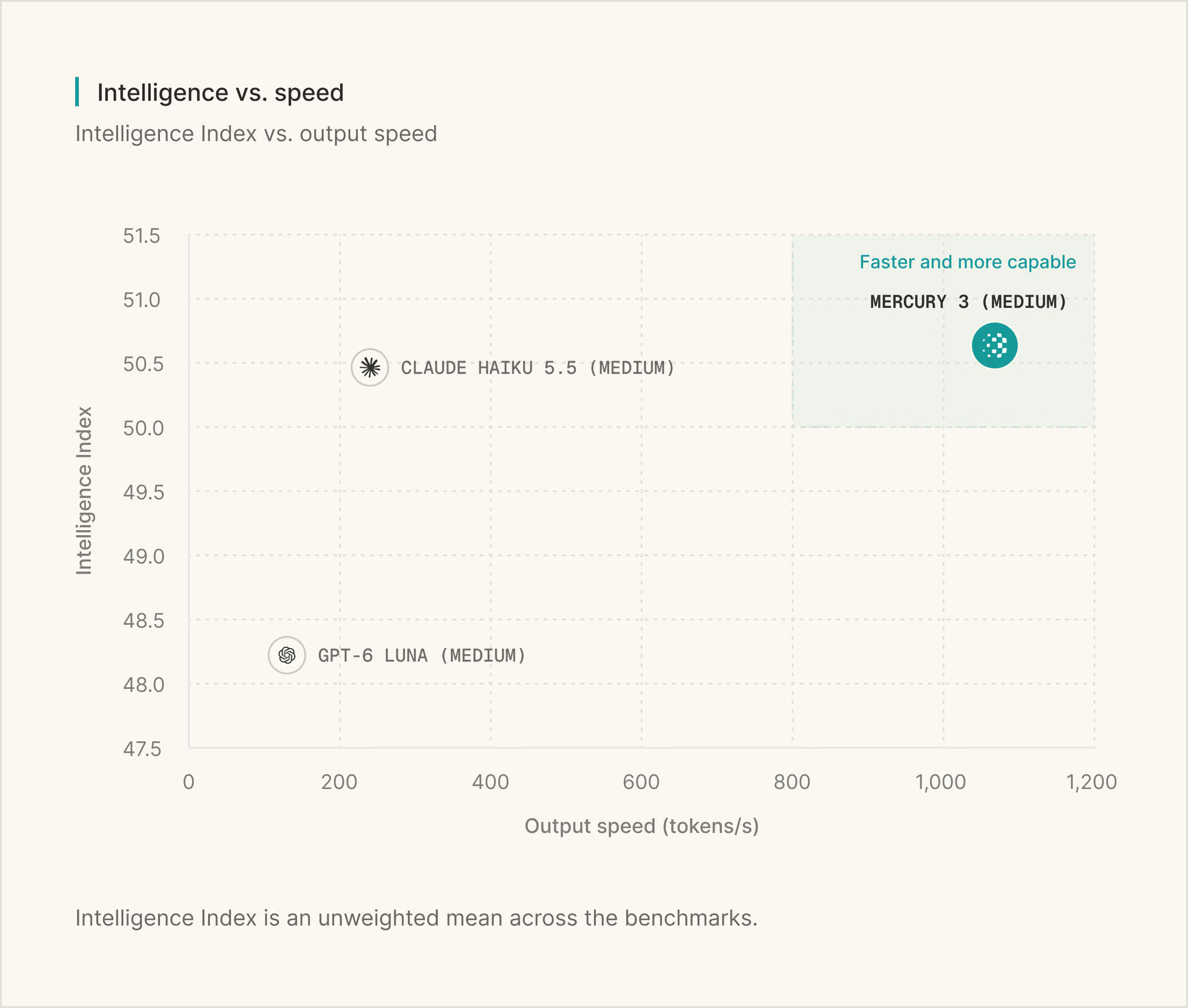
Image credit: @_inception_ai on X
That is about 4x Haiku's speed and about 8x Luna's, matching the "4–8x faster" in the press release. On quality, Mercury 3 leads Luna by roughly two index points but leads Haiku by only a couple of tenths. The y-axis starts at 47.5, which makes the gaps look larger than they are, and the footnote says only that the index is "an unweighted mean across the benchmarks." Neither the post nor the release names those benchmarks or says who ran them, so this is Inception's own comparison until independent results appear.
Price and access
Inception's release gives list pricing of $0.20 per million input tokens and $0.70 per million output tokens. At launch, Mercury 3 is 50% off: $0.10 per million input and $0.35 per million output, with cached tokens 90% off the input price. The release does not say whether the 90% comes off the list or the launch input price, or when the launch discount ends.
Anthropic's pricing page lists Claude Haiku 5.5 at $0.10 per million input and $0.50 per million output for prompts up to 100,000 tokens, with cache reads at $0.01. Above 100,000 tokens, Haiku 5.5 rises to $0.50 input and $2.50 output, with cache reads at $0.05, because it is priced by prompt length. Worked out from those published numbers:
Per million tokens | Haiku 5.5, up to 100K prompt | Haiku 5.5, over 100K prompt | Mercury 3 list | Mercury 3 launch |
|---|---|---|---|---|
Input | $0.10 | $0.50 | $0.20 | $0.10 |
Output | $0.50 | $2.50 | $0.70 | $0.35 |
Short prompts (up to 100K): at list price, Mercury 3 costs 2x Haiku's input price and 1.4x its output price. Only at the temporary launch price does it reach parity on input and come out 30% cheaper on output ($0.35 ÷ $0.50 = 0.7).
Long prompts (over 100K): against Haiku's higher tier, Mercury 3 is cheaper even at list price: 60% cheaper on input ($0.20 ÷ $0.50 = 0.4) and 72% cheaper on output ($0.70 ÷ $2.50 = 0.28). This advantage does not depend on the launch discount.
Cached input: Haiku's cache read is $0.01 for prompts up to 100K and $0.05 above 100K. Mercury 3's cached input would be $0.01 if the 90% discount applies to the launch price, or $0.02 if it applies to list. That puts it level with or twice Haiku's short-prompt cache rate, and below Haiku's long-prompt rate either way.
Per-token prices are not a perfect per-task comparison. Anthropic says its 4.7-and-later tokenizer produces roughly 30% more tokens for the same text, and Inception has not described how its own tokenizer compares. Haiku also has a batch rate that we have not compared here. For Haiku's own pricing story, see our coverage of Claude Haiku 5.5's release. We have not compared against GPT-6 Luna's price.
Inception describes Mercury 3 as OpenAI API compatible and says teams can switch to it without rewriting code; check that against your own client code before relying on it. Enterprise deployments support dedicated capacity, autoscaling, compliance controls and configurable data retention.
Where Inception says it fits
Inception points to latency-bound work: browser-use agents, interactive education, real-time search agents and customer support. Its reasoning is that agents wait on the model at every step, so small delays compound. One early customer, RevisionDojo's CTO Michael Tong, says hints and marked answers now come back in about a second with quality "as good as or better than the models we ran before."
Who should care
Our view: Mercury 3 is worth a test if you run agent loops, voice, search or tutoring on Haiku 5.5 or Luna and model latency is your bottleneck. The speed gap is large on Inception's chart. On cost, the picture depends on prompt length: for prompts up to 100K tokens, Mercury 3 only matches Haiku on input and undercuts it on output at the temporary launch price, while for longer prompts it is cheaper at list price. The quality lead is thin and self-reported, so run it against your own tasks before moving anything.


0 comments
No approved comments yet. You can start the conversation.
Leave a comment